

Buying Guides
Best Baby Swings and Bouncers 2026: Expert Reviews & Buying Guide
Soyeon Park·12 min read

Korean baby skincare isn't a trend — it's a philosophy. Here's what makes it different and why it actually matters for your newborn's skin.
Here’s what most baby skincare labels don’t tell you: “gentle” is a marketing word, not a standard. A product can legally say “gentle” and still contain fragrance, sulfates, and preservatives that dermatologists actively flag for infant skin. Most Western baby skincare is formulated to smell safe and look safe. Korean baby skincare is formulated to be safe — and that distinction is everything when you’re talking about a newborn whose skin barrier is still figuring out how to exist in the world. This article breaks down what actually separates Korean baby skincare from the shelf-fillers, what to look for in ingredients, and why it’s worth knowing before your baby’s skin tells you something’s wrong.
This sounds obvious, but most baby product marketing completely ignores it. A newborn’s skin barrier — the outermost layer that keeps moisture in and irritants out — is functionally underdeveloped at birth. It’s thinner, more permeable, and more reactive than adult skin. That means anything you put on it absorbs faster, irritates more easily, and has a harder time recovering.
According to the American Academy of Pediatrics (AAP), newborn skin is significantly more susceptible to irritation and absorption of topical substances, which is why the AAP recommends using fragrance-free, dye-free products with minimal ingredients in the first months of life. That’s not a suggestion — that’s the clinical baseline.
Most mass-market baby products technically meet the legal threshold for safety. But “legal” and “ideal for a three-week-old” are very different benchmarks. Korean baby skincare starts from the second benchmark.
Korean beauty culture has always prioritized skin health over skin appearance — barrier protection over coverage, hydration over fragrance, long-term skin integrity over short-term softness. That philosophy didn’t get watered down when it was applied to baby products. If anything, it got stricter.
Korean baby skincare brands tend to operate under a “less is more” formulation principle: fewer ingredients, higher-quality sourcing, and an almost obsessive focus on what’s been removed from the formula rather than what’s been added. The benchmark isn’t “no parabens” on a label. It’s no parabens, no artificial fragrance, no sulfates, no mineral oil, no MIT (methylisothiazolinone), no phenoxyethanol above safe thresholds — and that list is often verified by third-party dermatological testing, not just internal QA.
That’s a different standard. And when you’re dealing with newborn skin, it’s a standard that matters.
The most important thing Korean baby skincare does isn’t what it adds. It’s what it removes.
What Korean baby skincare puts in is equally intentional: ceramide-adjacent ingredients to reinforce the barrier, mild plant-based surfactants, and pH-balanced formulas designed to match the slightly acidic pH of healthy infant skin.
“Dermatologist tested” is another phrase that gets thrown around without much meaning in Western baby marketing. In Korean skincare, particularly for baby lines, dermatological certification tends to be more rigorous — often involving clinical patch testing on sensitive skin populations, not just internal review.

Brands like Cha&Mom have their formulas specifically tested for infant and sensitive skin safety, not just general consumer safety. That specificity matters. Baby skin — especially in the newborn stage — reacts differently than adult skin. Testing that accounts for that is the baseline, not a bonus feature.
If you’re looking for a practical starting point, the Cha&Mom Essential Duo Bundle available at Onzenna is built on exactly this principle: a wash and lotion set with a minimal ingredient list, nothing unnecessary, and formulas designed specifically for the developmental stage of infant skin. Starting with something this straightforward from day one is genuinely easier than troubleshooting a reaction at week three.
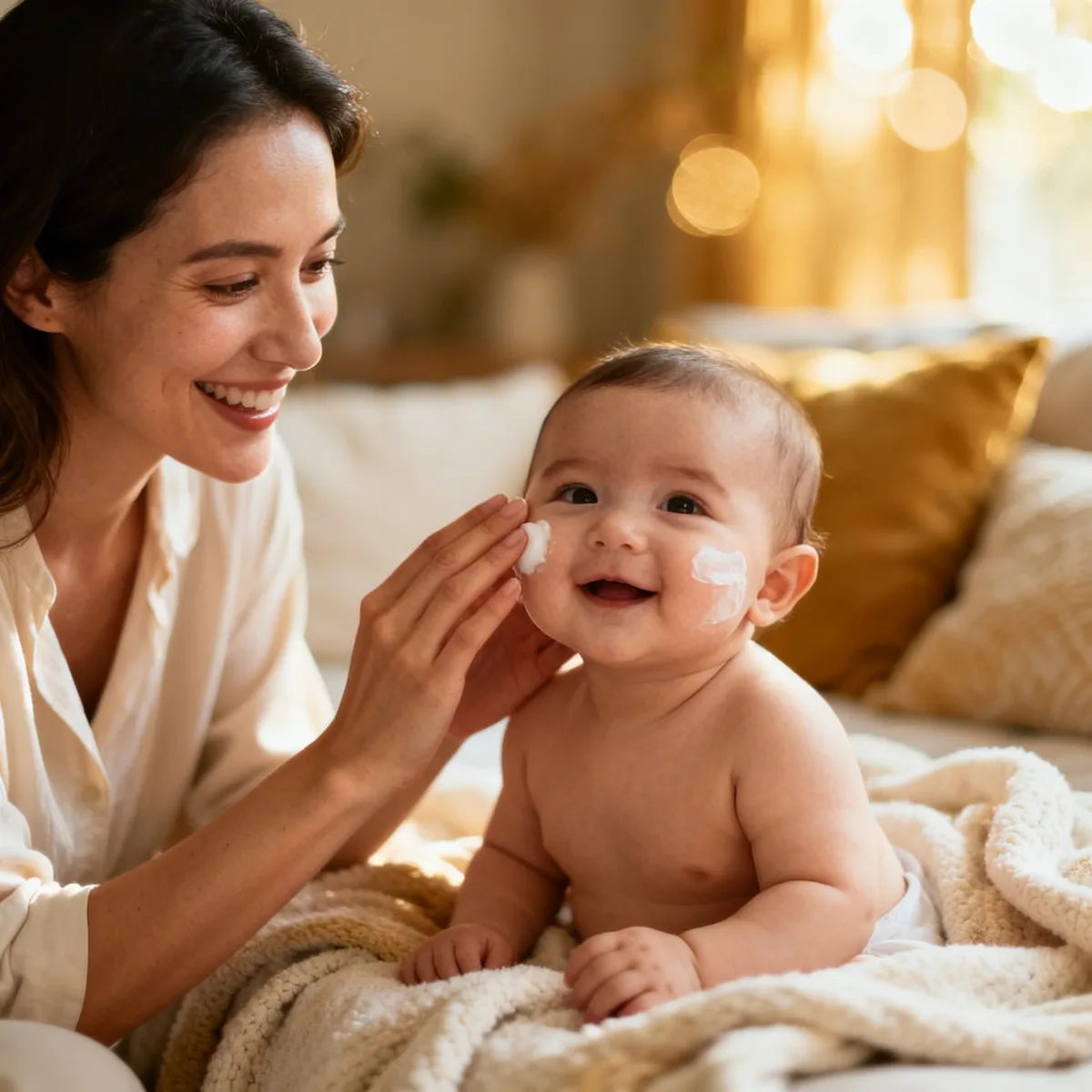
Here’s the honest version: your newborn doesn’t need a seven-step routine. They need two things — a gentle cleanser that doesn’t strip, and a moisturizer that actually supports barrier function. That’s it. Everything else is noise.
What Korean baby skincare gives you is the ability to do those two things without the risk of hidden irritants. You’re not choosing between safety and efficacy. You’re getting both in a formula that was built for your baby’s skin, not a marketing category.
The routine looks like this:
That’s the whole thing. Simple, defensible, and actually designed for what newborn skin needs.
You shouldn’t need a PhD to know if something is safe for your baby. Here’s the fast version:
Infant skin sets the foundation for skin health well into childhood. A compromised barrier in the early months — caused by repeated exposure to irritants, over-cleansing, or reactive ingredients — has been associated in research with increased sensitization risk over time. The National Eczema Association notes that maintaining a healthy skin barrier from birth is one of the most evidence-supported strategies for reducing early-onset eczema risk.
This doesn’t mean you need to panic. It means the products you choose in the first year aren’t just a vibe — they’re a low-effort, high-impact decision. Korean baby skincare makes that decision easier by removing the guesswork from the formulation side.

American Academy of Pediatrics — Guidance on newborn skin care, fragrance-free and minimal-ingredient recommendations for infants
National Eczema Association — Evidence-based guidance on skin barrier protection and eczema prevention in infancy
Yes — Korean baby skincare brands are formulated specifically for infant skin, typically excluding fragrance, sulfates, parabens, and other common irritants. Many are dermatologically tested on sensitive and infant skin specifically, which makes them a strong choice from the newborn stage.
The core difference is the formulation philosophy. Korean baby skincare prioritizes barrier protection and ingredient minimalism — removing potentially irritating ingredients by default rather than as a premium option. Western baby products often meet legal safety thresholds but may still include fragrance, sulfates, or preservatives not ideal for newborn skin.
You can start a simple skincare routine from birth. The AAP recommends fragrance-free, dye-free products with minimal ingredients from day one. Keep it simple: a gentle wash for bath time (2-3 times per week) and a plain moisturizer after bathing is all most newborns need.
Avoid artificial fragrance or parfum, sulfates (like SLS or SLES), mineral oil, MIT or CMIT preservatives, and any product with a long, complex ingredient list. The shorter and more recognizable the ingredient list, the better — especially in the newborn stage.
Korean baby skincare is often specifically suited for sensitive skin because of its minimal-ingredient, fragrance-free approach. That said, always patch-test any new product on a small area of skin first and check with your pediatrician if your baby has a known skin condition or recurring reactions.