

Health Guides
Tongue Tie in Babies: Signs, Diagnosis, Treatment & Breastfeeding Recovery
Jeehoo Jeon·10 min read

Learn which diaper rash treatments are backed by research, when natural remedies help, and how to treat severe cases. Real solutions from pediatric experts.
Here’s what most parents don’t realize about diaper rash treatment: the cream you choose matters far less than understanding *why* the rash appeared in the first place. Most diaper rash treatments fail not because they’re weak, but because they’re fighting the wrong enemy — slathering zinc oxide on a yeast infection, for example, won’t help. This guide cuts through the hype to show you which diaper rash treatments are actually backed by research, when natural remedies work (and when they don’t), and the one thing most parents miss that speeds healing faster than any cream.
Diaper rash isn’t one thing. It’s a category — and the cause determines everything about how you respond to it.
The most common type is irritant contact dermatitis. Urine and stool contain enzymes and ammonia that break down the skin barrier over time. When a wet diaper sits against skin, that process accelerates. The CDC notes that prolonged skin contact with moisture is the primary driver of most diaper rashes — which is why frequency of changes matters more than most other variables.
Friction compounds the problem. The inner thigh and waistband areas are exposed to constant rubbing. On skin already softened by moisture, that friction breaks the surface layer faster than it can repair itself.
Then there are chemical irritants. Fragrances, preservatives, and alcohol — found in some wipes, creams, and even certain diapers — can trigger localized inflammation in babies whose skin barrier is still developing. The AAP recommends fragrance-free, alcohol-free products specifically for this reason. If you’ve recently switched wipes or introduced a new product, that timing matters.
A separate cause entirely is Candida albicans — a yeast that thrives in warm, moist environments. A yeast-driven rash looks different: bright red with defined edges and satellite spots outside the main rash. It won’t respond to standard barrier creams because the mechanism is fungal, not inflammatory. This is where choosing the wrong diaper rash treatment can actually delay recovery.
Understanding which of these four causes — moisture, friction, irritants, or yeast — is driving the rash tells you what to actually do about it. Skin that’s properly dried and protected after each change is harder to break down in the first place. If you’re building a diaper-change routine, the guidance in how to dry newborn after bath applies the same principles to post-bath care.
The most well-researched first-line diaper rash treatment is zinc oxide. Applied as a thick paste at each diaper change, it creates a physical barrier between skin and moisture. Studies consistently show it reduces transepidermal water loss and protects compromised skin while it heals. Look for concentrations between 10% and 40% — the higher end is typically used for more inflamed skin.
The AAP recommends applying a generous layer of barrier cream or ointment with every diaper change as a core prevention and treatment strategy — not just when a rash appears. Petroleum-based ointments like plain petrolatum work on the same principle: occlusion. They don’t treat infection, but they give skin the physical protection it needs to repair itself.
What the research doesn’t support is talcum powder. It poses an inhalation risk for infants and offers no meaningful barrier benefit. Cornstarch-based powders are similarly unnecessary when effective barrier creams are available.
If the rash has a bright red border, satellite lesions, or hasn’t improved after three days of consistent barrier treatment, that pattern points to candidal (yeast) infection — and a barrier cream alone won’t resolve it. Topical antifungal creams like clotrimazole or miconazole are the appropriate intervention, though you’ll want to confirm with your pediatrician before using them on newborn skin. If you want to go deeper on what distinguishes Korean formulations for sensitive infant skin, korean baby skincare breaks down exactly that.
For day-to-day barrier protection, Cha&Mom is worth knowing about — a fragrance-free, Korean-formulated barrier cream designed specifically for infant skin, available at Onzenna if you want a tested alternative to the standard drugstore options.
Escalate to your pediatrician if the rash spreads beyond the diaper area, blisters form, or your baby develops a fever alongside the rash. Those combinations can signal something systemic that topical treatment alone won’t address.
Technique matters as much as the product itself. A thick, protective barrier applied incorrectly won’t do its job — and skin that isn’t fully dry before application will trap moisture underneath, making irritation worse.
Start by gently patting the area completely dry with a soft cloth. Rubbing, even lightly, adds friction to already-inflamed skin. If you’re using bamboo baby towels, their texture tends to be gentle enough for this without additional patting tools. Let the skin air-dry for 30 to 60 seconds before applying anything.

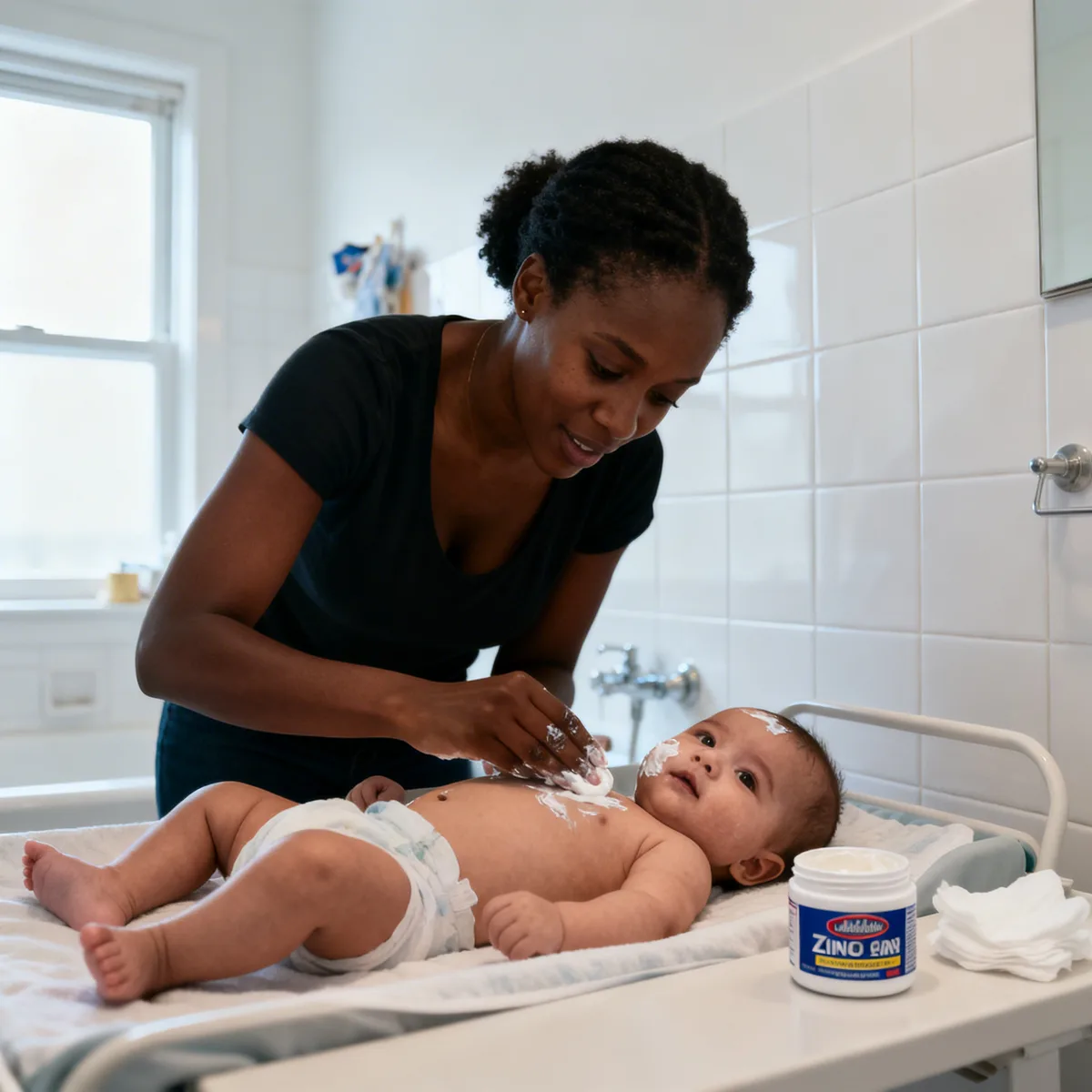
Apply your diaper rash treatment in a thick, even layer — the AAP describes it as a “frosting on a cake” application, not a thin smear. The goal is a visible barrier between skin and the diaper. Zinc oxide-based creams work by sitting on top of the skin, not absorbing into it, so coverage matters.
A few specifics worth knowing:
The CDC notes that diaper area skin is more permeable than other skin surfaces, which is why consistency in application routine — not just product choice — drives outcomes. Skipping applications when the rash looks “almost gone” is one of the most common reasons it returns within 24 hours.
The appeal of natural remedies is understandable. But “natural” and “effective” aren’t synonyms, and when skin is already compromised, the distinction matters.
Coconut oil has antimicrobial properties in lab settings. In practice, the clinical evidence for its use as a diaper rash treatment is limited — small studies, inconsistent methodology, no large randomised trials. It may provide mild moisturisation, but it doesn’t form a meaningful moisture barrier. For mild redness with intact skin, it’s unlikely to cause harm. For anything beyond that, it’s unlikely to be enough.
Colloidal oatmeal has stronger footing. The FDA recognises it as a skin protectant, and published research supports its ability to reduce inflammation and reinforce the skin barrier. It’s most useful in a soak or wash at bath time — not as a standalone treatment applied under a diaper, where occlusion changes how ingredients behave on the skin.
Conventional zinc oxide creams work through a different mechanism entirely. Zinc oxide physically blocks moisture from reaching the skin. It also has mild antimicrobial properties and doesn’t get absorbed — it sits on the surface and does its job mechanically. The AAP recommends applying a thick layer of zinc oxide paste or ointment at each diaper change as a first-line approach for preventing and managing diaper rash.
Petroleum jelly (plain, fragrance-free) is similarly evidence-backed for barrier protection. It’s one of the most studied occlusive agents in dermatology and costs very little.
Where natural remedies often fall short is in treating a rash that has already progressed — especially if a fungal component is involved. Candida-related rashes, which typically present with satellite lesions and a defined border, require an antifungal cream. No plant oil addresses that. If the rash isn’t responding within 48–72 hours of consistent treatment, that’s a signal to contact your paediatrician rather than switch products.
Most diaper rash clears within a few days of consistent barrier care and frequent changes. When it doesn’t, the rash itself is telling you something. Two specific types — yeast (candidal) infections and bacterial infections — look and behave differently from contact irritation, and they don’t respond to standard diaper rash treatment.
Candidal diaper rash is caused by Candida albicans, the same fungus responsible for oral thrush. It tends to appear as a bright red rash with sharply defined edges and smaller red spots (satellite lesions) scattered around the main area. The skin folds are typically involved — the opposite of irritant rash, which usually spares creases. Candida thrives in warm, moist environments, which makes the diaper area a common site, particularly after a course of antibiotics that disrupts normal bacterial balance.
Bacterial infections, most often caused by Staphylococcus aureus or Streptococcus, present differently again — you may notice yellow crusting, fluid-filled blisters, or skin that looks raw and weeping beyond what standard irritation produces. These require antibiotic treatment and should be assessed by a clinician promptly.
The AAP recommends contacting your pediatrician if a diaper rash is accompanied by blistering, open sores, bleeding, or fever, or if it hasn’t improved after two to three days of consistent home care.
For confirmed yeast infections, an over-the-counter antifungal cream such as clotrimazole or miconazole is typically the first line of care — applied at each diaper change until the rash has fully resolved, not just visibly improved. No barrier cream or zinc oxide formulation addresses a fungal infection on its own.

If you’re unsure whether what you’re seeing is irritation, yeast, or something bacterial, your pediatrician can usually identify it on examination. Getting that right matters — because treating a yeast infection with barrier cream alone means the rash continues, and the skin underneath continues to break down.
What you apply to the skin matters. But so does everything around it. A few straightforward habit changes can meaningfully shorten healing time when used alongside any diaper rash treatment.
Change frequency. The AAP recommends changing diapers promptly after soiling — prolonged contact with urine and stool is the primary driver of irritant diaper dermatitis. During an active rash, checking more often than usual reduces the time broken skin spends exposed to moisture and enzymes.
Air-dry before re-diapering. After cleaning, let the area air-dry completely before applying cream or closing the diaper. Sealing moisture in undermines barrier function. Even 60 seconds of air exposure helps.
Pat, don’t wipe. Friction slows healing. Use a soft cloth or unscented cotton pad dampened with warm water rather than standard wipes during a flare. If you use wipes, the CDC recommends fragrance-free, alcohol-free formulas for irritated skin.
Diaper fit. A diaper that’s too tight traps heat and increases friction at the leg creases — two conditions that slow recovery. A slightly looser fit during healing is worth trying.
Fabric and laundry choices for cloth diapers. If you use cloth, the NIH notes that detergent residue and fabric softeners can act as irritants on compromised skin. A second rinse cycle and skipping softeners during an active rash are simple adjustments. Natural fiber inserts — cotton or bamboo — tend to retain less heat than synthetic microfiber against the skin.
Overnight protection. Skin sits in one diaper for longer overnight. A thicker layer of zinc oxide paste before bed creates a more durable barrier through those hours.
None of these steps replace treatment where treatment is needed. But they remove conditions that work against healing — which is often the fastest thing you can do.
Severe diaper rash often requires a prescription antifungal or antibiotic cream rather than over-the-counter barrier creams alone. If the rash has bright red borders, satellite spots, or hasn’t improved with zinc oxide after 3 days, contact your pediatrician. They can identify whether infection is present and prescribe the right treatment.
Mild irritant rash typically improves within 2–3 days with consistent barrier cream application and frequent diaper changes. More inflamed rashes may take 5–7 days. If there’s no visible improvement after a week, or if it worsens, the cause may be fungal or bacterial and needs medical evaluation.
Layering multiple products is generally unnecessary and can complicate diagnosis if the rash persists. Stick with one well-researched barrier cream (zinc oxide or petroleum-based ointment) plus diaper changes every 2–3 hours. If you suspect yeast, switch to an antifungal rather than adding another product.
Yes, but choose products carefully. Look for fragrance-free, alcohol-free, and hypoallergenic formulas. Zinc oxide and plain petrolatum are generally safe for sensitive skin. If irritation worsens after starting a new product, stop and try a simpler option. Patch-test new products on a small area first if possible.
Contact your pediatrician if the rash is severe and spreading, has pus or oozing, shows signs of infection, appears to have satellite spots (suggesting yeast), doesn’t improve after 3–5 days of treatment, or if your baby is also feverish or unwell. Trust your instinct—when in doubt, call.