


Nursery & Home
Nursery Must-Haves: The Essential List Without the Fluff
Soyeon Park·12 min read

Cut through registry noise with this minimalist baby registry checklist. Only the essentials: safe sleep, feeding basics, and clothing. Skip the marketing fluff.
POV: You’re building a baby registry and every click opens three more “essentials” you’ve never heard of. Wipe warmers. Diaper pails. Swaddle wraps in seven coordinating patterns. And suddenly you’re wondering: do I actually need all this, or am I just tired and scrolling?
Here’s the truth: a minimalist baby registry checklist isn’t about deprivation – it’s about cutting through the noise so you can actually prepare. Newborns need warmth, food, sleep, and you. Everything else is negotiable.
This guide walks you through what genuinely matters, what you can skip without guilt, and how to politely hold the line when well-meaning relatives want to buy you things you don’t need.
Here’s what no one tells you: the longer your registry, the harder the first few months get.
More stuff means more decisions. Where does this go? Which one do I use first? Do I even need this? That mental load starts before the baby arrives and compounds fast once you’re running on three hours of sleep.
There’s a reason decision fatigue is a real psychological phenomenon. When you’re choosing between seven different swaddle styles at 2 a.m., your brain doesn’t care that they all have five stars. It just wants fewer options.
A baby registry checklist minimalist approach works because it forces a useful filter: does this solve an actual problem, or does it solve a problem I imagined while scrolling at midnight?
Newborns need warmth, food, sleep, and you. The gear that supports those four things earns its place. Everything else is a maybe – and maybes should come later, after you know your actual baby.
Carriers are a good example. Knowing the difference between baby carrier types before you register means you pick one that fits your body and your life – not three that collect dust.
The same logic applies to feeding gear, sleep setups, and anything with a plug. Buy less, understand what you have, and fill gaps as they show up. That’s not deprivation – that’s actually being prepared.
A shorter list also makes it easier for the people who love you to actually help. Nobody wants to guess between twelve versions of the same thing. Give them clarity and they’ll show up for you.
Safe sleep has a short list. A firm, flat surface – bassinet or crib – two to three fitted sheets, and nothing else inside. No bumpers, no pillows, no stuffed animals doing decorative work at 3am.
A bassinet makes sense for the first few months because it lives next to your bed. When your baby outgrows it – usually around four to six months – you move to the crib. You don’t need both at once.
Sheets: get two or three, max. Blowouts happen at the worst times, so you want a spare ready. That’s it. The coordinating quilts and canopies are for photos, not sleep.
Clothing is where registries quietly spiral. Newborns wear onesies, sleepers, and maybe one actual outfit per week if you’re ambitious. If you’re building something close to a BabyRabbit capsule wardrobe situation – a few well-made basics that wash and wear well – you need less than you think.
Buy for the season your baby will actually be in each size. A winter baby doesn’t need twelve short-sleeve onesies for their newborn stage. A summer baby doesn’t need a pile of heavy footed pajamas.
Sizes move fast. Newborn can be outgrown in two weeks. Stock the 0-3 and 3-6 month range more heavily, and leave room to buy as you go. If you want to understand what’s happening developmentally – including baby growth chart percentiles and what they actually tell you – that context helps here too.
Sleep sacks replace blankets once your baby outgrows the swaddle phase. One or two is enough. The rest of the crib stays empty on purpose.
That’s the whole category. A safe place to sleep, clean sheets, and clothes that fit the season. Everything beyond that is optional.
Feeding gear is where registries bloat fast. Everyone recommends everything, and you end up with a cabinet full of silicone contraptions you touched once.
The actual list is short. Four to six bottles, a few extra nipples in different flow rates, a bottle brush, and a drying rack. That’s your newborn feeding setup.

If you’re planning to breastfeed, a pump (often covered by insurance), nursing pads, and one or two comfortable nursing bras. You don’t need a dedicated nursing pillow, a lactation massager, and a warming device. Pick one support item and see how it goes.
For solid foods, you need a high chair with a cleanable seat and a tray – nothing else matters at that stage. If you want to know what actually separates a good chair from a frustrating one, the high chair buying guide breaks it down without the noise.
A few soft-tip spoons, some small bowls, and bibs with a catch pocket. That’s it for utensils. The baby food maker, the elaborate puree storage system, the suction plate set with eight compartments – mostly unused.
Skip the bottle warmer unless you already know you’ll use it. Most babies adapt to room temperature or slightly warmed bottles without a dedicated appliance.
If formula is part of your plan, understanding the types and amounts before you’re sleep-deprived helps more than any gadget. The formula feeding guide newborn parents actually need covers that clearly.
A baby registry checklist minimalist in approach isn’t about doing less – it’s about knowing which items do real work and which ones just look useful in a flat lay.
Diaper changes happen around 8-12 times a day in the newborn stage. You don’t need a station that looks like a command center to handle that.
A waterproof changing pad, unscented wipes, and a few cloth or disposable liners cover it. Add a small basket or caddy for diapers, cream, and a spare onesie – that’s your whole setup.
Diaper Genie, wipe warmers, built-in changing tables with drawers: none of them are necessary. A lined trash can and a drawer work just as well and cost a fraction of the price.
For bathing, a simple infant tub or a soft mesh insert that fits your kitchen sink does the job until they can sit. You don’t need a dedicated baby bath station.
Keep bath products short: one gentle wash that doubles as shampoo, a soft washcloth, and a hooded towel. Babies don’t need a 4-step skincare routine.
Daily care beyond the bath is equally simple. A soft-bristle brush, baby nail file or clippers, a nasal aspirator, and a rectal thermometer – that’s the list. The fancy LED nail trimmers and 3-in-1 grooming kits usually just mean more to lose track of.
One thing worth having in your caddy: a fragrance-free barrier cream you trust for diaper rash. Onzenna’s diaper balm uses clean ingredients without the synthetic fillers that can irritate sensitive skin.
If you’re building out your full baby registry checklist minimalist style, care items are the easiest category to over-buy. Most of what’s marketed to you solves a problem you won’t actually have.
And if you’re thinking ahead to when your baby starts daycare, a solid daycare checklist what to pack guide helps you figure out which of these items actually need to leave the house with them.
Wipe warmers. You don’t need warm wipes. Your baby will survive a room-temperature wipe, and you will not be thinking about wipe temperature at 3am – you’ll just be thinking about getting back to bed.
Bottle sterilizers are another one. A pot of boiling water does the same job. So does your dishwasher. The countertop appliance exists to make you feel like you’re being thorough. You’re not missing anything without it.
Crib bumpers are a harder no. They’re not just unnecessary – they’re a suffocation risk. The AAP has been clear on this for years. If someone tries to add them to your registry “for aesthetic reasons,” that’s a conversation worth having.
Dozens of swaddles. You’ll see registries with twelve swaddles listed and genuinely wonder why. Buy three or four to start. You’ll figure out fast which style your baby tolerates – and spoiler: some babies hate all of them, which is its own adventure. If you’re already deep in the weeds on baby not sleeping through night territory, you already know that swaddle quantity was never the variable.
Diaper Genie refills in bulk, themed bath towels, wipe dispensers that require batteries – all of it is in the same category. Marketed as convenience, used maybe twice.
The real filter for a minimalist baby registry checklist is simple: does this solve a real problem, or does it solve a fear? Most of the stuff on those crowded registry lists is fear-driven purchasing dressed up as preparation.

Cut it. You can always buy something later if you actually need it. You cannot un-clutter a nursery that’s full of things you were convinced you couldn’t live without.
The furniture category is where minimalist intentions go to die. A changing table. A dresser. A bookshelf. A glider. Suddenly you’ve filled a room with single-purpose pieces and spent three thousand dollars doing it.
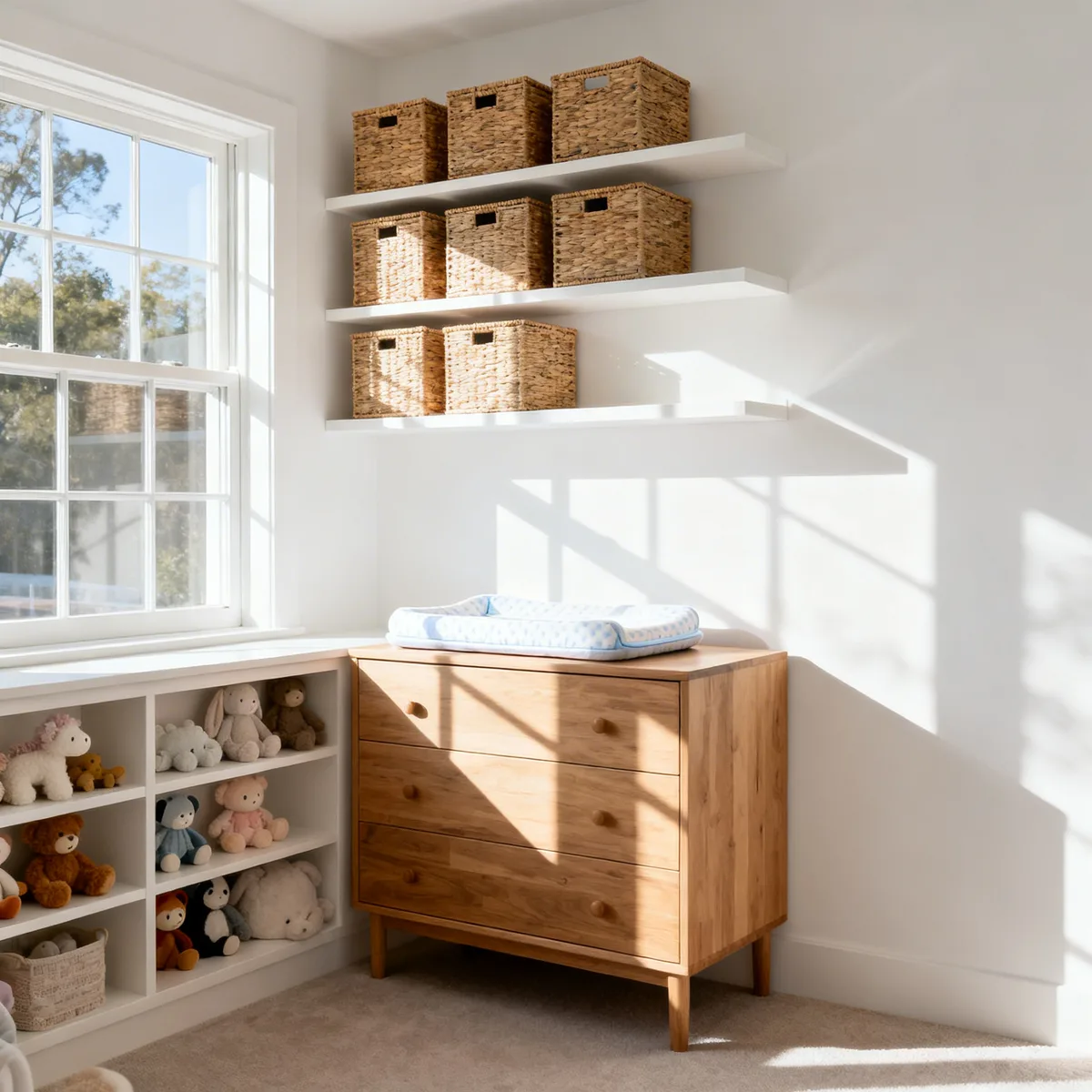
Do this instead: a dresser with a changing topper. That’s it. Same footprint, two functions. When the diaper stage ends, you remove the topper and you still have a dresser. Nothing to donate, nothing to sell.
The same logic applies to floor time. A good-quality padded playmat handles tummy time, independent play, and sensory exploration from newborn through toddlerhood. A dedicated activity center – the plastic arch contraption with spinning animals and seventeen attachments – does one thing for about three months.
If you’re building a genuine baby registry checklist minimalist in its intent, the playmat wins that comparison every time.
For seating, a floor rocker or a simple glider works. You don’t need both. Pick one based on where you’ll actually feed and settle your baby – the floor, or a chair. Not where you imagine yourself in the soft-lit Instagram version of new parenthood.
A bassinet for the first few months, then a crib. Or skip the bassinet entirely if your crib has a lower mattress position and you have a C-section recovery planned – worth thinking through before you’re 37 weeks pregnant and surrounded by unassembled furniture.
The pattern across all of it is the same. One item that does two things beats two items that do one thing each. Less to move, less to store, less to trip over at 3am.
Everyone has opinions about what you need. Your aunt who raised four kids in the nineties. Your coworker who swears by the wipe warmer. Your mother-in-law who already bought something before you even opened a registry.
Here’s the framework: you don’t owe anyone an argument. You owe them a response that ends the conversation gracefully.
When someone pushes an item you don’t want, try: “We’re keeping the registry really tight – we’re going the baby registry checklist minimalist route and only adding what we know we’ll use in the first few months.” That’s not a rejection of their taste. It’s a statement about your approach.
For the relative who already bought the thing: “That’s so thoughtful – we might hold off on setting it up until we see what we actually reach for.” Polite. Buys you time. Lets you quietly return it later without drama.
For the person insisting something is essential: “We’ve done a lot of research and decided to start with less and add as we go.” You’re not saying they’re wrong. You’re saying you have a plan.
The key is having a consistent line you can repeat. When everyone hears the same answer, it stops feeling personal to them – it’s just how you’re doing things.
It also helps to have your registry done and visible before the suggestions start rolling in. If people can see what you’ve chosen, there’s less room for them to fill with their own ideas. Your list becomes the reference point, not a void waiting to be filled.
None of this requires you to justify your choices or defend minimalism as a philosophy. You’re just building a home for a baby – not running a product review committee.
Safe sleep (bassinet or crib, fitted sheets), feeding basics (bottles or nursing setup, burp cloths), functional clothing sized for your baby’s arrival season, diapers and wipes, a few bathing essentials, and a car seat for safety. Everything else can wait until you know your actual baby’s needs.
A minimal setup is completely safe – in fact, it’s often safer. Safe sleep guidelines recommend a firm, flat surface with nothing else inside: no bumpers, pillows, or stuffed animals. Babies thrive on less clutter and less decision-making from exhausted parents. You’re not depriving your baby; you’re setting yourself up for calmer nights.
Be direct and grateful: “We really appreciate you wanting to help – we’ve thought through what we need, and we’re keeping our registry focused so we can actually use everything. Sticking to our list helps us tremendously.” Most people respect clarity. If they push, you can always say: “If you’d like to contribute, we’d love help with [specific item from registry] or a gift card for things we discover we need after baby arrives.”
Absolutely. The first few weeks reveal what your specific baby actually needs. If you realize you need a second white noise machine or a different carrier, you can add items or let close family know what would help. Starting minimal gives you room to fill real gaps instead of guessing about imaginary ones.