

Feeding Guides
Best Foods to Increase Toddler Weight: Nutrient-Dense Options That Actually Work
Laeeka Edries·11 min read

Complete breast milk storage guidelines: room temperature, refrigerator, freezer timelines, containers, and safe thawing. CDC-backed rules that actually work.
Here’s what nobody tells you about breast milk storage: the rules aren’t one-size-fits-all, and getting them slightly wrong doesn’t mean your milk is ruined — but getting them *really* wrong changes everything.
Most parents know to refrigerate or freeze, but the real safety margin lives in the details: exact temperatures, container choices, thawing order, and those weird moments when you’re not sure if mixing fresh milk with cold milk is okay. How to store breast milk matters — because the difference between 4 hours and 6 hours at room temperature, or between a standard freezer and a deep freeze, can mean days of extra supply or a batch you have to pour down the sink.
This is the complete breakdown of temperature guidelines, container options, and timelines that actually protect your milk — and your sanity.
You pumped. You’re exhausted. And now you’re staring at that bottle wondering if it’s still good — and feeling weirdly anxious about getting it wrong.
Here’s what I know: room temperature is fine for breast milk, but the window is shorter than most people expect.
If your room sits between 66–78°F (19–26°C), freshly expressed milk is safe at room temperature for up to 4 hours. That’s the sweet spot. Some sources say up to 6 hours in very clean conditions, but 4 hours is the number I’d trust.
Why does timing actually matter? Warm environments let bacteria multiply fast — and breast milk, as incredible as it is, isn’t sterile. The natural antibacterial properties in fresh milk slow that growth, but they don’t stop it forever.
The CDC recommends using or refrigerating freshly expressed breast milk within 4 hours when stored at room temperature, noting that cleaner pumping conditions may allow slightly longer storage — but 4 hours remains the standard safe guideline.
A few things that shorten that window without you realising: a warm kitchen in summer, milk that sat out before you noticed, or a bottle that wasn’t fully clean to start. If you’re ever unsure, the fridge is always the safer call.
And if you’re figuring out how to store breast milk alongside formula top-ups, it helps to understand how the two work together — our honest breakdown of breastmilk vs formula covers exactly that.
One more thing worth knowing: if you’re leaving milk out for a feed, try to keep it away from direct sunlight or heat sources. Temperature swings — even small ones — can shorten that safe window faster than you’d think.
The fridge feels like the obvious choice — and it is. But there’s a right way to use it, and most of us figure that out the hard way.
The CDC recommends storing breast milk in the refrigerator for up to 4 days. That’s your window. After that, the milk is still technically usable if it was stored well, but the quality starts to decline — and if you’re not sure how cold your fridge actually runs, 4 days is the number to trust.
Here’s the part people skip: where in the fridge you put it matters. The door is the worst spot. Temperature there fluctuates every time you open it. The back of a middle or bottom shelf stays consistently coldest — that’s where your milk should live.
Organisation by date sounds tedious when you’re running on three hours of sleep. But it saves you. Write the date pumped on every bag or container before it goes in. Stack or line them oldest-to-front so you’re always reaching for the milk that needs to be used first.
If you’re dealing with an oversupply and bottles are multiplying faster than you can use them, a newborn bottle feeding schedule can help you get a clearer picture of how much you actually need on hand day to day.
One more thing: use dedicated storage bags or hard-sided containers made for breast milk. Regular zip bags aren’t built for it — they can leak, and they don’t protect the milk the same way.
Keep portions small — 2 to 4 ounces — so you’re not thawing or discarding more than your baby needs at one feed. Every ounce you pumped cost you something. It’s worth protecting.
If you’re building a stash, the freezer is your best friend. But it’s not a “set it and forget it” situation — there are real rules here, and they matter.
In a standard home freezer, breast milk keeps for 3 to 6 months. In a deep freezer that stays at a consistent 0°F (-18°C), you can stretch that to 12 months. The CDC recommends using frozen breast milk within 6 months for the best quality, even if it’s technically safe beyond that — because freshness affects the nutritional and immune properties your baby actually benefits from.
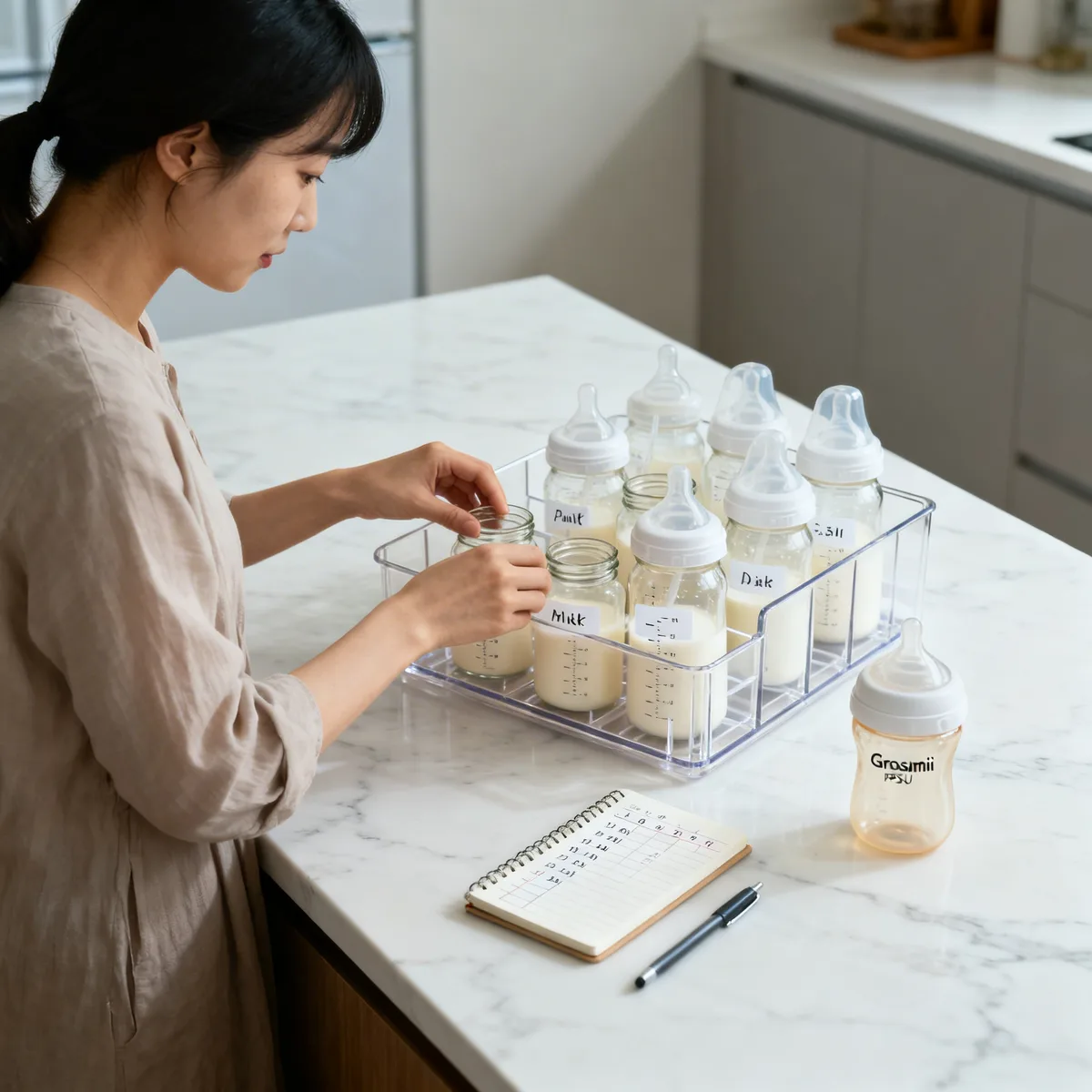
hard-sided storage containers If you’re already using Grosmimi bottles for feeding, their storage and feeding system is designed to take milk from pump to freezer to feed without a dozen transfer steps in between — worth knowing about if you’re trying to simplify the process.
Label everything. Date, time, and how many ounces. Future-you will be very grateful.
Lay bags flat to freeze — they stack so much easier that way, and you’ll use your freezer space better. Always use oldest milk first. Rotate like you would anything else in the kitchen.

For thawing: move the bag or container to the fridge overnight — that’s the safest method. If you need it faster, hold it under warm running water or sit it in a bowl of warm water. Never microwave breast milk. It creates hot spots and it breaks down some of what makes the milk valuable in the first place.
Once it’s thawed in the fridge, use it within 24 hours. Once it’s warmed, use it within 2 hours. And once your baby has started a feed? That milk doesn’t go back in the fridge.
Here’s the thing nobody tells you upfront: not all containers are created equal, and the wrong choice can mean wasted milk, wasted time, and a lot of unnecessary frustration.
Storage bags are the most popular option — and honestly, for good reason. They lay flat in the freezer, stack easily, and most are pre-sterilized. The downside is they’re single-use, which adds up in cost and waste over time.
Hard-sided bottles and containers are more sustainable. You wash them, reuse them, and they tend to seal more reliably than bags. The trade-off is freezer space — they take up more room and don’t stack as neatly.
Material matters more than most people realize. Always go for BPA-free plastic or glass. Glass is the gold standard — it doesn’t absorb odors, doesn’t leach anything, and holds up through hundreds of wash cycles. It’s heavier, but for home storage, that’s rarely a dealbreaker.
Whatever you use, make sure it’s designed specifically for breast milk storage. Regular food containers often aren’t airtight enough, and that affects freshness.
One thing that genuinely helps: knowing how to store breast milk in portion sizes your baby actually drinks. Don’t freeze 6-ounce bags if your baby takes 3 ounces at a feed. Smaller portions mean less waste when plans change or feeds go short.
And once you’re using bottles to feed — whether pumped milk or formula — keeping them properly cleaned is non-negotiable. Our guide on how to clean feeding bottles walks through what actually removes bacteria versus what just looks clean.
There’s no single perfect container. It comes down to your freezer space, your budget, and how much you want to deal with single-use waste. Know your priorities, then pick accordingly.
Here’s something nobody warns you about: you will absolutely forget when you pumped that bag. Even if you think you won’t. Even if it was this morning.
A simple labeling system saves you from the gut-punch of throwing out milk you worked hard for. Write the date pumped, the volume, and — if you’re tracking it — the time of day. That’s it. Nothing fancy required.
For the label itself, masking tape and a permanent marker works just as well as anything expensive. If you’re using bags, write directly on the bag before you fill it — ink can smear on a cold, wet surface.
In the fridge, line bags upright in a dedicated cup or small container so nothing gets shoved to the back and forgotten. Oldest milk goes in front, always. This is the one rule that matters most when it comes to knowing how to store breast milk without losing any to waste.
In the freezer, lay bags flat to freeze, then stack them like files in a shoebox or a small bin. Oldest dates face forward. You pull from the front, refill from the back — simple rotation, no thinking required at 3am.
Some moms write the “use by” date instead of the pump date, so you’re not doing math when you’re exhausted. If fresh milk keeps for four days in the fridge, just write the day it needs to be used by. Done.
Color-coded dot stickers are another easy win — one color per week. At a glance, you know what’s oldest without squinting at tiny numbers on a frozen bag.
The system doesn’t need to be perfect. It just needs to be consistent enough that whoever grabs the milk — you, your partner, a caregiver — grabs the right one.
You open a bag of milk you carefully pumped and stored, and it smells like soap. Or metal. Maybe even a little sour. And your heart sinks.
First — your milk is almost certainly fine. What you’re dealing with is high lipase activity.
Lipase is an enzyme naturally present in breast milk. Its job is actually a good one: it helps your baby digest fat. But in some mums, lipase is particularly active, and it keeps breaking down fat even after the milk is expressed. That’s what creates the soapy or metallic smell as milk sits in the fridge or freezer.
The CDC confirms that breast milk is packed with living cells, hormones, and enzymes that actively support your baby’s immune system — lipase is part of that same powerful picture. High lipase isn’t a flaw. It’s just your body doing its job a little enthusiastically.

So is high-lipase milk safe to feed? Yes — in almost all cases. Many babies drink it without any fuss at all. Some babies, though, will refuse it because of the taste change. That’s the only real problem here.
If your baby is rejecting stored milk, the fix is scalding. Heat freshly pumped milk in a pan until you see tiny bubbles form around the edges — just before a full boil, around 82°C (180°F) — then cool it quickly and freeze it. This deactivates the lipase before it can change the taste.
It’s a bit of an extra step when you’re already tired. But once you know how to store breast milk with this tweak built in, the whole process gets much more predictable.
One thing worth knowing: the smell develops faster in refrigerated milk than in freshly frozen milk. So if you’re planning to freeze a batch anyway, go straight from pump to freeze and skip the fridge entirely.
This is one of those questions that feels like it should have a simple answer — and then you go down a rabbit hole at 2am and come out more confused than before. You’re not alone in that.
Here’s the straightforward truth: yes, you can combine freshly expressed milk with milk that’s already been refrigerated. But there’s one rule that matters most — cool the fresh milk first.
Never add warm milk straight from the pump to cold stored milk. The temperature difference can partially warm the older milk, which shortens how long it stays safe. Express your fresh batch, pop it in the fridge for at least an hour, then combine.
The same logic applies to freezing. If you want to add fresh milk to a frozen bag, the fresh milk needs to be fully chilled first — and the amount you’re adding should be smaller than what’s already frozen, so it doesn’t thaw the older milk.
One more thing to keep in mind: when you mix batches, the combined milk takes on the age of the oldest milk in the container. So if you have milk that was expressed three days ago, the clock is already ticking from that date — not today’s.
The CDC recommends using refrigerated breast milk within four days for optimal safety, though milk stored properly can sometimes last up to eight days. When in doubt, go with the more conservative timeline.
If you’re building up a freezer stash while also dealing with engorgement breastfeeding challenges, keeping batches clearly labelled by date makes all of this so much easier to manage.
Label every container. Date, time, and which batches were combined if you can. Future you — exhausted and just trying to grab a bag quickly — will be genuinely grateful.
Freshly expressed breast milk is safe at room temperature (66–78°F / 19–26°C) for up to 4 hours. This is the CDC standard guideline, and it’s the number to trust — even though some sources mention up to 6 hours in very clean conditions.
If your home is warmer, or if you’re unsure about the starting temperature, use it or refrigerate sooner.
Yes, but with one rule: cool the freshly expressed warm milk to room temperature first, then add it to the already-cold milk. Never pour warm milk directly into cold milk, as this can encourage bacteria growth in the older portion.
Always use the older milk’s date as the combined batch’s date.
That soapy or metallic smell comes from an enzyme called lipase, which naturally breaks down fats in your milk over time — especially in frozen or refrigerated milk. It’s completely normal and safe to use, even if the smell is off-putting.
Some mothers naturally have higher lipase activity. If this bothers you, scalding milk briefly before storage can slow the process.
Refrigerated milk (4 days) is best for feeds happening soon and retains slightly more antibodies than frozen milk. Frozen milk lasts 3–6 months in a standard freezer or up to 12 months in a deep freezer, making it ideal for building a longer-term supply buffer.
Freezing stops bacterial growth entirely, but some nutrients degrade slowly over time — so fresher is always marginally better.
No — once you thaw breast milk in the refrigerator, use it within 24 hours and do not refreeze it. Thawing allows bacteria to start multiplying again, even if the milk was safely stored before.
Plan thawing carefully so you’re only defrosting what you’ll actually use.