
Buying Guides
Baby Monitor Types: Video, Audio, and Smart — Which One Actually Works for Your Family
Soyeon Park·12 min read

Find the safest convertible car seat 2026 with NHTSA crash test ratings and expert reviews. Budget, mid-range, and premium options compared for every family.
POV: You’re standing in the car seat aisle holding two seats that look almost identical, cost completely different amounts, and apparently have very different crash test ratings. Which one actually keeps your kid safer – and how do you tell the difference?
Here’s the truth: safety isn’t determined by price tag or marketing claims. Every convertible car seat sold in the US must meet federal safety standards, but independent crash test ratings from NHTSA, IIHS, and JPMA tell you which seats actually perform best in real-world crashes. The best convertible car seat 2026 isn’t always the most expensive one – it’s the one backed by data.
This guide breaks down safety ratings, installation ease, weight limits, and real parent concerns so you can find the right convertible car seat for your family and budget.
Marketing copy will tell you a seat is “the safest on the market.” The actual standards that determine safety have nothing to do with that claim.
In the US, every car seat sold must meet Federal Motor Vehicle Safety Standard 213 – NHTSA’s baseline requirement. That’s the floor, not the ceiling.
NHTSA also runs its own ease-of-use ratings, which grade installation, harness adjustments, and labeling. A seat can pass federal standards and still be frustratingly easy to install wrong. That matters because a misinstalled seat is a compromised seat.
The IIHS evaluates a separate set of criteria – structural integrity, how well a seat restricts child movement in a crash, and whether the instructions actually make sense to real humans. Their ratings aren’t required by law, which makes them more useful as an independent filter.
JPMA certification tells you a manufacturer submitted their product for third-party testing against ASTM safety standards. It’s not a crash test, but it signals the brand isn’t cutting corners on the certification process.
When you’re researching the best convertible car seat 2026 options, cross-reference all three sources. A seat that scores well across NHTSA ease-of-use, IIHS crash performance, and JPMA certification is a seat that’s actually been scrutinized – not just marketed.
Side-impact protection is worth a specific look. Federal standards don’t require it. Some seats have robust side-impact engineering; others are minimal. The IIHS flags this in their ratings if you know where to look.
One more thing: price doesn’t predict safety rating. A $500 seat doesn’t automatically outperform a $200 one in a crash. The data often says otherwise. Check the ratings before you check the price tag.
This is where the data gets interesting. Some of the strongest performers in independent testing sit right in this price range.
Graco Extend2Fit 3-in-1 (~$200)
NHTSA overall rating: 4/5 stars. Rear-faces to 50 lbs, forward-faces to 65 lbs, then converts to a highback booster. The extending panel keeps rear-facing legroom realistic for bigger kids.
Pros: Wide weight range, easy install, fits most vehicles without a fight. Cons: Bulkier than it looks in photos – measure your back seat before you commit.
Chicco NextFit Sport (~$280)
NHTSA rating: 4/5 stars. Nine recline positions and Chicco’s RideRight bubble levels make installation less of a guessing game. Side-impact protection is more engineered here than you’d expect at this price.
Pros: Genuinely easier to install correctly, which matters more than most people realize. Cons: On the higher end of this tier, and the fabric options are limited if that’s something you care about.
Cosco Scenera Next (~$150)
NHTSA rating: 4/5 stars. The lightest seat on this list at under 10 lbs – if you’re rotating between two cars or navigating taxis and rideshares, this one makes sense.
Pros: Slim profile, affordable, solid ratings. Cons: Fewer features overall, and the padding is minimal – fine for most kids, worth noting for longer drives.
If you’re doing the full baby gear sweep alongside this, our stroller buying guide applies the same logic – ratings and fit first, brand name second.
All three of these seats hold their own in NHTSA scoring. The right pick depends on your car, your kid’s size, and how often you’re moving the seat around.
This is where the gap between “good enough” and “genuinely better” becomes real. Better foam, more installation feedback, higher weight ceilings – you feel the difference.
Chicco NextFit Max ClearTex ($350-$380) tops a lot of lists for good reason. The RideRight bubble levels take the guesswork out of angle installation, and the 9-position recline actually holds position in most vehicles without readjustment. Rear-facing to 40 lbs, forward-facing to 65 lbs.

The fabric is GREENGUARD Gold certified – no chemical off-gassing, which matters if your kid runs hot and sweaty in the seat. It’s one of the cleaner options in this range for sensitive kids.
Graco Extend2Fit 3-in-1 ($280-$320) earns its place here with a rear-facing extension panel that adds 5 inches of legroom. Kids stay rear-facing longer without hitting the seat-back – which is the whole point of extended rear-facing recommendations.
The harness adjusts from the front. Small thing, huge quality-of-life improvement when you’re managing a squirmy toddler in a parking lot.
Britax One4Life ClickTight ($450-$500) is the long-game buy. It rear-faces to 50 lbs, forward-faces to 65 lbs, then converts to a belt-positioning booster to 120 lbs. One seat, potentially 10+ years.
The ClickTight installation system – you literally buckle the seatbelt inside the seat’s compartment – gets consistently high marks in real-world usability data. Fewer installation errors, more consistent fit across different vehicles.
If you’re building out your full toddler setup and want the same framework applied elsewhere, the high chair buying guide runs through a similar cost-versus-longevity lens. Spend once on things your kid uses daily – that’s the logic here too.
Any of these is a legitimate pick for the best convertible car seat 2026 shortlist. The Britax wins on longevity, the Chicco on installation confidence, the Graco on rear-facing range at a lower price point.
At this price point, you’re not paying for a logo. You’re paying for extended rear-facing limits, advanced side-impact systems, aerospace-grade materials, and seats that fit your kid from 4 pounds to 120+.
The Clek Foonf is the benchmark here. Steel frame, energy-absorbing crumple technology, and a rear-facing limit of 50 lbs. It’s one of the few seats designed to absorb crash energy the way a car’s body does – not just restrain.
The Nuna RAVA runs close. Flame-retardant-free fabrics, a no-rethread harness, and a rear-facing range up to 50 lbs. The recline mechanism is genuinely intuitive, which matters when you’re adjusting it in a tight back seat.
The Cybex Sirona lineup brings a rotating base into the premium conversation. Full 360-degree swivel, load leg for crash stability, and a fit that works in smaller European-style vehicles where most American seats struggle.
Who actually needs to spend this much? Families doing high daily mileage, anyone with a low-clearance vehicle where installation is consistently difficult, or parents who want to buy once and not touch the car seat category again until booster time.
The materials difference is real too. Premium seats use merino wool blends, TENCEL liners, or certified organic fabrics – relevant if your kid runs hot, has sensitive skin, or you’re thinking about resale value years down the line.
If you’re building out a full gear setup at this level, pairing decisions follow the same logic as choosing a best stroller for newborn – the features that seem excessive until the day you actually need them.
The Clek wins on crash engineering. The Nuna wins on materials and daily usability. The Cybex wins in tight vehicles. All three hold up for years without compromise.
Weight and height limits tell you how long a seat will actually last. Most convertible seats rear-face to 40-50 lbs and forward-face to 65-80 lbs – but the height cutoff often ends the ride before the weight limit does.
Rear-facing duration matters more than most people realize. The longer your child stays rear-facing, the better the crash protection. A seat with a 49″ rear-facing height limit gives you significantly more runway than one capped at 43″.
LATCH and seat belt installation are both safe when done correctly – the difference is in how forgiving each system is in your specific vehicle. LATCH simplifies the process, but it’s weight-limited (usually to 65 lbs combined child + seat), and not every car’s LATCH anchors are easy to access.
Vehicle compatibility is the spec that gets skipped and then regretted. A seat can be top-rated across every review and still not fit your back seat without crowding the front passenger into the dashboard.
Before you buy, check the manufacturer’s vehicle fit list – most publish one. If your car isn’t listed, that’s a signal worth taking seriously, not ignoring.
The only real way to test fit is to bring the seat to the car, or find a certified child passenger safety technician (CPST) who can do it with you. Many fire stations and hospitals offer this for free.

When you’re comparing what might be the best convertible car seat for 2026 and beyond, install confidence matters as much as crash ratings. A correctly installed average seat beats a misinstalled premium one every time.
If you’re doing a full gear audit right now, the same fit-first logic applies to carriers – worth reading through baby carrier types if you haven’t locked that down yet.
Side-impact protection is the one feature worth paying attention to. Real side-impact systems use energy-absorbing foam – typically EPS or EPP – built into deep side wings that cushion the head and torso during a lateral crash.
What doesn’t count: decorative side bolsters, extra padding that compresses on contact, or vague “reinforced shell” language with no foam specification. Those are marketing. Check the seat’s documentation for actual material callouts.
The harness system matters more than most people realize. A five-point harness distributes crash forces across the shoulders, hips, and chest – the strongest parts of a small body. The NHTSA recommends keeping children in a five-point harness as long as possible before transitioning to a booster, because it significantly reduces the risk of injury in frontal and side crashes.
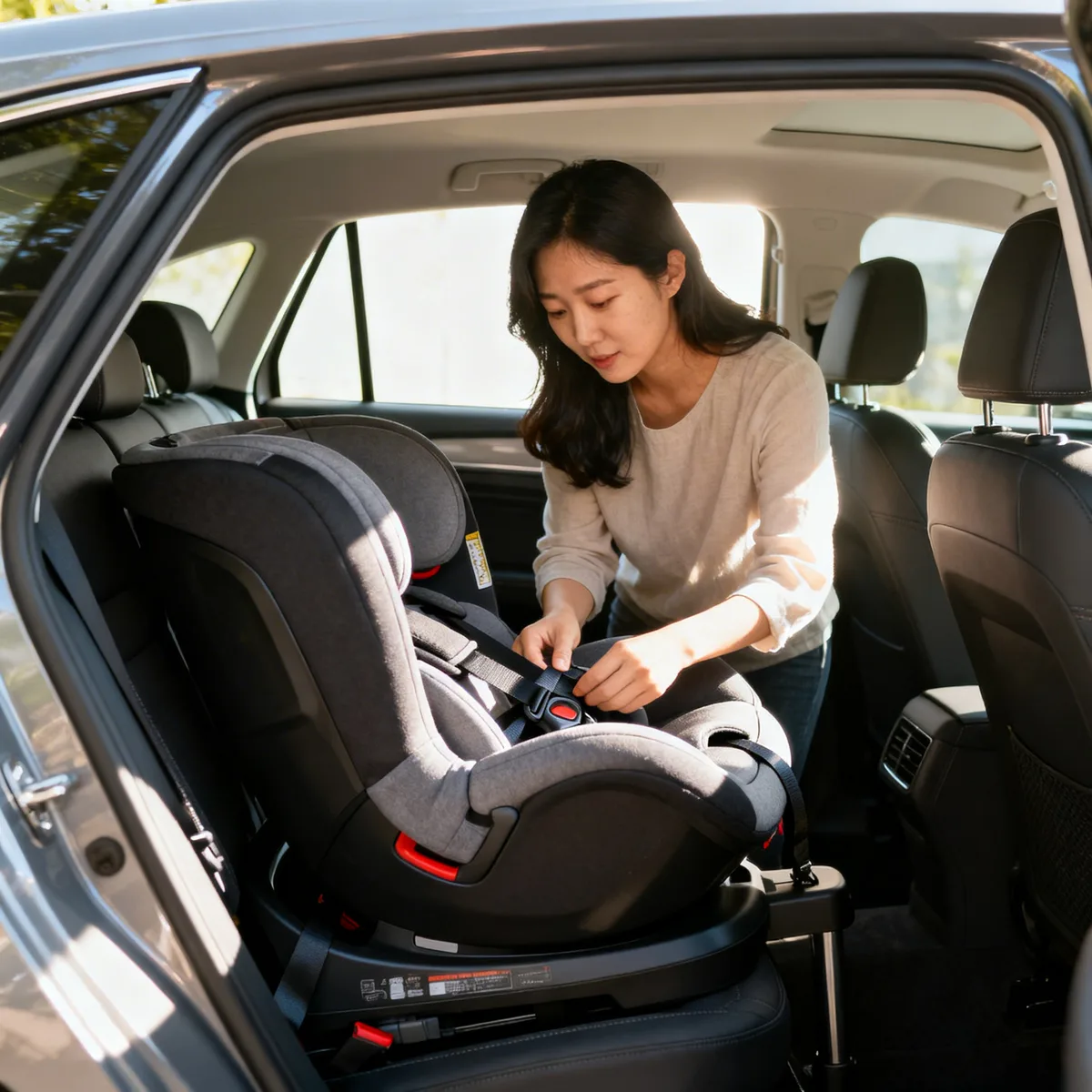
Harness fit is where most people slip up. The chest clip goes at armpit level, not on the stomach. Straps should lie flat with no twist, and the pinch test – if you can pinch webbing at the collarbone, it’s too loose – is the fastest real-world check.
Headrest design is legitimately important, but only when it’s adjustable without rethreading the harness. One-hand, no-rethread adjustment means you’ll actually move it as your child grows. If adjusting the headrest requires you to rethread straps, it won’t get done consistently.
Features that add cost without adding safety: cup holders, canopy attachments, memory foam seat pads, and most “premium fabric” upgrades. Comfort is fine. Just don’t let it drive the decision.
If you’re doing a broader home safety audit alongside your gear research, the same evidence-over-marketing logic applies – the baby proof kitchen guide runs through which interventions actually prevent injury versus which ones just look thorough.
Most convertible seats are built to last 10 years from the manufacture date – that’s the standard expiration window, and it exists because plastic degrades and safety standards evolve, not because manufacturers want you to rebuy.
Whether a premium seat lasts longer than a mid-range one is genuinely unclear. What fails first is almost always the cover fabric and harness buckle action, not the shell. Those things wear at roughly the same rate regardless of price point.
Rear-facing weight limits get hit less often than you’d think. Most kids outgrow the height limit – when the top of the head sits within an inch of the seat’s shell – before they reach the weight ceiling. If you’re tracking growth and wondering what’s typical, the baby growth chart percentiles guide gives useful context on how kids actually move through size ranges.
When your child does outgrow the rear-facing position, you switch to forward-facing in the same seat. That’s the whole point of a convertible. You’re not buying a new seat – you’re adjusting the harness and reanchoring.
Eventually, they’ll outgrow the forward-facing harness limit too. At that point, you move to a booster. Some of the seats people consider the best convertible car seat options for 2026 have high enough harness limits – 65 lbs and above – that you’ll get several more years before that transition.
Normal wear to expect: harness webbing that stiffens in cold weather, buckle tongues that get crumby and sticky, covers that pill. None of that is a safety issue. What does matter is any visible crack in the plastic shell – that seat needs to be replaced.
If a seat was in a crash, retire it. Even a minor one. Most manufacturers recommend it, and there’s no reliable way to assess internal structural damage by looking at it.
Look for seats with 4-5 star NHTSA overall ratings and cross-reference IIHS crash performance data and JPMA certification. The article reviews specific 2026 models across budget, mid-range, and premium tiers – check each seat’s rating before price.
Rear-facing limits vary by model but typically range from 40-50 lbs. The longer a child stays rear-facing, the more protection they get in a crash – so higher limits do matter, especially if your child is on the larger side.
Safety isn’t determined by price. Budget seats with strong NHTSA ratings often perform as well as premium options in crash tests – the difference lies in comfort features, ease of installation, and durability, not core safety performance.
LATCH (Lower Anchors and Tethers for Children) is a dedicated anchor system; seat belt installation uses your vehicle’s standard seat belt. Both are equally safe when installed correctly – choose based on which fits your vehicle and feels more secure in your hands.
Check the seat’s width, depth, and height specs against your vehicle’s back seat dimensions. Many retailers offer in-store fitting help, and some brands publish vehicle compatibility guides – always test fit before buying if possible.