
Buying Guides
Best Convertible Car Seats 2026: Safety-First Picks for Every Budget
Soyeon Park·11 min read

Compare baby pacifier types, shapes & materials. Learn orthodontic vs. round, silicone vs. latex, sizes by age — and choose the best pacifier for your baby.
POV: You’re standing in the baby aisle holding five different pacifiers that all look vaguely the same but come with wildly different claims about teeth, jaw development, and oral comfort.
Here’s what actually matters: baby pacifier types and shapes aren’t marketing fluff. They’re designed for specific stages of mouth development, feeding methods, and comfort preferences – and choosing the right one can mean the difference between a pacifier your baby actually uses and a drawer full of rejected nipples.
This guide walks you through every shape option (orthodontic, round, breast-shaped), material choice, and size consideration – so you can match a pacifier to your baby’s needs instead of guessing.
A pacifier isn’t just a plug for a crying baby. The shape, size, and nipple design all interact with how your baby’s mouth is developing – and getting that wrong can work against you.
Newborns have different oral needs than six-month-olds. A nipple that’s too long or too wide can cause jaw strain in early weeks. One that’s too small creates a different problem as your baby grows and needs more resistance to satisfy the suck reflex.
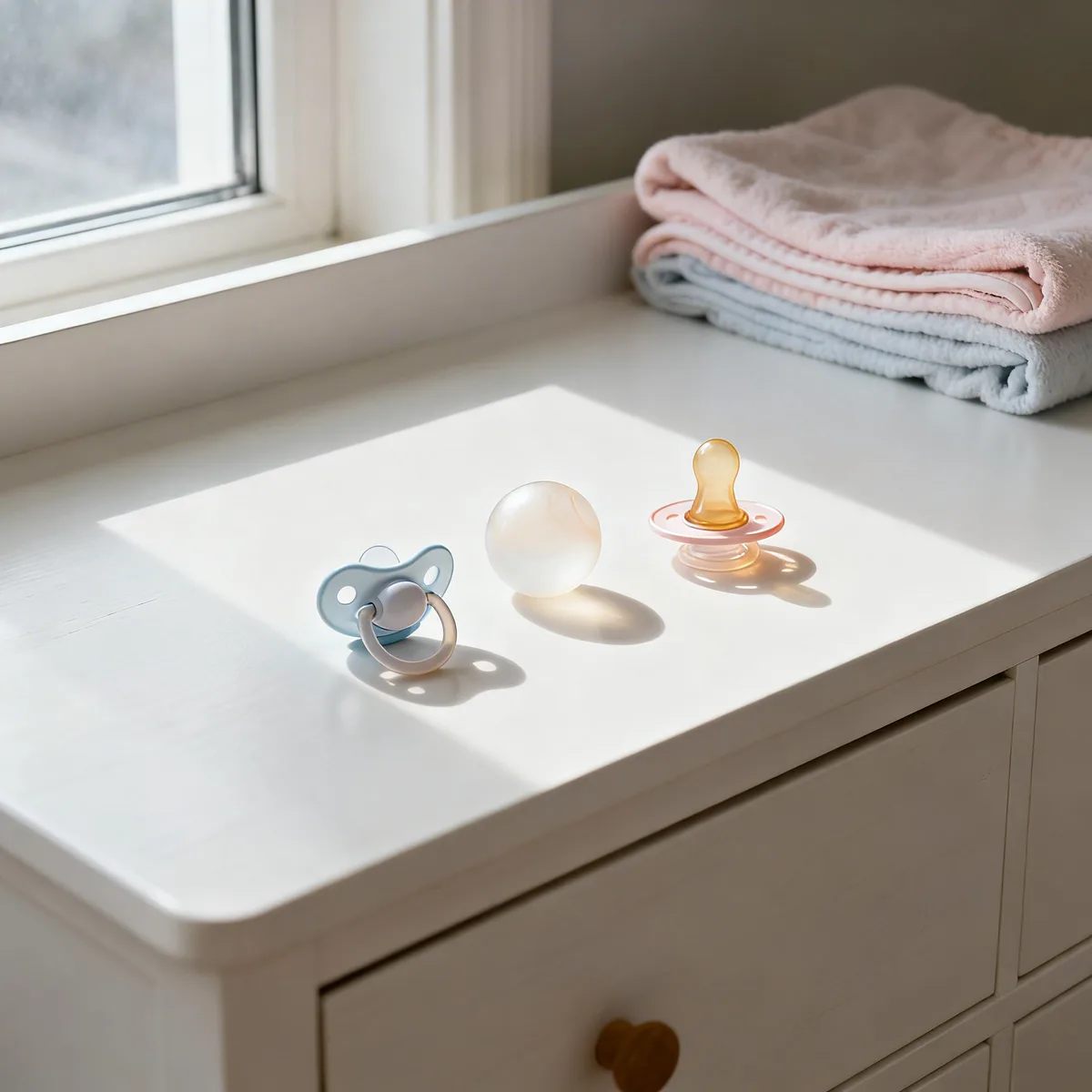
There are three main baby pacifier types and shapes you’ll encounter: orthodontic (flattened on the bottom, rounded on top), round or cherry-shaped (symmetrical nipple), and natural or breast-shaped (wider base, designed to mimic the feel of nursing).
That last category matters if you’re breastfeeding. The natural or breast-shaped designs are built to reduce confusion between the bottle, breast, and pacifier – which becomes relevant quickly. If you’re already thinking through feeding logistics, bottle feeding positions is worth reading alongside this.
Orthodontic shapes are often recommended by dentists and pediatricians for longer-term use because they’re designed to reduce pressure on developing teeth and gums. The AAP recommends offering a pacifier at nap time and bedtime during the first year, noting it’s associated with a reduced risk of SIDS – but notes that shape and fit still matter for oral health over time.
The bottom line: what your baby accepts is personal. But knowing what the design is actually trying to do gives you something real to work with – not just trial and error until one sticks.
When people talk about baby pacifier types shapes, orthodontic designs come up constantly – and not without reason.
The defining feature is the nipple itself: flat on the bottom, rounded on top. That asymmetrical shape is built to sit against the tongue the way a breast or bottle nipple would during a feed, rather than pushing uniformly against the palate.
The idea is that your baby’s mouth does less compensating. With a symmetrical round nipple, the tongue and jaw have to work around the shape. With an orthodontic design, the geometry is already doing some of that work.
This matters most if your baby is spending significant time at the pacifier – long stretches, multiple times a day. The concern with any pacifier used heavily past 18 months isn’t the pacifier itself, it’s cumulative pressure on soft tissue that’s still forming.
The AAP recommends offering a pacifier at nap and bedtime during the first year, citing a reduced risk of SIDS – and for that window, an orthodontic shape gives you something more intentional than a default choice.
Where the hype gets ahead of itself: no pacifier cancels out prolonged use. If your baby’s in the habit well into toddlerhood, the shape helps but doesn’t fix everything. Weaning timing still matters more than design alone.
Orthodontic pacifiers also tend to work better for babies who are already comfortable with bottle feeding. If you’re navigating a mix of breast and bottle, it’s worth reading up on the formula feeding guide newborn considerations that overlap here – nipple confusion is a real variable, and pacifier shape is part of that conversation.
Bottom line: orthodontic isn’t a marketing word dressed up in science. The design has a logic. Whether that logic matters for your baby depends on how and how long they’re using it.
The two main baby pacifier types shapes you’ll encounter are traditional round nipples and anatomical flat (or “orthodontic”) designs. They look different for a reason – each mimics a different oral experience.
Round pacifiers have a symmetrical, cherry-shaped nipple. They sit in the mouth the same way regardless of orientation, which makes them easier to reinsert at 2am without turning a light on.
Flat pacifiers are designed to compress under tongue pressure and rest lower in the mouth. The idea is that they more closely replicate the shape of a breast nipple during active nursing.
On palate impact: prolonged pacifier use of any kind can influence oral development, but flat designs are generally thought to put less upward pressure on the hard palate. The AAP recommends limiting pacifier use after 6 months partly to reduce the risk of dental misalignment as teeth begin to develop.

For latch comfort, breastfed babies often take to flat designs more readily – the muscle mechanics feel familiar. Babies who are exclusively bottle-fed tend to adapt easily to round shapes, sometimes preferring them.
There’s also a tactile preference factor. Some babies reject flat pacifiers outright regardless of feeding method. Others refuse anything round. You won’t know until you try.
If your baby is heading toward a childcare setting soon, it’s worth noting that the first day of daycare often surfaces strong pacifier preferences – caregivers working with multiple babies don’t have time to troubleshoot, so knowing what your baby actually accepts matters before drop-off.
Neither shape is universally better. Shape preference is real, individual, and sometimes completely illogical. Start with one, observe, and adjust.
Beyond orthodox and round, there are three more baby pacifier types shapes worth knowing: cherry, bottle-teat, and breast-shaped. Each exists for a reason. None of them are gimmicks.
Cherry nipples are the classic. Small, round bulb at the tip, symmetrical all the way around. They’ve been around forever because they work – especially for younger babies who haven’t developed a strong preference yet.
Bottle-teat pacifiers are designed to mimic the feel of a bottle nipple. If your baby is already comfortable taking a bottle, this shape often clicks immediately. It’s a logical bridge, not a marketing pitch.
Breast-shaped pacifiers are the most specialized of the three. The nipple is wider at the base and softer overall, designed to match the compression pattern of actual breastfeeding. For breastfed babies who struggle with pacifier rejection, this shape tends to have the highest acceptance rate.
That said, “breast-shaped” doesn’t automatically mean better for breastfed babies. Some exclusively breastfed babies refuse them outright and take a cherry tip without blinking. Biology is specific to each baby, not to categories.
Where these shapes genuinely earn their place: the bottle-to-breast or breast-to-bottle transition window. If you’re introducing a pacifier after weeks of nursing, starting with a breast-shaped option gives the baby a familiar reference point. It reduces the sensory gap.
Real-world effectiveness across all three shapes depends less on design specs and more on timing, hunger state, and whether your baby is in the mood to cooperate at all. Introduce any new shape when your baby is calm and not actively hungry – you’ll get a much cleaner read on whether it’s actually working.
Material matters more than most people expect. The two main options – silicone and latex – behave differently in your baby’s mouth, and they hold up differently over time.
Silicone is firm, odorless, and doesn’t degrade as quickly. It’s easier to sterilize and holds its shape through repeated boiling and dishwasher cycles. If you want something low-maintenance that stays consistent, silicone is the straightforward call.
Latex is softer and more flexible – closer to skin in texture, which some babies genuinely prefer. The tradeoff: it degrades faster, absorbs odors, and can trigger allergic reactions in latex-sensitive babies. If there’s any family history of latex allergy, skip it.
The AAP recommends inspecting pacifiers before every use and replacing them immediately if you notice stickiness, discoloration, or tears – latex nipples in particular break down without obvious warning signs.
Size is the other variable people underestimate when navigating baby pacifier types shapes. A nipple that’s too large can strain an infant’s jaw and interfere with proper oral muscle development. Too small, and it won’t stay put.
Most brands use a straightforward age-based sizing system: 0-6 months, 6-18 months, 18 months and up. Start with the newborn range and size up when the pacifier starts riding too high or falls out constantly during calm sucking.
The shield diameter also matters. It needs to be large enough that it can’t fit entirely in a baby’s mouth – a minimum of 1.5 inches across is the standard safety threshold. Check that the ventilation holes in the shield are present. They’re not a design detail; they prevent skin irritation around the mouth.
When in doubt, buy two different materials in the same size and let your baby show you which one they actually tolerate. Preference at this stage is almost entirely sensory.
Start with feeding method. If you’re breastfeeding, an orthodontic or round nipple-shaped pacifier tends to work better – both mimic the natural compression your baby uses at the breast.

Bottle-fed babies are often more flexible. They’ve already adapted to a firm, consistent shape, so standard round nipples or symmetrical orthodontic designs usually land well.
Age is the other hard filter. Newborn pacifiers (0-3 months) are sized specifically for small mouths and weaker jaw muscles. Using a 6-month size on a newborn isn’t just uncomfortable – it’s a safety issue.
The different baby pacifier types and shapes break down like this: round nipples are traditional and work for most babies; orthodontic flat-bottom designs support jaw alignment as teeth develop; and cherry-shaped nipples sit closer to a round shape but with a more pronounced tip some babies strongly prefer.
If your baby has oral sensitivity – reflux, tongue tie history, or sensory aversions – start with the softest silicone you can find and a symmetrical shape. Asymmetric designs can feel disorienting for babies who are already working harder to suck.
Dental concerns come into play later, typically after 18 months. At that point, orthodontic designs matter more. Before then, the priority is simply whether your baby will accept it and use it safely.
One practical move: check what nipple your baby is already accepting on a bottle. Many manufacturers make pacifiers in matching shapes – switching between them is less disruptive than starting from scratch.
And if you’re in the thick of the newborn phase and researching everything at once, the same logic applies here as it does to bigger gear decisions – doing that research early, like when you’re 29 weeks pregnant, means you’re choosing from a calm place instead of a sleep-deprived one.
The most expensive pacifier mistake isn’t buying the wrong one. It’s buying six of the wrong one before you figure that out.
Most rejections come down to shape mismatch – not mood, not stubbornness. Baby pacifier types shapes vary more than the packaging suggests, and a baby used to a round, bulb-style nipple will often refuse a flat orthodontic one, and vice versa.
Round (or cherry) nipples mimic a breast shape more closely. Orthodontic nipples are flattened on the bottom – designed to reduce palate pressure, but only useful if your baby actually accepts one.
The fix isn’t trial and error across every brand. It’s one purchase at a time. Buy a single pacifier, see if it lands, then buy more of the same.
Age matters too. Newborns and three-month-olds don’t have the same oral development – a size labeled “0-6 months” covers a lot of ground. If your baby suddenly starts rejecting a pacifier they used to love, sizing up is worth trying before assuming the problem is something else.
Switching types mid-stream is where most people lose time and money. If you’re breastfeeding, some research suggests round nipples cause less confusion – but this varies by baby. If you’re bottle feeding, matching the pacifier shape to your bottle nipple is a smarter starting point than picking based on reviews alone.
One other thing that gets ignored: shield size. A shield that’s too large can press uncomfortably against a small face. A shield that’s too small is a safety concern. Most guidelines recommend a shield no smaller than 1.5 inches across – it should never fit entirely in a baby’s mouth.
You don’t need a drawer full of options. You need the right one, bought once, confirmed before you stock up.
Orthodontic pacifiers have a flattened bottom and rounded top, designed to mimic the shape of a breast or bottle nipple during feeding. Regular or cherry-shaped pacifiers are symmetrical and round, which means your baby’s mouth has to work slightly harder to accommodate the shape. Orthodontic designs are often recommended by dentists and pediatricians for longer-term use because they’re designed to reduce pressure on developing teeth and gums.
Silicone is more durable, hypoallergenic, and withstands heat sterilization better, making it the most common choice for everyday use. Latex is softer and closer to the feel of a breast, which some breastfed babies prefer – but it breaks down faster and carries a small allergy risk. For most families, silicone is the practical choice; if your baby has a latex sensitivity or strongly prefers the softer feel, latex is worth trying.
Extended or heavy pacifier use past 18 months can apply cumulative pressure to soft tissue that’s still forming, potentially affecting tooth alignment and palate development. The risk is less about the shape itself and more about duration and intensity of use – but orthodontic shapes are designed to minimize that pressure when pacifiers are used regularly. Weaning timing matters more than design alone, but choosing an orthodontic shape gives you an intentional advantage.
Babies have strong oral preferences shaped by what they’ve experienced – breastfeeding, bottle feeding, or early pacifier exposure. A baby used to a breast may reject a round pacifier’s stiff texture in favor of a flatter, softer design. Mouth size, tongue shape, and jaw structure also play a role. What works for one baby won’t work for another, which is why trying multiple shapes before buying in bulk makes sense.
Most pacifier brands offer size ranges by age (typically newborn, 3+, 6+, 12+ months), and you’ll know it’s time to size up when your baby’s mouth looks cramped around the nipple or they start rejecting it. Shape changes depend on your baby’s response – if they’re consistently spitting out one style but accepting another, stick with what works. Around 12 months, some families transition to orthodontic shapes exclusively if they plan to use pacifiers into toddlerhood, since the design offers more intentional oral support.