


Health Guides
Tongue Tie in Babies: Signs, Diagnosis, Treatment & Breastfeeding Recovery
Jeehoo Jeon·10 min read

Find the best baby lotion for sensitive skin. Dermatologists explain why infant skin is different, which ingredients actually work, and how to introduce products safely.
Here’s what nobody tells you about baby skin: it’s not just a smaller version of adult skin. It’s structurally different — thinner, more porous, and still developing — which means the lotions that work fine for you could trigger irritation in your newborn.
Most parents assume any “gentle” lotion will do, but finding the best baby lotion for sensitive skin requires understanding what your baby’s skin actually needs. This guide breaks down the ingredients dermatologists actually recommend, which ones to avoid, and how to introduce products safely without guessing.
A newborn’s skin is not simply smaller adult skin. It is a structurally distinct organ that is still developing — and that difference has real consequences for how you care for it.
The outermost layer of skin, the stratum corneum, acts as a barrier between the body and the outside world. In adults, this layer is dense and well-established. In newborns, it is significantly thinner and less organised, which means it loses moisture faster and absorbs external substances more readily.
Infant skin also has a higher surface-area-to-body-weight ratio than adult skin. This means that anything applied topically — lotions, soaps, fragrance — reaches a proportionally larger biological surface.
The skin’s acid mantle, a thin protective film that helps resist bacteria and irritants, takes time to fully form after birth. The AAP notes that newborn skin continues to mature throughout the first year of life, which is why reactions to environmental triggers are more common in early infancy.
This immaturity is the underlying reason so many caregivers search for the best baby lotion for sensitive skin — the need is physiological, not incidental.
Transepidermal water loss (TEWL) is measurably higher in infants than in adults. Higher TEWL means the skin dries out more quickly, which can compromise barrier function further and create a cycle of dryness and irritation.
When that barrier is already compromised — as it is in conditions like eczema — the skin becomes even more vulnerable to allergens and irritants. If your baby is showing signs of persistent irritation, the baby eczema treatment guide covers what the research says about managing flares and protecting the skin barrier long-term.
Understanding this biology is the starting point for every skincare decision you make in those early months.
The ingredient list is where most skincare decisions should actually start. A few well-researched compounds consistently show up in dermatologist-approved formulas — and understanding what each one does makes it easier to choose with confidence.
Colloidal oatmeal is one of the most studied ingredients for reactive skin. It contains avenanthramides, compounds shown to reduce inflammation and calm itching by interrupting inflammatory signalling at the skin level. The FDA has recognised it as a skin protectant since 2003.
Ceramides are lipids your baby’s skin naturally produces — but sensitive or eczema-prone skin often has lower levels of them. Topical ceramides help reinforce the skin barrier by filling the gaps between skin cells, reducing water loss and blocking out irritants.
Glycerin is a humectant, meaning it draws moisture from the air into the skin. It’s gentle, well-tolerated, and found in many of the formulas considered the best baby lotion for sensitive skin by dermatologists and paediatricians alike.
The AAP recommends fragrance-free, dye-free moisturisers for babies with sensitive or eczema-prone skin, noting that fragrances are among the most common triggers for contact dermatitis in infants.
Two ingredient categories worth actively avoiding: parabens and sulfates. Neither is necessary for an effective formula, and both have documented associations with skin irritation in young children.
If your baby is also experiencing sun sensitivity — a common overlap with reactive skin — the same ingredient scrutiny applies to sun protection products. The baby sunburn treatment guide covers what to look for there specifically.
Short ingredient lists, in general, carry lower risk. Fewer components means fewer opportunities for a reaction — a straightforward principle that holds across most dermatology guidance for infants.
Some ingredients that are well-tolerated in adult skincare can disrupt a baby’s skin barrier. Knowing what to look for on a label is one of the most practical steps you can take.
Fragrance (parfum). This is the most common trigger for contact dermatitis in infants. “Fragrance” on a label can represent dozens of undisclosed chemicals — including known sensitisers like linalool and limonene.
Parabens. Used as preservatives, parabens (methylparaben, propylparaben, butylparaben) have documented associations with skin sensitisation. They appear frequently in conventional baby lotions and are worth avoiding on reactive skin.
Sodium lauryl sulfate (SLS). A surfactant found in some wash-based lotions. SLS strips natural oils from the skin surface and compromises barrier integrity — particularly problematic for babies with eczema-prone or dry skin.
Phenoxyethanol. A preservative that the AAP has flagged as potentially harmful for infants, specifically advising against its use in products applied to newborns and young babies.

Phthalates. Sometimes present as carrier compounds in fragranced products. Phthalates are absorbed through the skin and have been the subject of ongoing regulatory review in several countries.
Alcohol (ethanol or isopropyl alcohol). Drying and potentially irritating to thin infant skin. Short-chain alcohols listed high on an ingredient label are a reliable reason to look elsewhere.
If you’re looking for the best baby lotion for sensitive skin, none of these ingredients offer any functional benefit that a cleaner alternative can’t match.
Mineral oils and petrolatum are sometimes flagged by parents, but both have a strong safety record and are widely used in dermatologist-recommended formulations. The concern there is occlusion in very premature infants — not typical use in healthy term babies.
Cross-referencing the ingredient list against resources like the Environmental Working Group’s Skin Deep database gives you a structured way to evaluate products before purchase.
When you’re looking for the best baby lotion for sensitive skin, the formulation matters more than the brand name on the front of the bottle.
Dermatologist-recommended options tend to share a few consistent traits: fragrance-free, hypoallergenic, and built around a short, recognizable ingredient list. The American Academy of Dermatology specifically advises avoiding fragrances and dyes in products for babies with eczema-prone or reactive skin.
Colloidal oatmeal is one of the most evidence-backed ingredients you’ll find in gentle baby lotions. The FDA has recognized it as a skin protectant since 2003, and clinical studies show it reduces itch and supports barrier repair — particularly useful if your baby’s skin tends to flare in dry or cold weather.
Ceramide-based lotions are another strong category. Ceramides are lipids that occur naturally in the skin barrier; research published in the journal Pediatric Dermatology found that ceramide-dominant formulations can meaningfully improve skin hydration in infants with atopic dermatitis.
Glycerin is a humectant you’ll see in many well-regarded formulas — it draws moisture into the skin and has a strong tolerability profile across sensitive skin types. Shea butter and sunflower seed oil are commonly used emollients with low sensitization rates, making them reliable choices for daily use.
If you want a starting point from a brand that takes ingredient transparency seriously, a friend who works in pediatric skincare pointed me toward Cha&Mom — worth looking at if you’re trying to avoid common irritants without sacrificing effectiveness.
Whatever lotion you choose, apply it within a few minutes of bathtime while the skin is still slightly damp. The NIH notes that this timing significantly improves moisture retention compared to applying to fully dry skin.
Even the best baby lotion for sensitive skin can trigger a reaction if introduced without care. A patch test is the right place to start — and it takes less than two minutes.
Apply a small amount of lotion to the inside of your baby’s wrist or behind one knee. These areas are thin-skinned and reactive, which makes them reliable test sites.
Wait 24 hours before applying the product more broadly. You’re looking for redness, raised skin, hives, or unusual fussiness in the hours after contact.
If the patch site stays clear, begin with one application per day on a limited area — the legs or arms are a practical starting point. This gives you a controlled window to observe how the skin responds before committing to full-body use.
The American Academy of Pediatrics (AAP) recommends introducing one new product at a time and waiting several days between new additions. Using multiple new products at once makes it impossible to identify the source of a reaction.
Keep the routine consistent in the early weeks. Applying lotion at the same point each day — typically right after the evening bath — helps you notice changes in skin response quickly.
Document what you use and when. A simple note in your phone is enough. If a reaction does occur, your pediatrician will want to know the product name, ingredients, and how long it had been in use.
If irritation appears — redness, dryness that worsens, or any swelling — stop use immediately and contact your pediatrician before trying a replacement product. The CDC advises against self-treating skin reactions in infants without clinical guidance.
Patience here is practical, not overcautious. Babies’ skin barriers are still developing, and what works well at two months may need revisiting as they grow.
Some reactions are obvious. Redness, hives, or swelling shortly after application are clear signals to stop using a product immediately.

Others are more gradual. If your baby’s skin looks drier, flakier, or more irritated after a week of consistent use, the lotion itself may be the problem — not a lack of moisture.
Watch for these specific signs: skin that feels rough or tight after application, new patches of dry or scaly skin, persistent redness around the areas where lotion was applied, and any scratching or fussiness during or after moisturising.
Fragrance and preservatives are among the most common triggers. Even products labelled “natural” or “gentle” can contain botanical extracts — like lavender or chamomile — that irritate developing skin. When searching for the best baby lotion for sensitive skin, an ingredient list with fewer components is generally a safer starting point.
The AAP recommends avoiding products with added fragrances or dyes on infant skin, particularly for babies with a family history of eczema or allergies.
If irritation appears, note the product name, the ingredients, and how long it was in use before symptoms started. That information matters when you speak with your pediatrician.
Mild, short-lived dryness after a bath is normal. Redness that spreads, skin that weeps or crusts, or symptoms that persist beyond 48 hours after stopping the product — those warrant a call to your pediatrician or a visit to a dermatologist.
A dermatologist can distinguish between contact dermatitis, eczema, and other conditions that look similar but require different care. Self-substituting products without a diagnosis can extend the problem rather than resolve it.
Tracking your baby’s baby growth chart percentiles at well visits is a good habit — skin health is worth the same consistent attention.
Timing matters more than most people realize. The American Academy of Dermatology recommends applying moisturizer within three minutes of bath time — while skin is still slightly damp — to lock in hydration before the moisture barrier has a chance to dry out.
Use the flat of your fingers, not your fingertips. Gentle, broad strokes reduce friction on reactive skin. Avoid rubbing in circles, which can create heat and irritation in areas already prone to sensitivity.
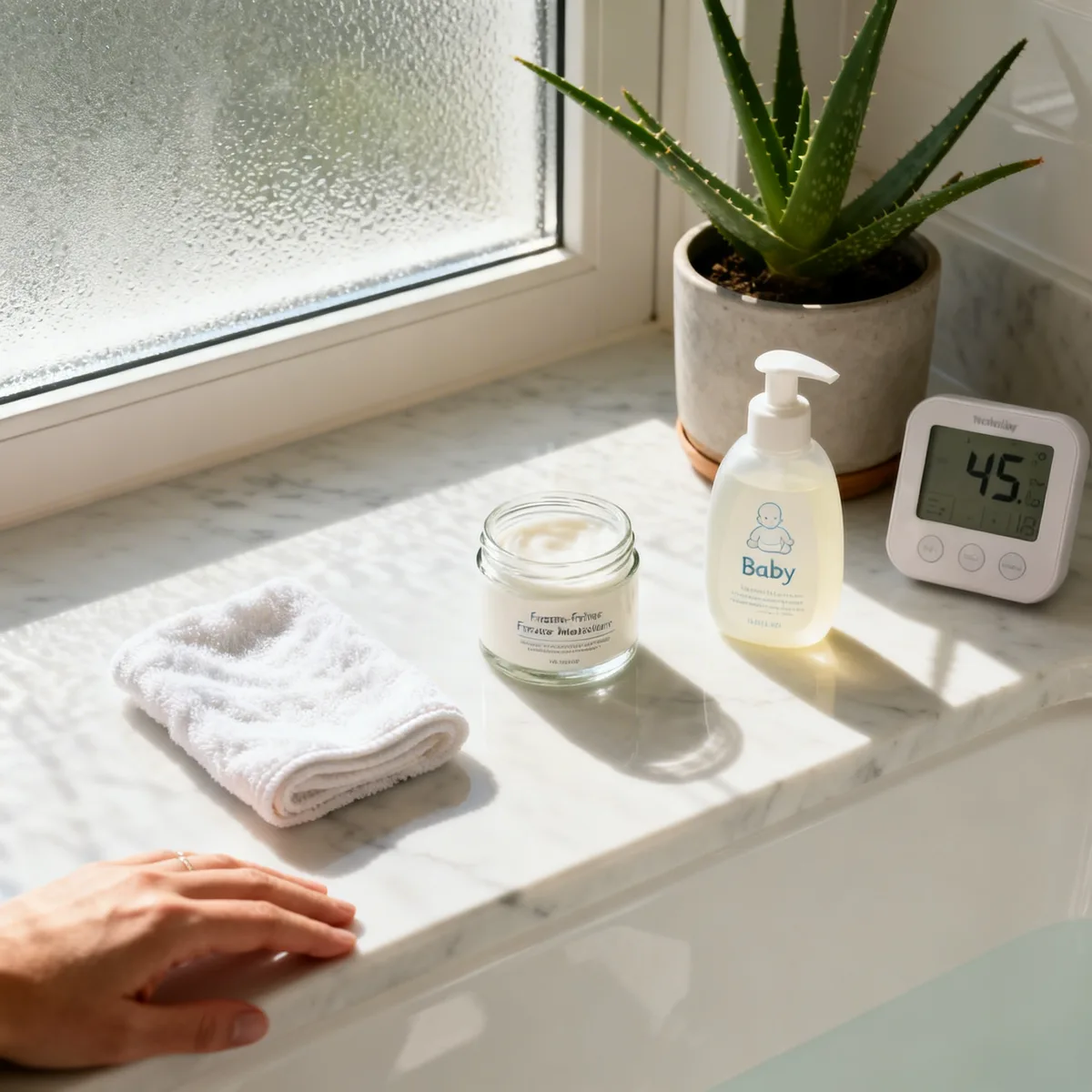
Room humidity plays a real role in skin hydration. The AAP notes that indoor air — especially in winter months with central heating — can drop to humidity levels that actively pull moisture from skin. A cool-mist humidifier in your baby’s room can help maintain conditions that support the skin barrier overnight.
When choosing the best baby lotion for sensitive skin, dermatologists generally recommend fragrance-free, dye-free formulas with a short ingredient list. Fewer ingredients mean fewer potential triggers — and it’s easier to identify a problem if one appears.
Onzenna’s fragrance-free baby lotion is formulated with exactly this principle in mind — designed for daily use on reactive and sensitive skin without unnecessary additives.
Laundry detergent is often overlooked. The NIH identifies residual detergent on fabric as a common contact irritant for infants. Using a fragrance-free, dye-free detergent and an extra rinse cycle can reduce skin exposure significantly.
Bath frequency is another practical lever. The AAP recommends bathing newborns no more than three times per week — daily baths can strip the skin’s natural oils faster than they’re replenished.
Keep nails trimmed short. Scratching — even during sleep — breaks the skin barrier and creates entry points for irritants and bacteria. It’s a small step that dermatologists consistently flag as high-impact for sensitive-skinned babies.
Yes, lotion is safe for newborns from birth, especially fragrance-free and dye-free formulas designed for sensitive skin. In fact, moisturising helps prevent dryness and supports barrier development during those critical early weeks. If your baby has eczema or visible irritation, starting early with the right lotion can reduce flares.
Baby lotion is water-based and absorbs quickly, making it ideal for daily use on larger areas. Baby cream is thicker and more occlusive, locking in moisture longer — better for very dry patches or eczema-prone skin. Baby oil sits on top of the skin without absorbing and can trap moisture but may feel heavy for everyday use on sensitive skin.
Eczema typically appears as red, itchy patches that persist despite moisturising, sometimes with visible flaking or weeping. Dry, sensitive skin usually improves with consistent lotion use and is less likely to show inflammation or cause visible discomfort. If irritation doesn’t improve within a week of switching to a gentle, fragrance-free lotion, consult your paediatrician.
Even fragrance-free adult moisturisers may contain ingredients, preservatives, or concentrations not tested on infant skin. Baby-formulated products are specifically designed for the thinner barrier and higher absorption rate of newborn skin. It’s safer to use products tested and approved for infants, especially if your baby has sensitive skin or eczema.
Apply lotion at least once daily, ideally within three minutes of bathing when the skin is still slightly damp — this helps seal in moisture. For babies with eczema or very dry patches, dermatologists often recommend twice-daily application. Watch your baby’s skin response and adjust frequency if irritation develops.