Quick Summary
If you’re looking for ways to keep your little one entertained and engaged, sensory bins for 1 year olds are an excellent choice that promotes development through play. These interactive sensory bins for 1 year olds offer endless possibilities for exploration and learning. From rice and pasta to water beads and kinetic sand, you’ll discover simple yet effective ideas to create bins that your toddler will love.
Here’s what nobody tells you about sensory bins: they work because 1 year olds aren’t actually playing — they’re testing. Every squeeze, drag, and grab is data collection, and a sensory bin gives their brain enough variation to stay genuinely engaged while you drink your coffee while it’s still warm.
Traditional toys deliver one fixed experience and lose their appeal in minutes. Sensory bins for 1 year olds shift every time your child digs into them, which means their brain keeps working. This article covers five practical bin ideas, safety rules that actually prevent choking hazards, realistic attention spans, and setup hacks that make cleanup less of a nightmare.
Why Sensory Bins Work for 1 Year Olds (and Why Yours Keeps Ignoring Toys)
At 12 months, your baby’s brain is running a full-time research operation. Every texture, temperature, and resistance level is data — and they need a lot of it.
Traditional toys give them one fixed experience. Press the button, hear the sound.
Done. There’s no variation, no discovery, no reason to go back after the first few times.
Sensory bins work differently. The material shifts every time they dig into it.
The weight changes depending on how much they grab. Nothing about it is predictable, which means their brain keeps working.
This matters because 12-month-olds are deep in a developmental window built around cause and effect. They’re not playing — they’re testing.
What happens when I squeeze this? What does it feel like to drag my hand through it slowly versus fast?
Sensory bins for 1 year olds give them enough variation to stay genuinely engaged, not just briefly stimulated. That’s a different thing.
One holds attention for two minutes. The other holds it long enough that you can drink your coffee while it’s still warm.
There’s also a tactile development piece here that matters later. Babies who get consistent hands-on sensory experiences tend to be less reactive to new textures — which, if you’re already thinking about best finger foods for 9 month old transitions into toddlerhood, is worth knowing now.
The bin doesn’t need to be elaborate. The point isn’t the container. It’s giving their hands something real to figure out.
5 Sensory Bin Ideas for 1 Year Olds That Won’t End in a Mess
The mess isn’t inevitable. It’s usually a setup problem.
Put the bin inside a shallow storage tote or on a silicone mat, strip them down to a onesie, and suddenly cleanup is a two-minute job instead of a reason to avoid this entirely.
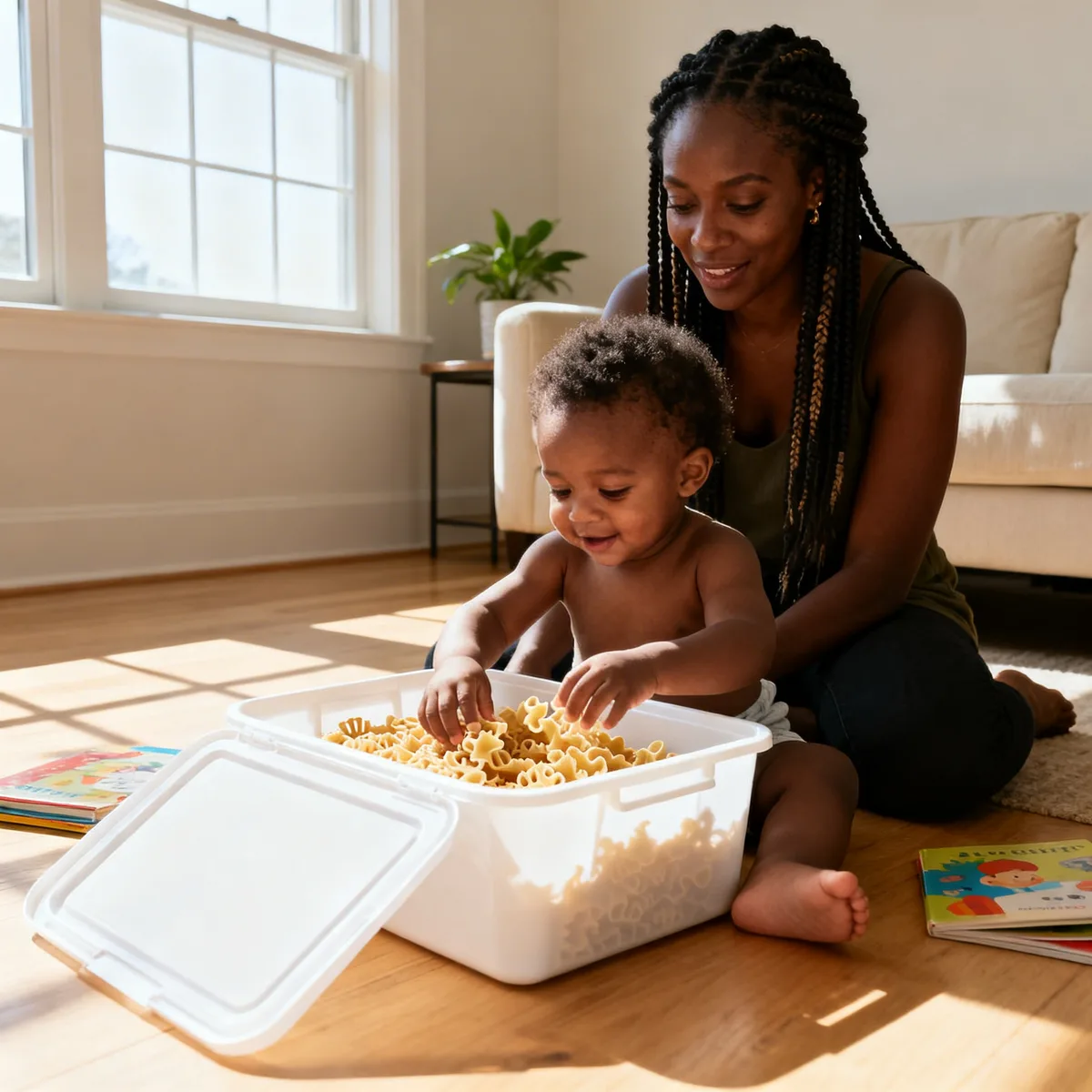
1. Cooked pasta with olive oil. Cool it completely, toss with a little oil so it doesn’t stick, and let them go. It’s squishy, slippery, and completely safe if it goes in the mouth — which it will.
2. Water beads (supervised only). Visually, they’re compelling.
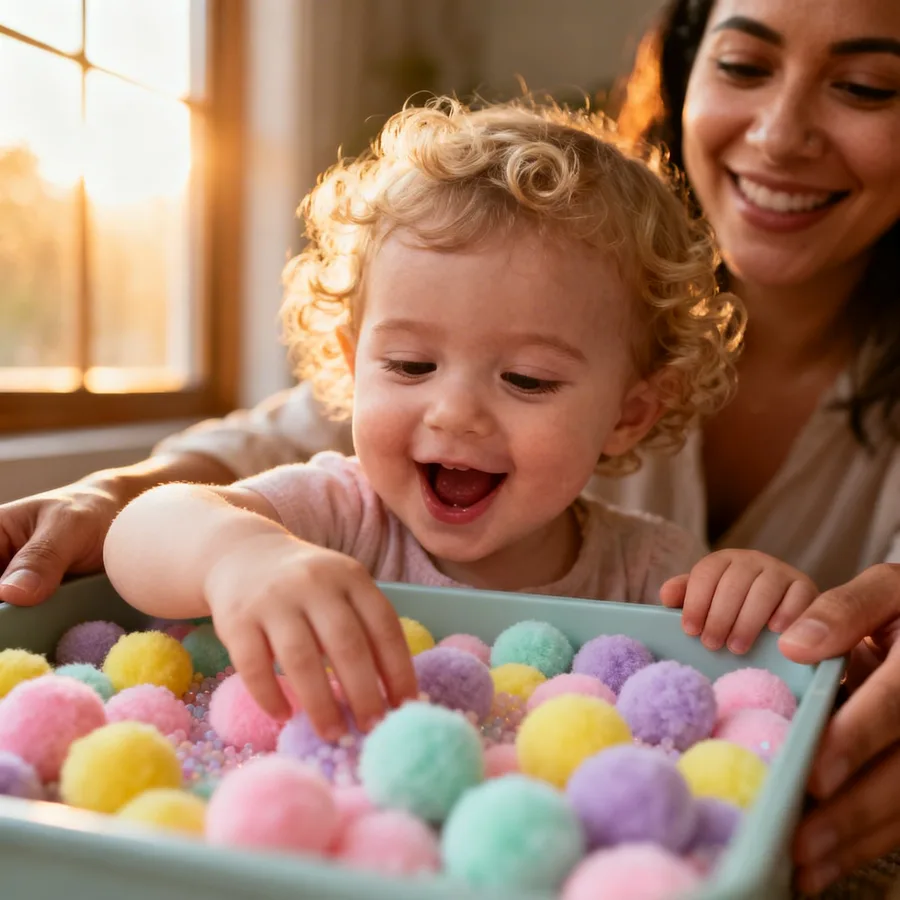
Tactilely, they’re unlike anything else. Keep the quantity small and stay in the room.
These are not a leave-and-come-back activity for this age group.
3. Dried oats with wooden spoons and small containers. Scooping, pouring, dumping — this combo covers a lot of developmental ground. Oats are soft enough that mouthing isn’t a choking concern, and they’re easy to vacuum.
4. Shredded paper over crinkle toys. Hide a few crinkle items under the paper and let them dig. The rustling sound adds an auditory layer that keeps attention longer than you’d expect.
5. Chilled damp cloth strips over smooth objects. Wet muslin strips over wooden rings or silicone teethers — especially useful if you’re in the thick of when infant start teething territory. The cool texture is soothing, and it gives their gums something to press against without you having to hold anything.
A few hard rules for sensory bins for 1 year olds: nothing smaller than a ping pong ball, no sharp edges, and skip anything that expands when wet unless you’re watching the whole time.
You don’t need five bins. Start with one.
See what holds their attention. Build from there.
Safe Materials for Sensory Bins at This Age
At one year old, everything goes in the mouth. That’s not a problem — it’s just the reality you’re designing around.
The rule that actually matters: nothing smaller than a golf ball. Some people say ping pong ball, but at this age, err smaller. If it fits through a toilet paper roll, it stays out of the bin.
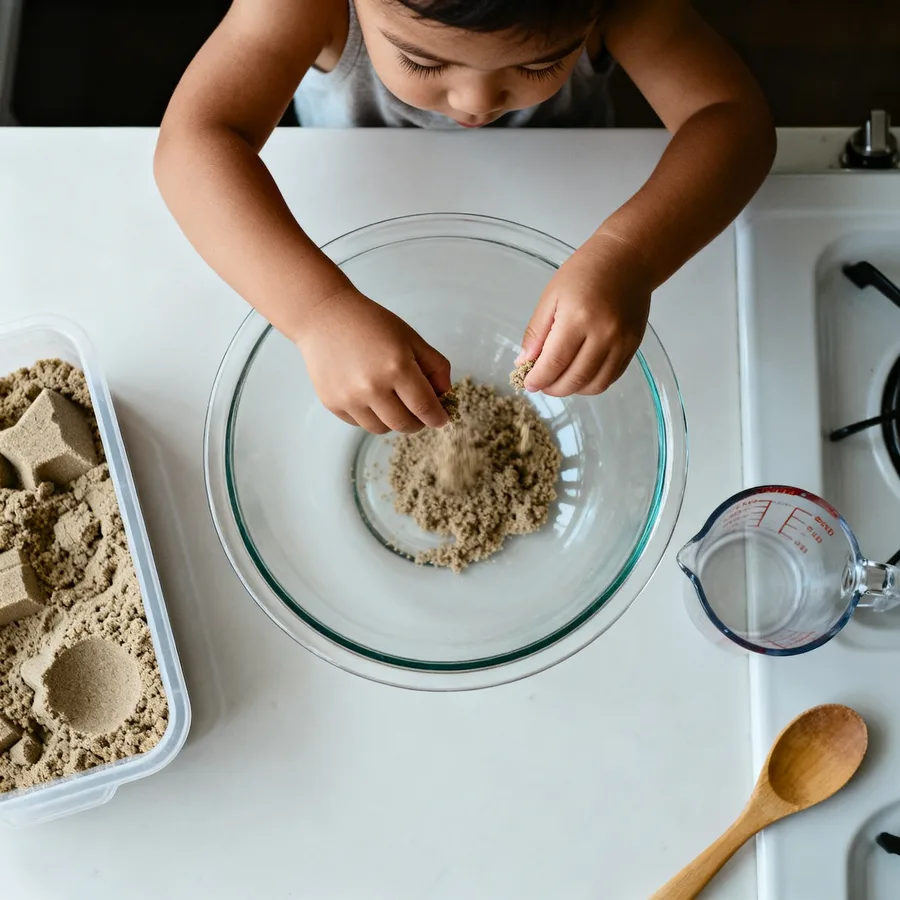
For fillers, cooked pasta, large dried beans (think kidney beans, not lentils), and water are genuinely safe. Kinetic sand and cloud dough are popular, but both require eyes-on supervision — they break into smaller pieces and kids this age will eat them without hesitation.
Skip rice and small dried pasta entirely for sensory bins for 1 year olds. It’s a choking risk people underestimate because it feels harmless.
Material quality matters just as much as size. Plastic scoops and cups are fine, but check for rough edges and cracks — those collect bacteria and can cut soft gums.
Silicone tools are a better call. They’re easy to clean, don’t degrade, and hold up to the kind of abuse a one-year-old delivers without blinking.
Natural wood pieces are a yes — as long as they’re sealed, splinter-free, and large enough. Unsealed wood absorbs moisture and grows mold faster than you’d expect.
Avoid anything with paint that isn’t explicitly labeled non-toxic. Same goes for dyed fillers unless you made them yourself with food-grade coloring.
Keep the bin shallow. Deep containers mean face-first dives, and at this age, that’s not dramatic — it’s Tuesday.


How Long Will Your 1 Year Old Actually Play in a Sensory Bin?
Three to ten minutes. That’s it. And honestly, five minutes of real engagement is a win at this age.
One-year-olds don’t have long attention spans — they have intense attention spans. There’s a difference.
When it’s working, they’re completely locked in. When it’s not, they’re already gone.
Signs they’re actually engaged: repeated touching, mouthing and then going back in anyway, moving materials from one hand to the other, or just staring at something they’ve picked up like it’s a rare artifact. That’s the good stuff.
Signs they’re done: they start throwing everything, they step in, or they walk away. Don’t fight it. Chasing extended play when they’ve already checked out just sours the whole thing.
To get more out of sensory bins for 1 year olds, start with less. A few scoops of material, one or two tools, no overwhelming setup. Novelty does the heavy lifting — the same bin that got ignored Monday might get ten minutes of solid attention on Thursday for no reason you can explain.
Sit with them instead of hovering. Picking something up yourself and turning it over tends to pull them back in better than any encouragement you could say out loud.
Rotate what’s inside, not necessarily the bin itself. Swap dried rice for water beads, or add a single new scoop tool. Small changes land big at this developmental stage.
Also — timing matters more than setup. Right after a nap, before hunger sets in, in a calm room.
If they’re tired or overstimulated, no bin in the world is going to hold them. Know your window and use it.
Setup and Storage Tips for Busy Parents
The bin itself doesn’t have to be fancy. A wide, shallow plastic storage container works. So does a rimmed baking sheet for dry materials — easier to contain, easier to wipe.
Keep a dedicated sensory kit in a single lidded bin or drawer. Everything in one place: the filler, the tools, a small dustpan. You’re not rebuilding this from scratch every time.
For sensory bins for 1 year olds specifically, smaller is better. A container roughly the size of a shoebox gives them enough room to explore without scattering material across half the floor.
Pre-portion dry fillers into zip-lock bags or mason jars. You grab, you pour, you’re done in under two minutes. No measuring, no digging through a pantry.
Cleanup is where most parents lose the will to do this again. Put a cheap shower curtain liner or a splat mat under the bin before you start — not after you realize you need one.
A small hand broom and dustpan stored right next to the setup means cleanup happens in one motion, not a hunt. That matters at the end of a session when your kid is already moving on and making other chaos.
Wet fillers need a drain step. A colander works for water beads and pasta. Dry them on a dish towel before storing, or they’ll smell like a problem by Thursday.
Rotate materials on a two-week cycle and store the off-rotation ones out of sight. Novelty does the engagement work for you — you just have to be the one who manages the lineup.
Red Flags: When Sensory Bins Aren’t Working (And What to Try Instead)
Not every toddler is going to dive in. That’s not a failure — it’s information.
If your child is crying, gagging, or immediately trying to escape the activity, that’s overwhelm, not a bad mood. Some kids have sensory sensitivities that make certain textures genuinely uncomfortable, and pushing through it doesn’t help.
Watch for these specific signals: gagging at the smell or feel of materials, refusing to touch anything even with prompting, escalating distress that doesn’t settle after a minute or two, or complete shutdown. Any of those means stop.
Developmental readiness is also real. Sensory bins for 1 year olds work best when a child is already curious about textures in daily life — touching food, grabbing grass, reaching into things. If your kid isn’t doing any of that yet, a bin full of rice might just be confusing noise.
Start smaller. A single material in a bowl.
Your child’s hand guided to touch something once, with zero pressure to continue. Sensory exposure doesn’t have to be a whole setup.
If bins aren’t landing at all, try sensory experiences that are already built into the day. Water play at bath time.
Mud outside. Tearing paper.
Finger foods with different textures. The goal is exposure to varied input — the bin is just one delivery method, not the only one.
Older toddlers who consistently avoid touch-heavy play or have strong reactions to everyday textures — tags on clothing, certain foods, wet hands — are worth a conversation with your pediatrician. Occupational therapists work with kids on sensory processing regularly, and early is always better than later.
Sensory play is supposed to be low-stakes. If it’s become a battleground, it’s time to change the approach, not push harder.
Sources
- American Academy of Pediatrics — developmental milestones and play recommendations for toddlers ages 1–3 years.
- CDC — developmental milestones for children at 2 years, including fine motor and sensory skill progression.
Frequently Asked Questions
How long should a sensory bin activity last for a 1 year old?
Most 1 year olds will engage with a sensory bin for 10–20 minutes before losing focus. This varies by child — some will go longer, others will move on faster. The goal isn’t sustained play; it’s quality exploration in the time they do engage.
What are the best materials for sensory bins that won’t be a choking hazard?
Cooked pasta, dried oats, shredded paper, and soft fabric strips are all safe choices because they break apart easily if mouthed. Avoid small beads, buttons, nuts, and anything smaller than a toilet paper tube. Water beads work if supervised closely, but should never be left unattended with a 1 year old.
Can I reuse sensory bin materials, or do I need to buy new ones each time?
Most materials can be reused multiple times. Dried oats, pasta, and paper can go in storage containers between uses.
Water beads should be drained and stored in a sealed container. Damp cloth strips should be washed and dried.
Rotating materials keeps novelty high without constant repurchasing.
Is a sensory bin better than other toys for 1 year old development?
Sensory bins aren’t better — they’re different. They excel at sustained engagement and fine motor development because the material changes with every interaction. Traditional toys have their place, but sensory bins tend to hold attention longer and offer more learning potential at this age.
What’s the best container size for a sensory bin for a one-year-old?
A shallow storage tote (around 4–6 inches deep, 12–18 inches wide) works best. Shallow bins keep materials within reach without overwhelming them, and they’re easy to place on a mat or inside a larger tote for containment. Avoid very large or deep bins that make it hard for small hands to access the bottom.


Keep Reading

Best Baby Swings and Bouncers 2026: Expert Reviews & Buying Guide

Best Infant Car Seat 2026: Top Safety Picks for Newborns & New Parents

Why is My Baby’s Skin So Sensitive? : Understanding the Probiotic Shower

K-Baby Is Having a Moment — Here's What's Real and What's Just Marketing

First Trimester Survival Guide: What Nobody Actually Tells You