


Trying to Conceive
How to Track Ovulation: 5 Methods Explained (So You Actually Know When You’re Fertile)
Jeehoo Jeon·14 min read

Learn the real signs of ovulation your body produces. Recognize cervical mucus changes, basal body temperature shifts, and physical sensations to predict your fertile window accurately.
Here’s what nobody tells you about ovulation: most people trying to conceive are missing the signs of ovulation and timing things wrong without realizing it. They’re relying on calendar math — assuming ovulation happens on day 14 — when their body is actually giving them real-time signals that are far more reliable.
Signs of ovulation are measurable, observable, and specific. They shift across your cycle in patterns you can learn to recognize: cervical mucus changes, subtle temperature rises, physical sensations, even shifts in mood and smell. Once you know what to look for, you stop guessing and start knowing where you actually are in your fertile window.
This guide walks you through every sign your body produces — which ones matter most, how to track them accurately, and how to use them (alone or alongside ovulation kits) to understand your cycle and time intercourse when it actually counts.
Ovulation is the release of a mature egg from one of your ovaries. That egg survives for just 12 to 24 hours — making the days surrounding ovulation the only window each cycle when conception is possible.
In a textbook 28-day cycle, ovulation typically occurs around day 14. But most cycles aren’t textbook. The American College of Obstetricians and Gynecologists (ACOG) notes that cycle length can vary significantly from person to person — and even month to month for the same person.
Sperm, by contrast, can survive in the reproductive tract for up to five days, according to the NIH. This means your fertile window actually spans roughly six days: the five days before ovulation and the day of ovulation itself.
Knowing where you are in that window matters. Timing intercourse based on calendar dates alone — assuming ovulation always falls on day 14 — can cause you to miss your actual fertile days entirely if your cycle runs shorter or longer than average.
That’s where recognizing the signs of ovulation becomes useful. Your body produces measurable physical cues in the days leading up to and during ovulation. Learning to read them gives you real-time information rather than an estimate based on averages.
If you’re also thinking ahead to what conception means for your body in the months that follow, it’s worth knowing that postpartum body changes begin earlier than most people expect — starting immediately after birth and continuing well into the first year.
Cervical mucus is produced by glands in your cervix, and its texture shifts predictably across your cycle in response to rising and falling estrogen levels.
In the days right after your period, discharge is typically minimal or absent. As estrogen rises in the follicular phase, mucus gradually increases — first appearing sticky or crumbly, then transitioning to a creamier, lotion-like consistency.
The most significant change happens in the days just before and during ovulation. Mucus becomes clear, slippery, and highly elastic — often described as resembling raw egg whites. This is one of the clearest signs of ovulation your body produces.
The scientific term is spinnbarkeit — a German word referring to the ability of the mucus to stretch between two fingers without breaking. At peak fertility, it can stretch an inch or more.
This texture change is functional, not coincidental. The AAP notes that cervical mucus at peak fertility is specifically structured to support sperm transport, helping sperm survive and move more efficiently toward the egg.
After ovulation, progesterone rises and mucus quickly shifts again — becoming thick, cloudy, and less abundant. This forms what’s known as a mucus plug that makes it harder for sperm to pass through.
To track these changes accurately, check mucus at the same time each day, ideally before showering. You can observe it on toilet paper, underwear, or by wiping externally — internal checks aren’t necessary.
Keep a simple daily log: note the quantity, color, and whether it stretches. Patterns emerge within one or two cycles for most people.
Cervical mucus tracking is most reliable when combined with other physical signals. It works alongside basal body temperature and, if you’re using them, ovulation predictor kits — each method capturing a different part of the same hormonal picture.
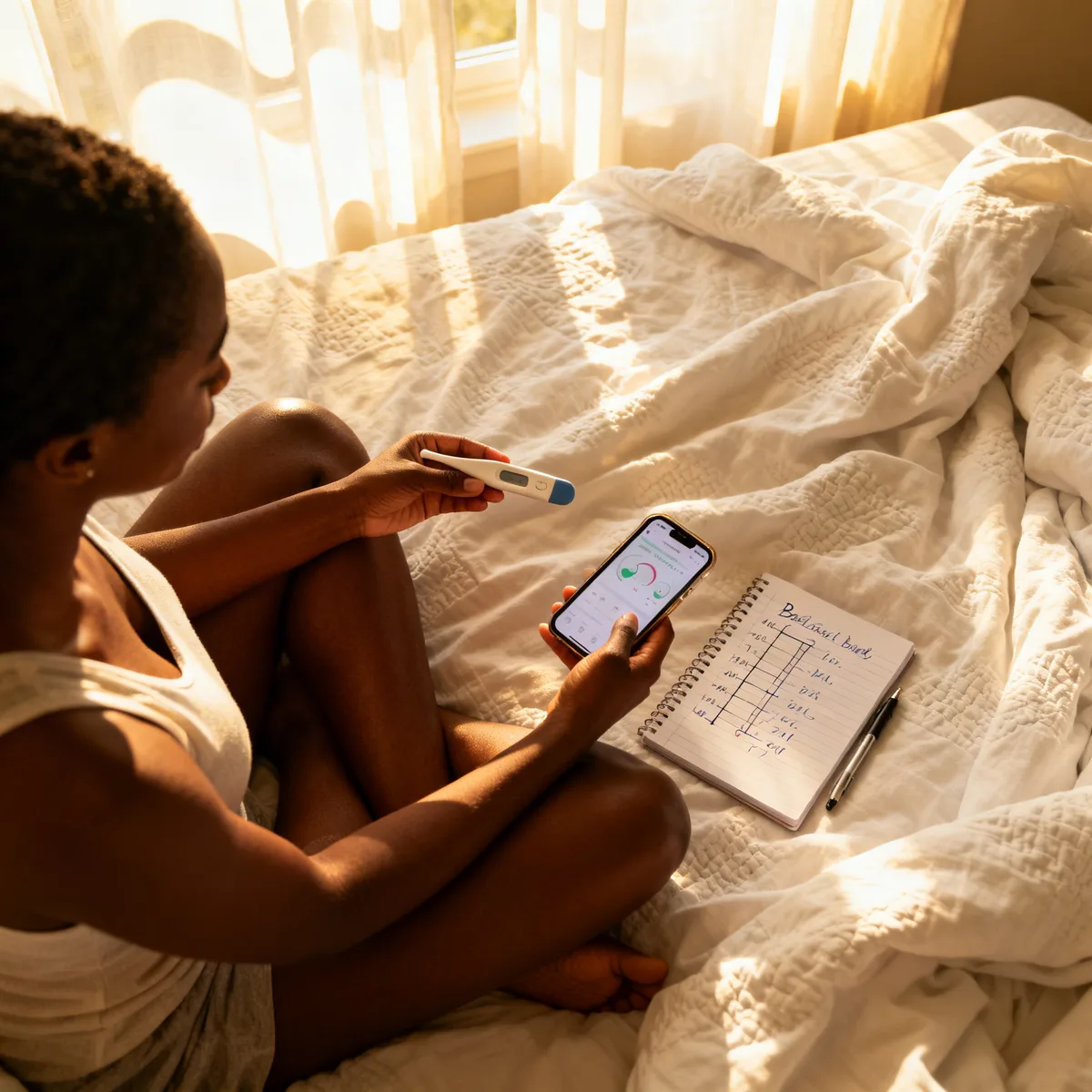
Basal body temperature (BBT) is your body’s resting temperature, measured first thing in the morning before you get up, eat, drink, or speak.
After ovulation, progesterone causes a small but consistent rise in BBT — typically 0.2°C to 0.5°C (about 0.4°F to 1°F). That shift, sustained over at least three consecutive days, confirms that ovulation has already occurred.
This is an important distinction. BBT tells you that ovulation happened — not that it’s about to. Used alone, it doesn’t predict your fertile window in advance. Used alongside cervical mucus data, it helps you build a clearer picture of your cycle over time.

To track accurately, you need a basal body thermometer, which measures to two decimal places. A standard household thermometer isn’t precise enough. Take your reading at the same time each morning, after at least three to four hours of uninterrupted sleep.
Record your temperature daily, even on days the number looks unremarkable. A single elevated reading doesn’t signal a shift — you’re looking for a sustained pattern. Apps designed for fertility charting can visualize this for you, but a paper chart works just as well.
Sleep disruption, illness, alcohol, and time-zone changes can all affect your reading. Note these variables in your log so you don’t misread an outlier as a genuine temperature shift.
The AAP recommends that anyone planning a pregnancy discuss fertility awareness methods with their healthcare provider to ensure the approach fits their individual health context.
Over two to three cycles, your chart starts to show where your temperature rise typically falls — which is where the method earns its value. Some of the most recognizable signs of ovulation, like the fertile mucus window, will consistently appear just before that shift, helping you anticipate timing rather than simply confirm it after the fact.
Your body doesn’t stay quiet around ovulation. Several physical signs of ovulation show up reliably enough that, once you know what to look for, they’re hard to miss.
The most well-documented is mittelschmerz — a German word meaning “middle pain.” It’s a mild, one-sided pelvic ache or twinge that occurs when the dominant follicle releases its egg. It typically lasts anywhere from a few minutes to a day or two.
Breast tenderness is another common signal. Rising estrogen and luteinizing hormone (LH) in the days around ovulation can make breast tissue feel fuller or more sensitive than usual. If you’re already wearing a supportive nursing bra while breastfeeding, this cyclical tenderness — distinct from nursing-related soreness — can help you track where you are in your cycle.
Bloating around ovulation is also common. Hormonal shifts affect how your body retains fluid, and mild abdominal puffiness in the days surrounding your fertile window is a normal response to that fluctuation.
Many people also notice a distinct uptick in energy or mood around ovulation. This isn’t coincidental. Estrogen peaks just before ovulation and has documented effects on mood regulation and physical drive.
The AAP recommends that individuals tracking their cycles for reproductive planning learn to distinguish normal mid-cycle sensations from symptoms that warrant medical attention — such as severe unilateral pain, which can occasionally signal conditions like ovarian cysts or ectopic implantation.
None of these physical signals confirm ovulation on their own. But taken together, they build a pattern. The more cycles you observe, the more clearly that pattern emerges.
Beyond the physical markers, some people notice subtler shifts in the days surrounding ovulation — ones that are easy to dismiss but worth paying attention to.
A heightened sense of smell is one of the more well-documented secondary cues. Research published in Hormones and Behavior found that olfactory sensitivity tends to peak around mid-cycle, likely linked to rising estrogen levels.
Increased libido is another pattern many people report. This isn’t coincidental — the surge in luteinizing hormone (LH) and estrogen that drives ovulation also influences the neurological pathways associated with sexual motivation.
Skin changes can occur too. Some people notice their complexion looks clearer or has a subtle glow in the days leading up to ovulation, while others experience minor breakouts as hormone levels shift. Both responses are considered normal variations.
Mood and energy levels may also fluctuate. The NIH notes that estrogen has a measurable effect on serotonin activity, which may explain why some people feel more sociable, energetic, or mentally sharp during the follicular and ovulatory phases.
These secondary signs of ovulation are not universal. Not everyone notices them, and their intensity can vary cycle to cycle depending on stress, sleep, nutrition, and overall hormonal health.
It’s also worth noting that mood shifts don’t always trend positive. If you find anxiety or low mood clustering at certain points in your cycle consistently, that’s worth discussing with your provider — mood changes tied to hormonal fluctuations are real and well-studied. The postpartum anxiety symptoms space deals with related hormonal mood dynamics, and the underlying mechanisms have overlap.
Tracking these secondary cues alongside primary markers — basal body temperature, cervical mucus, LH testing — gives you a fuller picture over time.

Ovulation predictor kits (OPKs) detect the luteinizing hormone (LH) surge that triggers ovulation. That surge typically occurs 24 to 36 hours before an egg is released, which means a positive OPK gives you a meaningful advance window — not just confirmation after the fact.
Most urine-based OPKs have a clinical accuracy rate of around 97% when used correctly, according to published performance data from kit manufacturers reviewed by the NIH. The operative phrase is “used correctly.”
Timing matters. For a typical 28-day cycle, start testing around day 10 or 11. If your cycle is shorter or longer, subtract 17 days from your average cycle length — that’s roughly when to begin.
Test at the same time each day, ideally between 10am and 2pm, and limit fluid intake for a couple of hours beforehand. Diluted urine can blunt the LH reading and produce a false negative.
OPKs work best as one layer of a broader approach. They confirm a hormone event, but they don’t tell you about the full fertile window — which opens earlier, when cervical mucus becomes clear and stretchy. The AAP recommends that anyone planning a pregnancy discuss cycle tracking methods with their provider, since individual hormone patterns can vary significantly and affect interpretation.
Combining OPK results with signs of ovulation like changes in cervical mucus and basal body temperature gives you data points that cross-reference each other. A temperature rise the morning after a positive OPK, for example, confirms that ovulation likely occurred.
If you’re also navigating early prenatal planning, knowing your cycle timing precisely becomes relevant quickly — your confirmed ovulation date directly informs the gestational dating conversation at your first ob appointment what to expect.
A single cycle gives you a snapshot. Three to six cycles give you a pattern.
The most reliable approach combines at least two methods: logging basal body temperature (BBT) alongside cervical mucus observations, OPK results, or both. The CDC recommends tracking for several months before drawing conclusions, because individual cycle length and ovulation timing vary — even in people with regular periods.
For BBT tracking, consistency matters more than precision. Take your temperature at the same time every morning before getting out of bed, using a thermometer accurate to two decimal places. Log the number immediately — memory isn’t reliable enough for a 0.2°F shift.
Cervical mucus follows a predictable progression: dry or sticky in the days after your period, becoming creamier mid-cycle, then clear and stretchy — often described as raw egg white — in the days leading up to ovulation. That egg-white texture is one of the most consistent signs of ovulation your body produces.
For logging, apps like Clue, Flo, and Natural Cycles allow you to enter BBT, mucus quality, and OPK results in one place. Their algorithms identify patterns across cycles and estimate your fertile window based on your own data — not a generic 28-day model.
A paper chart works equally well if you prefer it. A simple grid with dates across the top and data categories down the side gives you a visual map that’s easy to review across months.
The goal is to find your personal baseline: when your temperature typically rises, how many days before that your mucus peaks, and whether your cycle length is consistent. That baseline is what makes future predictions accurate.
Once you have three or more charted cycles, patterns become clear enough to anticipate your next fertile window — rather than react to it in the moment.
Sperm can survive up to five days in the reproductive tract, so you can become pregnant if you have intercourse up to five days before ovulation occurs. Combined with the day of ovulation itself, your fertile window spans approximately six days total each cycle.
Yes. Hormonal fluctuations, stress, medications, and certain health conditions can trigger ovulation-like symptoms — cervical mucus changes, breast tenderness, or pelvic sensations — without a mature egg actually being released. This is why tracking multiple signs over several cycles (rather than relying on one symptom) gives you a clearer picture.
Basal body temperature shift is one of the most objective markers because it reflects the physiological change that occurs after ovulation (a rise in progesterone). However, it confirms ovulation after it’s already happened. Cervical mucus changes and LH surge detection are better for predicting ovulation in advance so you can time intercourse strategically.
Your fertile window lasts approximately six days: the five days leading up to ovulation plus the day ovulation occurs. The egg itself survives only 12 to 24 hours, but sperm longevity is what extends this window backward.
No. While cervical mucus changes and basal body temperature shifts are nearly universal, secondary signs like mittelschmerz, breast tenderness, or mood changes vary widely. Some people notice them strongly; others don’t notice them at all. This is why tracking your personal patterns across multiple cycles matters more than comparing your experience to anyone else’s.