

Feeding Guides
Baby-Led Weaning: Your Complete Beginner’s Guide to Self-Feeding
Laeeka Edries·14 min read

Not all organic baby snacks are created equal. Here’s what sets Korean brand Naeiae apart from US brands — and why the ingredient list tells the real story.
Here’s something most snack labels won’t tell you: “organic” doesn’t automatically mean simple. A snack can be certified organic and still contain 22 ingredients, three types of added sugar, and enough sodium to make a dietitian wince. The organic baby snack aisle has a marketing problem — and once you see it, you can’t unsee it. This article breaks down what actually separates a genuinely clean snack from one that’s just wearing the right buzzwords, and why Korean baby snack brand Naeiae keeps coming up when parents start asking harder questions about what’s going in the puff.
Walk down any baby snack aisle — physical or digital — and you’ll find “organic” stamped on roughly 80% of the options. It’s become the floor, not the ceiling. USDA organic certification means the ingredients were grown without synthetic pesticides or fertilizers. That’s genuinely good. But it says nothing about how many ingredients there are, whether sugar is hiding under six different names, or whether the texture and format of the snack actually makes sense for a baby’s oral development stage.
The CDC’s dietary guidelines for children under two explicitly recommend avoiding added sugars entirely — not limiting them, avoiding them. Yet a scan of popular American organic baby snacks reveals that added sugar (often listed as brown rice syrup, cane juice, or tapioca syrup) makes regular appearances even in products marketed for 6-month-olds. Organic sugar is still sugar. And for babies whose taste preferences are being formed right now, every ingredient on that list is doing something.
Korean baby food culture operates from a different starting assumption. Where American snack brands often work backwards from palatability — make it taste great, then figure out how to make it look healthy — Korean brands like Naeiae tend to start with a much shorter ingredient list and build from there. The cultural emphasis on jeong-sik (roughly translated: wholesome, proper food from the beginning) means the baseline expectation for what goes into a baby’s mouth is just different.
This isn’t romanticizing a culture. It’s a pattern you can verify yourself. Flip over a Naeiae snack and count the ingredients. Then flip over a leading American organic puff. The difference in list length is usually immediate and obvious. Shorter isn’t always better — but when you’re feeding a 9-month-old, fewer unfamiliar compounds is generally a reasonable goal.
Let’s be specific, because vague comparisons don’t actually help you make better choices at checkout.
A typical popular American organic baby puff might contain: organic corn flour, organic cane sugar, organic sunflower oil, organic tapioca starch, sea salt, natural flavors, plus a handful of vitamin fortifications. That’s not terrible. But “natural flavors” is a catch-all term that covers hundreds of possible compounds — the FDA allows manufacturers to use it without disclosing what those flavors actually are, as long as they’re derived from a natural source. For parents trying to manage early allergen exposure or sensitivities, that ambiguity matters.
Naeiae snacks — like their rice-based puffs — typically list recognizable single-ingredient components: organic rice, sweet potato, carrot. Sometimes a vegetable powder. That’s often the full list. No natural flavors. No added sugar. No sodium. The flavor comes from the ingredient itself. It sounds obvious when you say it out loud, but it’s genuinely rare in the category.
Snack choice isn’t just an ingredient conversation. It’s also a developmental one. The American Academy of Pediatrics recommends introducing a variety of textures progressively during the 6–12 month window to support oral motor skill development — and the format of a snack (how it dissolves, how it requires the gums to work) is part of that developmental picture.

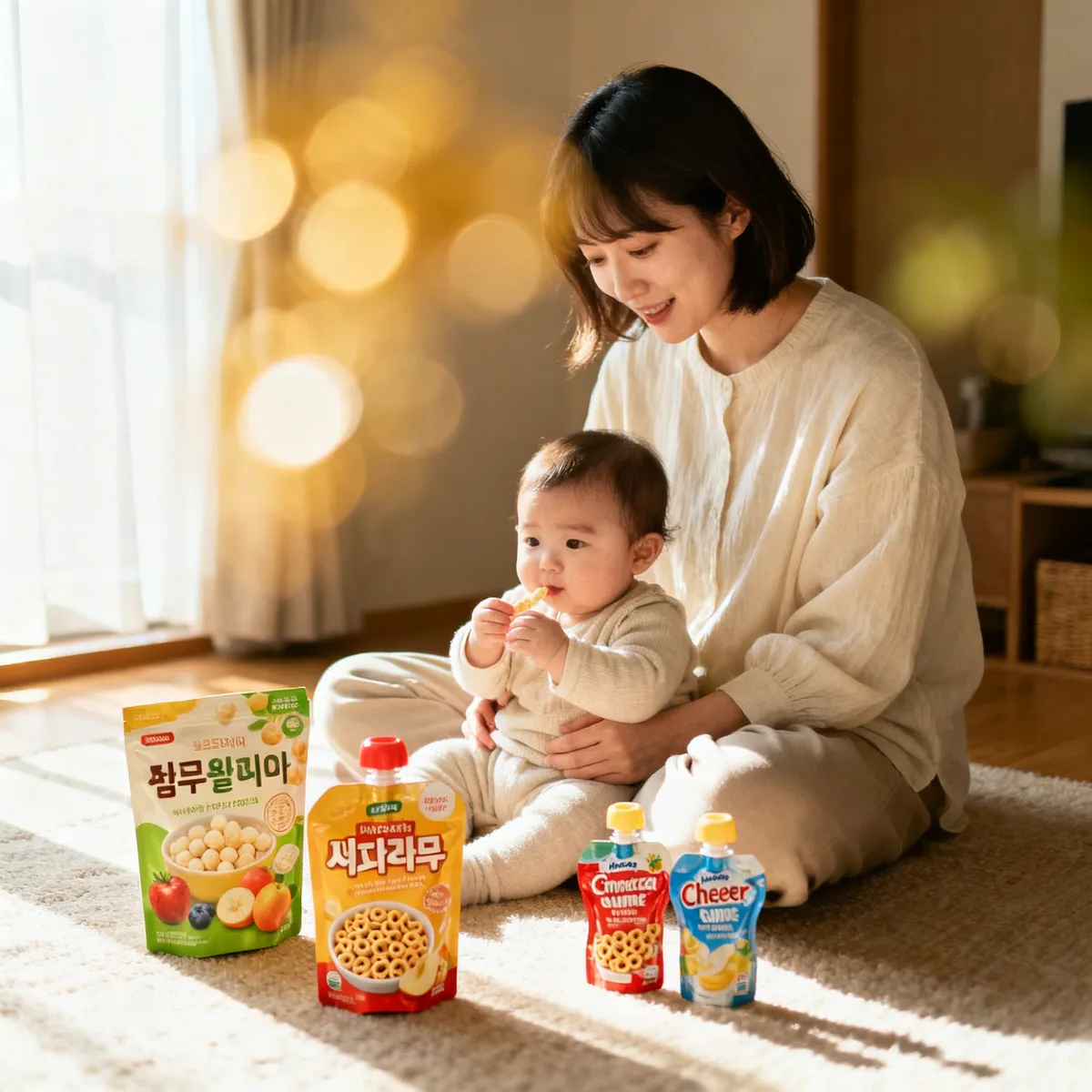
Many American puff snacks are engineered to dissolve extremely quickly, which reduces choking risk but also reduces the oral motor challenge. That’s a reasonable trade-off for early eaters. But Naeiae’s rice-based formats are designed with a dissolve rate that’s fast enough to be safe while still giving developing gums something to work against. It’s a small distinction that compounds over hundreds of snack sessions as babies are learning what food feels like. If you’re at this stage, the Naeiae snack range available at Onzenna is worth a look — ingredient lists short enough to read in five seconds, formats genuinely appropriate for babies just getting into finger foods.
Here’s the uncomfortable truth: babies find sweet things easier to accept than savory ones. It’s biological — amniotic fluid is slightly sweet, breast milk is sweet, so sweet = safe is a hardwired infant association. Snack brands know this. Which is why even products marketed as “no added sugar” sometimes contain ingredients like fruit puree concentrate or rice syrup solids that function identically to added sugar in the body, just without technically triggering the label.
The CDC recommends that children under 2 avoid added sugars entirely because early sugar exposure shapes taste preference in ways that echo into toddlerhood and beyond. A baby who is consistently offered low-sugar, savory-forward snacks in the first year is statistically more likely to accept a wider variety of foods later. This isn’t about being strict — it’s about not accidentally narrowing your future options by defaulting to whatever’s sweetest.
Naeiae’s savory rice puffs are one of the cleaner examples of what low-sugar snacking for babies can actually look like in practice. Not rice cakes dipped in sweetener. Just rice, done well.
You don’t need a nutrition degree. You need a few reliable checkpoints.
No. That’s not the point. There are American brands doing genuinely clean, short-ingredient snacks. And there are Korean brands that are just as processed as anything on a US shelf. The point is that Naeiae represents a philosophy — not a geography — and that philosophy happens to produce snacks that score well across every checkpoint that actually matters: ingredient simplicity, no added sugar, developmentally appropriate texture, and transparency on the label.

The reason Korean baby snack brands like Naeiae are getting attention from parents right now isn’t trend-chasing. It’s that they’re clearing a bar that a lot of the American market is still talking around. When you strip the marketing language away and just look at what’s actually in the bag, the difference is usually right there in the ingredient list.
Centers for Disease Control and Prevention — Dietary guidelines on added sugar avoidance for children under 2 (cdc.gov)
American Academy of Pediatrics — Guidance on texture progression, sodium intake, and feeding development in infants (aap.org)
Most finger food snacks are appropriate from around 6–8 months, once a baby has started solids and can sit with minimal support. Always check the specific age recommendation on the package and make sure the snack dissolves easily with minimal gum pressure — babies this age have no molars and rely entirely on their gums to manage texture.
Yes. Naeiae snacks are available through Onzenna, which ships Korean baby products to customers in the US. You don’t need to import anything or navigate international shipping.
The most consistent difference is ingredient list length and the presence of added sugar. Many Korean baby snack brands, including Naeiae, focus on single-ingredient or minimal-ingredient formats with no added sugar or sodium. American organic snacks often include more ingredients, added sweeteners, and catch-all terms like “natural flavors” that reduce label transparency.
Organic certification matters for reducing pesticide exposure, which is a legitimate concern for babies whose detox systems are still developing. But organic alone doesn’t guarantee a short ingredient list or the absence of added sugar. The better question to ask is: how many ingredients are in this, and can I recognize all of them? Price should follow that answer, not the other way around.
Look at two things: the dissolution rate (can it be mashed with gums alone, with no chewing required?) and the size (can it be picked up with a pincer grip, or is it too large to manage safely?). The AAP recommends working through a variety of textures progressively between 6 and 12 months to support oral motor development. When in doubt, do a dissolution test yourself — place the snack in water for 30 seconds and see how it breaks down.
Korean baby snacks like Naeiae typically focus on simple, single-ingredient formulations with minimal processing. American brands often include more additives, preservatives, and flavor enhancers. Naeiae products emphasize natural ingredients sourced from Korean farming practices, whereas many American snacks prioritize shelf stability and convenience packaging.
Both can be safe when they meet their respective country’s food safety standards. However, Naeiae undergoes Korean food safety regulations, which have strict requirements for baby foods. American organic brands must meet FDA standards. The difference lies in ingredient philosophy rather than safety—Naeiae simply uses fewer ingredients overall, which some parents prefer for reducing allergen exposure.
Korean baby snacks like Naeiae are often more expensive due to import costs, smaller production runs, and premium sourcing practices. American brands benefit from larger domestic markets and established supply chains, making them more affordable. The price difference doesn’t necessarily reflect quality, but rather market availability and distribution efficiency.
Naeiae products are generally simpler than American alternatives, which can be beneficial for allergic babies. However, always check the ingredient list and allergen warnings on specific products. Korean snacks may contain different allergens than American brands, so review packaging carefully. Consult your pediatrician before introducing any new snack, especially if your child has known allergies.