


Trying to Conceive
Signs of Ovulation: What Your Body Is Telling You During Your Fertile Window
Jeehoo Jeon·14 min read

Learn the most reliable fertile window symptoms—cervical mucus, basal body temperature, LH surge—to identify your peak fertility days and time conception.
Here’s what nobody tells you clearly: you’re only fertile for about six days each cycle — the five days before ovulation plus ovulation day itself. Most people think it’s longer, or that it always happens on day 14, or that they’ll just know when it happens. None of those assumptions are reliable.
Your body actually signals when your fertile window is opening. These fertile window symptoms — cervical mucus changes, temperature shifts, subtle cramping — are driven by hormone surges that trigger ovulation.
Learning to recognize them isn’t about turning conception into a clinical experiment. It’s about understanding your own body so you can time intercourse with confidence instead of guessing.
This guide covers the most reliable signs to track, how to spot them, and the myths that trip people up most often.
Here’s something nobody really tells you: you’re only actually able to conceive for a small slice of your cycle. About six days total — the five days before ovulation and the day of ovulation itself.
That window exists because sperm can survive inside the body for up to five days, but a released egg only lives for 12 to 24 hours. Miss that overlap, and you’re waiting another month.
So timing matters. A lot.
The thing is, your body actually signals when that window is opening. Those signals are what we call fertile window symptoms — physical changes driven by the hormone surge that triggers ovulation.
Learning to read them isn’t about turning conception into a science project. It’s about understanding your own body so you’re not just guessing.
The WHO notes that folic acid supplementation before conception significantly reduces the risk of neural tube defects in early pregnancy — which is a good reminder that preparing your body starts before you ever get a positive test. If you haven’t looked into this yet, our guide on prenatal vitamins is worth a read.
The more you know your cycle, the more confidence you bring to the process. And honestly? That confidence matters too.
Your fertile window doesn’t look the same for everyone. Cycle length varies.
Ovulation timing shifts. Stress, sleep, illness — they all play a role.
That’s why tracking symptoms is more useful than relying on a standard calendar count alone.
Your body is talking. This is about learning how to listen.
Here’s the thing nobody tells you clearly: your body gives you real, physical signals around ovulation. You just have to know what you’re looking for.
Cervical mucus is your most visible clue. As you approach peak fertility, it changes — from dry or sticky to wet, clear, and stretchy.
Think raw egg white. That texture means conditions are right for sperm to survive and travel.
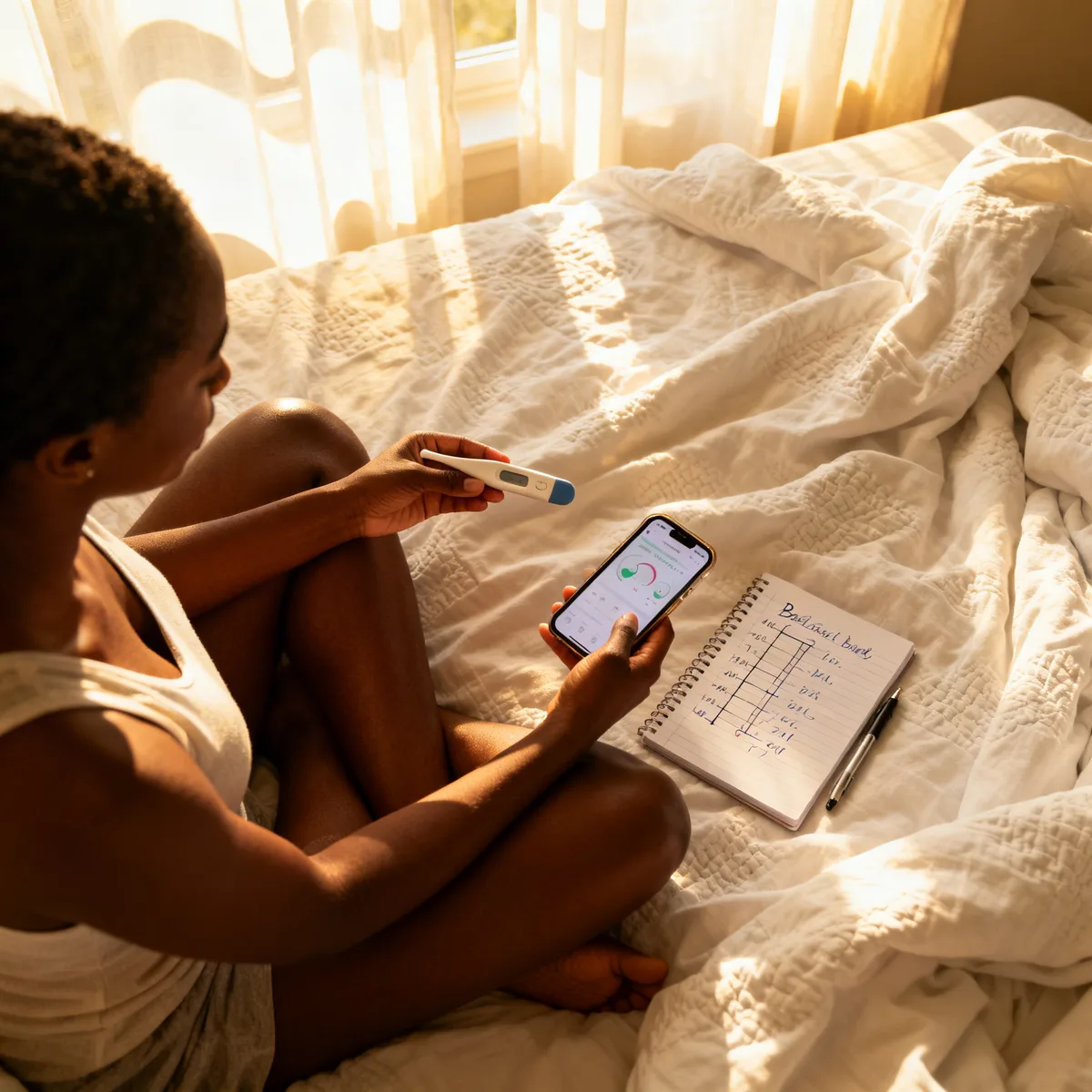
Basal body temperature (BBT) is subtler but just as useful. Your resting temperature rises slightly — usually 0.2 to 0.5°C — after ovulation.
You need to take it first thing in the morning, before you move or talk. Over a few cycles, the pattern becomes readable.
Then there’s the LH surge. Luteinizing hormone spikes in the 24 to 36 hours before ovulation.
This is what at-home ovulation tests pick up. A positive result means ovulation is close — not that it’s already happened.
Some women also notice one-sided pelvic aching, called mittelschmerz, right around ovulation. It’s not universal, but if you feel it, it’s worth noting in your tracking.
Tracking these fertile window symptoms together gives you a much clearer picture than any single sign alone. The WHO recommends using multiple fertility awareness indicators — including temperature, cervical mucus, and cycle timing — for more accurate ovulation identification.
None of this requires expensive equipment. A simple basal thermometer, a notes app, and a bit of consistency go a long way.
And if you’re already thinking ahead to pregnancy and what comes after — from newborn feeding cues to postpartum recovery — getting this foundation right is the first step in feeling prepared, not just hopeful.
Nobody really warned me about this one. And honestly, it’s the signal most worth paying attention to.
Throughout your cycle, the mucus your cervix produces changes in texture, colour, and volume. Right after your period, things tend to feel dry — little to nothing showing up. Then it shifts.
A few days before ovulation, you’ll notice more discharge. It starts cloudy or creamy, almost like lotion. Then it changes again — and this is the part to watch for.

At your most fertile, it becomes clear, slippery, and stretchy. It looks and feels almost exactly like raw egg white.
You can stretch it between your fingers and it holds. That’s the signal.
That’s your body telling you ovulation is close or happening now.
This egg-white mucus is one of the most reliable fertile window symptoms you can observe without any equipment at all. It creates the ideal environment for sperm to survive and travel — without it, that journey gets a lot harder.
After ovulation, mucus thickens and decreases again. That shift is another data point. If you’ve been tracking for a cycle or two, you start recognising your own pattern — and it stops feeling confusing.
To check, just wipe with clean toilet paper before using the bathroom, or use a clean finger. You’re looking at the consistency, not just the amount. Stretchy and clear wins every time.
The WHO recommends using cervical mucus observation alongside other fertility indicators — like basal body temperature — because combining signals gives you a fuller picture than any single sign alone.
This takes practice. Your first cycle of tracking might feel uncertain. By your third, you’ll know your body in a way you didn’t before — and that knowledge is worth having, wherever you are in your journey toward pregnancy.
Here’s the thing nobody warns you about: your body is doing a lot more than you can see. Once you start paying attention, it almost feels like it’s been trying to tell you something all along.
Basal body temperature — your resting temp, taken first thing in the morning before you move or speak — shifts after ovulation. You’re looking for a sustained rise of about 0.2°C that holds for at least three days. That rise tells you ovulation has already happened.
So BBT confirms the event. It doesn’t predict it. That’s the part that trips people up at first.
What BBT does beautifully is show you your pattern over time. After two or three cycles of consistent tracking, you’ll start to see when your temperature typically rises — and that helps you anticipate your fertile window symptoms in future months, not just confirm them after the fact.
Beyond temperature, there are subtler signals worth noticing. Breast tenderness around ovulation is real.
It’s not your imagination and it’s not PMS (that comes later). It’s estrogen doing its job, and it often shows up earlier than people expect.
Mild cramping — sometimes called mittelschmerz — can happen on one side of your lower abdomen right around ovulation. It doesn’t last long. Some women feel it every cycle; others rarely notice it at all.
Pelvic heaviness or a low, dull pressure is another one. Quiet, easy to dismiss, but there.
None of these signs work perfectly on their own. But layered together — temperature, mucus, tenderness, sensation — they start to form a picture that actually makes sense.
Your body has been running this cycle your whole life. You’re just learning to read it now.
And if you eventually need that knowledge for prenatal care, knowing your cycle well is genuinely useful groundwork — MedlinePlus notes that early and regular prenatal care supports better outcomes for both you and your baby (medlineplus.gov/prenatalcare.html).
Here’s the thing about OPKs — they feel overwhelming until they suddenly don’t. Once you understand what they’re actually measuring, it all clicks.
Luteinizing hormone (LH) is always present in your body at low levels. But in the 24–36 hours before ovulation, it surges. That surge is your body’s signal to release an egg.
An ovulation predictor kit detects that surge in your urine. A positive result — usually a test line as dark or darker than the control — means ovulation is likely coming within the next day or two.
This is where timing really matters. Your most fertile window is the day of your LH surge and the day after. Having sex during those two days gives you the best shot.
Start testing a few days before you’d expect to ovulate. For a 28-day cycle, that’s usually around day 10 or 11. Test at the same time each day — afternoon tends to catch the surge more reliably than first thing in the morning.
One thing worth knowing: the WHO recommends folic acid supplementation before and during early pregnancy to support healthy fetal development. If you’re actively tracking your LH surge and trying to conceive, now’s the time to have that in place.
OPKs are especially useful if your fertile window symptoms feel subtle or inconsistent. Not everyone notices clear physical signs. The kit gives you a concrete data point when your body isn’t giving you obvious cues.
They’re not perfect — some conditions like PCOS can cause multiple LH surges without ovulation following. But for most people, they’re one of the most reliable tools you have. Use them alongside what your body is telling you, not instead of it.

Let’s get this one out of the way first: ovulation does not happen on day 14 for everyone. That number comes from a textbook 28-day cycle — and most people don’t live in a textbook.
Your cycle length shapes when you ovulate. If your cycle runs 35 days, you might ovulate closer to day 21.
If it’s 24 days, it could be day 10. The math changes.
The myth doesn’t account for that.
Cycle irregularity also gets misunderstood. Irregular doesn’t mean broken.
It means your fertile window shifts — sometimes from month to month. That’s why tracking fertile window symptoms over several cycles matters more than watching the calendar.
Here’s one that doesn’t get talked about enough: stress genuinely messes with ovulation. Not in a vague, “just relax and it’ll happen” way — in a real, hormonal way. High cortisol can delay or even suppress ovulation entirely, which means your usual signs might show up later than expected, or feel muted.
If you’ve been in a stressful season and your cycle feels off, that’s probably why. It’s not in your head.
The WHO recognises that irregular menstrual cycles and ovulatory disorders are among the leading contributors to female infertility worldwide — which tells you this is far more common than the day-14 myth would have you believe.
One more thing: missing your fertile window symptoms one month doesn’t mean you ovulated without signs. It might mean stress, illness, travel, or poor sleep blunted them. Your body is responsive to everything happening around it.
So if the signs feel inconsistent, that’s useful information. It’s your body telling you something shifted — not that you’re doing it wrong.
Here’s the part that surprises a lot of people: your fertile window isn’t just the day you ovulate. It’s actually up to five days long — and that’s genuinely good news.
Sperm can survive inside your body for up to five days. That means having sex in the days before ovulation isn’t wasted effort — it might be exactly the right move.
The egg itself only lives for 12 to 24 hours after it’s released. So the real strategy isn’t hitting one precise moment. It’s making sure sperm are already there, waiting, when ovulation happens.
Most people find the highest-chance days are the two or three days just before ovulation — and the day ovulation actually occurs. That’s your sweet spot.
You don’t need to track fertile window symptoms obsessively to time this well. But if you’re noticing cervical mucus changes or a slight shift in temperature, those signs are your body giving you a heads-up that the window is opening.
The WHO recommends at least 150 minutes of moderate physical activity per week for overall reproductive health — worth knowing, because how you’re living in the days around ovulation matters too, not just the timing of sex.
One practical thing: every other day during your fertile window tends to work well for most people. It keeps sperm count healthy without the pressure of daily scheduling.
And if you’re already thinking past conception to what comes next — good prenatal care starts earlier than most people realise. MedlinePlus notes that prenatal care should ideally begin before you’re even pregnant, so it’s never too soon to start thinking about it.
You don’t need perfect timing. You need a window — and now you know exactly how wide it is.
Watch your cervical mucus and take your basal body temperature first thing each morning with a dedicated thermometer. Cervical mucus becomes clear, wet, and stretchy (like egg white) as you approach ovulation — that’s your signal. BBT rises slightly after ovulation, confirming the window has passed.
Yes. Hormonal imbalances, thyroid issues, and polycystic ovary syndrome (PCOS) can trigger cervical mucus changes or even positive ovulation tests without actual ovulation occurring. This is why tracking multiple symptoms together — not relying on one sign — matters.
Ovulation symptoms refer to signs happening right at the moment of release (like mittelschmerz or a temperature spike after). Fertile window symptoms include the broader hormonal changes throughout the days leading up to ovulation, when conception is actually possible.
Ovulation predictor kits (which detect LH surge) are about 99% accurate at confirming the surge is happening. Cervical mucus tracking and BBT are reliable when charted correctly over multiple cycles, but less precise on a single day. Using both methods together gives you the strongest picture.
Some women experience mittelschmerz — a sharp, one-sided pelvic ache right around ovulation. It’s real but not universal; only about 20% of people notice it.
If you feel it, note which side and when. However, don’t rely on pain alone to confirm you’re fertile, since cramping can happen without ovulation.