


Baby Safety
Flying with a Toddler: Airplane Activities and Survival Tips (Tested by Real Parents)
Jeehoo Jeon·12 min read

Drowning prevention guide for babies and toddlers. Learn age-appropriate water safety, bath temperature, pool supervision, and silent drowning signs — practical protection at every stage.
When it comes to baby water safety, drowning is the leading cause of accidental death for children ages 1 to 4 — and it happens in seconds, often silently, in water as shallow as two inches.
What makes baby water safety uniquely urgent is not parental anxiety but physiology: infants have disproportionately large heads, weak neck muscles, and no ability to right themselves if they tip forward. Toddlers gain mobility before they gain judgment.
This guide covers age-specific water hazards and protection strategies — from bath time temperature to pool barriers to recognizing silent drowning — so you can understand where the real risk lives and what actually protects.
Drowning is the leading cause of accidental death in children ages 1 to 4 in the United States, according to the CDC. It is not a risk that scales with recklessness — it happens fast, and it happens quietly.
Infants and toddlers are physiologically vulnerable in ways that make water uniquely dangerous. They have large heads relative to their body weight, weak neck muscles, and limited ability to right themselves if they tip forward.
The AAP recommends that children be enrolled in swim lessons starting at age 1, noting that swimming instruction is associated with a significantly reduced risk of drowning in young children. That guidance reflects decades of injury prevention research, not caution for its own sake.
The numbers make the case clearly. The CDC reports that for every child who dies from drowning, another five receive emergency care for nonfatal submersion injuries — many of which result in lasting neurological damage.
Age changes the picture, but it doesn’t eliminate the risk. Infants can drown in as little as one to two inches of water. Toddlers gain mobility before they gain judgment. Preschoolers often overestimate their own abilities in the water.
Baby water safety is also inseparable from the broader question of home hazard awareness. If you’re working through your home environment systematically, the baby proofing checklist covers water hazards room by room alongside other key risk areas.
Understanding where the danger actually comes from — and when your child is most vulnerable — is where meaningful protection starts.
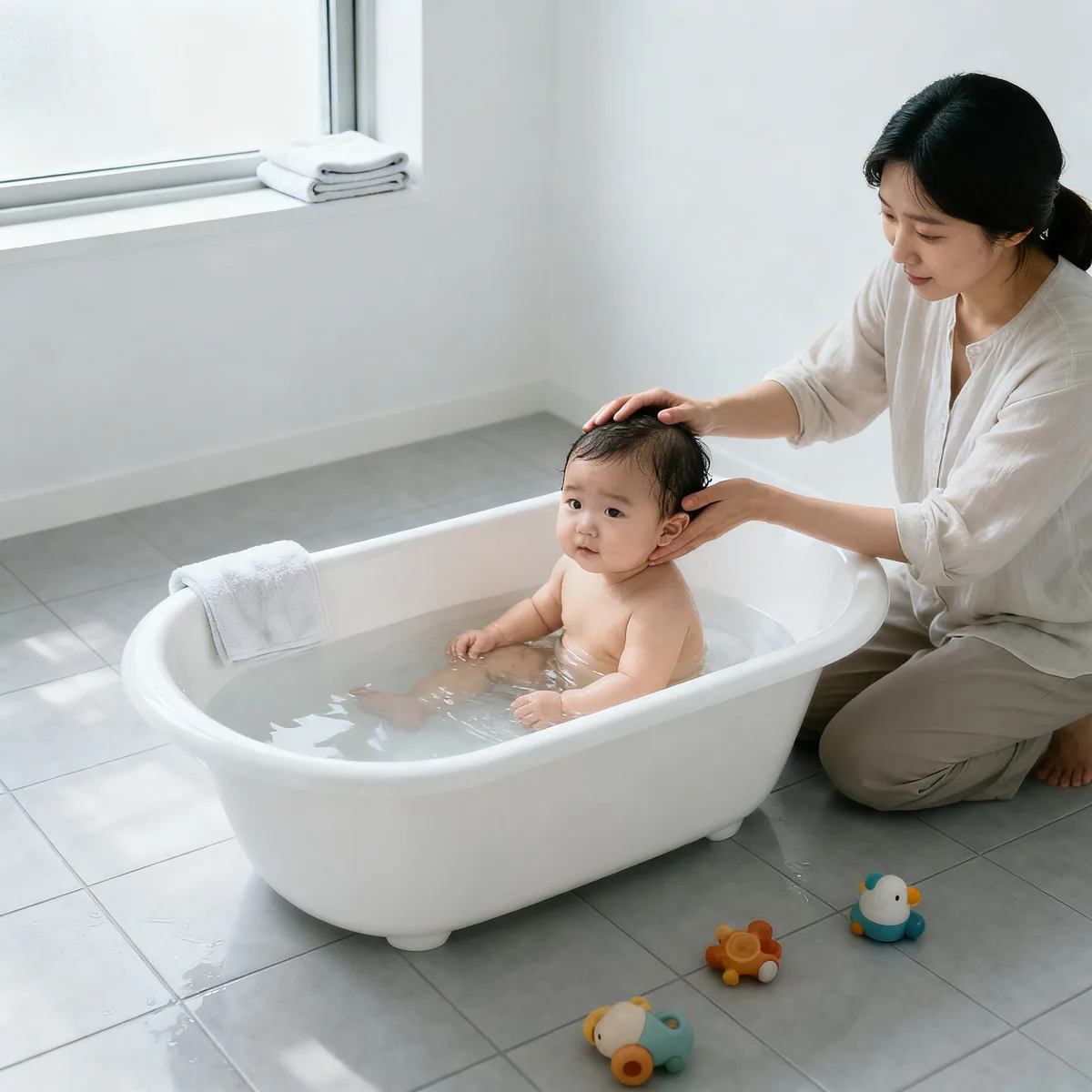
Newborns don’t need a full tub. Until the umbilical cord stump falls off — typically within one to three weeks — sponge baths are the right approach.
Once you do move to water immersion, depth matters more than most people expect. Two to three inches is sufficient for an infant. Deeper water increases risk without adding any benefit.
Temperature should sit between 98°F and 100°F (36.7°C–37.8°C). Test with your elbow or wrist, not your hand — those areas are more sensitive to heat. bath thermometer
The AAP recommends that an adult maintain constant, within-arm’s-reach supervision any time an infant is near water — including during bath time. A ringing phone or a knock at the door is not a reason to step away.
Infant drowning can occur in very shallow water, very quickly, and without sound. That’s not alarmism — it’s the physiological reality of a baby’s limited head control and inability to self-rescue.
Around six months, most babies have enough head and trunk control to transition to a supported seated position in a baby tub. This is a developmental shift, not a calendar milestone — follow your baby’s physical readiness, not a fixed date.
Bath seats and ring inserts are not safety devices. They are positioning aids. Leaving a baby unattended in one — even briefly — is not safe.
Bath time is also a natural window for sensory exploration. If you want to make it more intentional as your baby grows, baby sensory activities offers age-specific ideas that pair well with water play in a supervised setting.
Keep the routine simple, warm, and consistent. That consistency itself becomes part of what makes bath time feel safe — for both of you.
Toddlers move fast. The same developmental leap that has your child climbing the couch also makes water more dangerous — not less.
Drowning can happen in as little as one to two inches of water. A toddler who can walk confidently can still lose their footing in a wet tub in seconds.
The AAP recommends that an adult remain within arm’s reach of toddlers during any water activity — not across the room, not watching from the doorway. That standard applies to the bathtub, the backyard pool, and any container holding standing water.

This age group is also the most likely to act on water curiosity without understanding consequence. Toddlers don’t recognize depth or danger. They see water and move toward it.
A few practical measures make a real difference. A non-slip bath mat reduces the most common cause of tub injuries — falling. A spout cover protects against head impact. Draining the tub immediately after bath time removes the hazard before you move on to the next part of your routine.
If your toddler is developing the coordination and confidence that often comes with this stage, you may already be watching their physical abilities expand quickly. Understanding fine motor skills activities baby development follows can also help you anticipate what they’re capable of reaching, grabbing, or climbing next — including near water.
Baby water safety at this stage is less about products and more about presence. No bath seat, no flotation device, and no locked position replaces an adult who is focused and within reach.
When bath time ends, the supervision doesn’t stop. Toilet lids, pet water bowls, and buckets left outside all carry real risk for this age group. The rule stays the same wherever there is water.
Water safety outside the home works in layers. No single measure is enough on its own.
The first layer is physical barriers. A four-sided fence — isolating the pool from the house and yard — with a self-closing, self-latching gate is the most effective structural protection available. The AAP recommends four-sided pool fencing that completely surrounds the pool as the single most effective barrier for preventing childhood drowning.
Door and pool alarms add a second layer. They don’t replace fencing, but they close gaps — an unlatched gate, a door left open after a distracted moment.
Flotation devices are widely misunderstood. Puddle jumpers and inflatable arm floaties are not Coast Guard-approved life jackets and are not designed for unsupervised use. For infants and toddlers in or near open water, a properly fitted US Coast Guard-approved Type II or Type III personal flotation device is the appropriate choice.
Developmental stage matters here. Infants have no voluntary control in water. Toddlers are fast, fearless, and quiet — drowning rarely involves splashing or calling for help. Neither age group can self-rescue.
Swim lessons are valuable, but they don’t eliminate risk. The AAP supports swim lessons for most children starting at age one, while noting that no program drowning-proofs a child.
The third layer is supervision — and it has to be active. Designated water watchers, undistracted, within arm’s reach of young children, make the difference when the other layers fail.
CPR readiness belongs in this conversation too. Knowing infant and child CPR before an emergency — not after — is part of what preparedness looks like around water. Just as you’d think through baby choking vs gagging before your child starts solids, water safety responses are worth learning well before pool season starts.
Open water introduces hazards that a controlled pool environment doesn’t. Rip currents, uneven terrain, waves, and unpredictable depth changes all raise the baseline risk — especially for young children.
Rip currents are responsible for the majority of lifeguard rescues at surf beaches. They’re not always visible from shore. Before your child enters the water, check local conditions and look for posted flags or lifeguard advisories.
Salt water ingestion is a real concern for babies and toddlers. Even small amounts can disrupt the sodium balance in developing bodies. Infants are particularly vulnerable because their kidneys aren’t yet efficient at processing excess salt.
The AAP recommends keeping babies under 6 months out of direct sunlight entirely, and applying broad-spectrum SPF 30 or higher sunscreen to infants older than 6 months on all exposed skin before outdoor water time.
Heat compounds everything. Sand reflects UV radiation, and shallow water provides little temperature regulation. Shade, hydration, and time-limited exposure aren’t optional additions — they’re part of the plan.
Baby water safety at the beach starts before you step onto the sand. Pack more sun protection than you think you need, plan your entry and exit points in advance, and identify where the lifeguard stations are.
Water entry readiness matters here too. A child who has had even basic water familiarity — through a structured swim lesson or consistent supervised water play — responds differently to unexpected immersion than one who hasn’t.
Supervision at the beach follows the same principle as any open water: one adult, one child, undivided attention. The noise and activity of a beach environment make distraction a genuine risk. A designated water watcher, not rotating casually between adults, is the standard worth holding.
If your child shows signs of distress after swallowing water — vomiting, lethargy, or unusual irritability — seek medical attention. These can be early indicators of complications that aren’t always obvious in the moment.

The US Coast Guard certifies life jackets for infants and children — and a properly fitted, USCG-approved life jacket is the only flotation device with documented evidence behind it.
Swim vests, puddle jumpers, and inflatable arm bands are not the same thing. The American Academy of Pediatrics is explicit: these are not safety devices. They can give children — and adults watching them — a false sense of security.
Neck rings marketed for infant “water relaxation” carry particular risk. No major pediatric or safety organization endorses them, and the AAP advises against their use entirely.
A correctly fitted life jacket sits snug against your child’s body without riding up over the chin or ears. Fit matters as much as certification. Check the weight range, fasten every clip, and test the fit in shallow water before entering open water.
Supervision aids — pool alarms, wearable alerts, underwater cameras — exist in a wide range on the market. Some add a useful layer of awareness. None replace continuous, in-arm-reach supervision for infants and toddlers.
Baby water safety fundamentally cannot be outsourced to equipment. The CDC notes that drowning can happen in seconds, silently, even in the presence of adults nearby.
Gear is a complement to supervision — never a substitute for it. Whatever you choose to use in the water, the adult within arm’s reach remains the only reliable constant.
The AAP recommends that all parents and caregivers learn infant and child CPR before they need it — not after.
CPR certification courses are available through the American Red Cross and the American Heart Association, many of which offer pediatric-specific modules. Some hospitals provide free or low-cost training for new parents before discharge.
Recognizing a drowning child is harder than most people expect. Contrary to what movies show, a drowning child rarely splashes or calls out.
The mouth sits at or just below the waterline. The head tilts back. The eyes may be glassy or closed. This is what the CDC calls “silent drowning” — and it can occur within seconds, in shallow water, with adults present.
If you pull a child from the water and they are unresponsive and not breathing normally, call 911 immediately and begin CPR. Do not wait for signs of breathing to appear on their own.
Even if a child seems fine after a water incident — coughing, vomiting, or appearing disoriented — seek medical evaluation. Secondary drowning, though rare, involves delayed fluid accumulation in the lungs and can develop hours after the event.
Water safety classes are worth considering early. The AAP supports swim lessons for most children starting at age one, noting that formal instruction is associated with reduced drowning risk in young children.
Look for programs that include water survival skills — floating, rolling to back, treading water — not just stroke technique. Some programs offer infant aquatic education starting at six months, focused on breath control and back-float positioning.
Building your own response readiness matters just as much as teaching your child. Knowing what to do in the first 60 seconds of an emergency is a skill that stays with you.
The AAP recommends swim lessons starting at age 1, but formal water entry depends on your child’s comfort and your supervision readiness, not a hard age cutoff. Newborns can be near water (beaches for air and rest), but active water immersion is safest after a few months of physical development. Always use multi-layer protection: barriers, flotation aids, and constant within-arm’s-reach supervision — regardless of age.
No. Flotation devices are positioning aids only, not safety devices. They can fail, slip, or create a false sense of security that leads to reduced vigilance. The CDC and AAP are clear: constant, hands-on supervision is non-negotiable and cannot be outsourced to equipment. A supervising adult must be within arm’s reach and actively watching at all times.
Bath water should be between 98°F and 100°F (36.7°C–37.8°C). Test the temperature with your elbow or wrist, not your hand — those areas are more heat-sensitive. A dedicated bath thermometer removes guesswork and is inexpensive insurance against accidental burns.
Active drowning is often silent: no splashing, no calls for help. Signs include gasping or irregular breathing, head tilted back, inability to call out, and loss of horizontal body position in the water. After water exit, watch for delayed symptoms (pulmonary edema) over the next 24 hours: difficulty breathing, lethargy, persistent cough, or chest pain. Seek immediate emergency care for any near-drowning incident.
The AAP recommends formal swim lessons starting at age 1, as research shows early instruction significantly reduces drowning risk. That said, water comfort and safety awareness can begin much earlier through supervised water play and modeling calm, cautious behavior around water. Lessons are not a substitute for supervision — they are one layer of a multi-layer protection strategy.