Baby Safety
How to Baby Proof Your Kitchen: A Complete Safety Guide for Crawlers & Toddlers
Jeehoo Jeon·13 min read

Flying with toddler airplane activities that actually work. Age-specific tips, packing lists, screen time guidance, and ear pressure relief tested by real parents.
Here’s what nobody tells you about flying with a toddler: the chaos you’re imagining is actually predictable—and once you understand why airplane cabins are so hard on little bodies and brains, you can plan around it instead of white-knuckling through it.
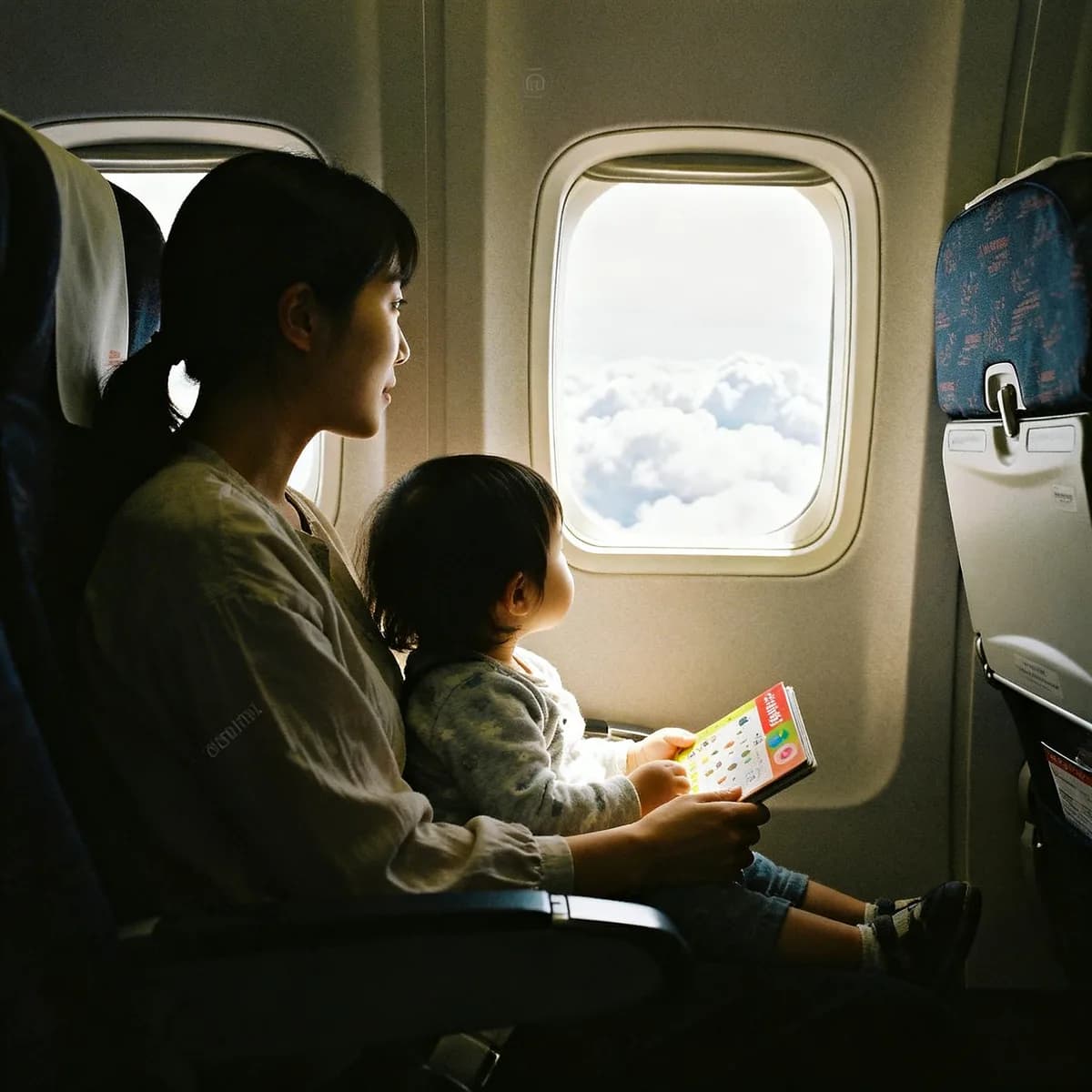
Flying with toddler airplane activities isn’t about keeping them perfectly still for three hours. It’s about matching their developmental stage to the right combination of sensory input, movement breaks, and strategic distraction.
This guide covers exactly what works: age-specific activity lists, packing strategies that actually fit in a carry-on, when screen time makes sense (no guilt), and practical tactics for managing ear pressure, sleep, and the chaotic moments around boarding and landing—tested and refined by real parents who’ve done this more than once.
If you’ve spent weeks dreading an upcoming flight, you’re not alone. The anxiety is real — and it’s not irrational.
Airplane cabins are genuinely difficult environments for children between 12 and 36 months. This is a developmental stage defined by physical movement, sensory exploration, and a nervous system that hasn’t yet learned to self-regulate under stress.
Cabin pressure changes during takeoff and descent are a significant factor. The Eustachian tubes in toddlers are shorter and more horizontal than in adults, which makes pressure equalization harder and slower. The discomfort is real — and your toddler doesn’t have the words to tell you what’s happening.
Then there’s the sensory environment itself. Airplane cabins produce continuous low-frequency noise that the CDC identifies as a potential stressor for young children. Add recycled air, unfamiliar smells, close proximity to strangers, and overhead lighting that doesn’t change — and you have an environment designed for adult tolerance, not toddler comfort.
Movement restriction compounds everything. The American Academy of Pediatrics (AAP) notes that toddlers need frequent physical activity for normal neurological development. A 3-hour flight asks them to do the opposite of what their bodies require.
The unfamiliar environment matters too. Toddlers rely heavily on predictable surroundings for emotional regulation. A plane removes every familiar cue — the furniture, the sounds, the smells of home. That’s not a tantrum waiting to happen. That’s a stress response doing exactly what it’s designed to do.
Understanding these factors doesn’t make the flight easier on its own. But it does shift the framing. The challenges are specific and explainable — which means they can be planned around. Thinking through toddler bedtime routine logic actually applies here too: predictability and sensory cues matter just as much at 30,000 feet as they do at home.
What works at home doesn’t always work at altitude. The key is matching activity to developmental stage — and to how much time you actually need to fill.
12–18 months: Attention spans are short, so variety matters more than volume. Pack 6–8 small items in a zip pouch: a soft board book, a silicone teether, a fabric peek-a-boo toy, sticker sheets (toddler-safe, repositionable), and a few familiar snacks. On short-haul flights, rotating these every 10–15 minutes is usually enough. On long-haul, add a pre-downloaded toddler app — the AAP allows limited screen time for video calls and co-viewing for this age, so a shared screen with you counts.
18–24 months: Language is emerging, so interactive activities land well. Mess-free coloring books, simple lift-the-flap books, and reusable sticker scenes hold attention longer than passive toys. For flights over two hours, a small sensory bag — think pipe cleaners, a mini-mirror, textured fabric squares — can add 20–30 quiet minutes.
2–3 years: This age can engage with simple pretend play and basic puzzles. Wikki Stix, magnetic doodle boards, and window clings (pressed onto the tray table) are all screen-free and genuinely quiet. For long-haul, a downloaded show or toddler audiobook bridges the gap when everything else has run its course.
If your toddler eats on the tray table, keep one thing familiar from home. Beemymagic‘s silicone bowls and trays (heart- or clover-shaped, around 6–8 oz, with a handle for small hands) pack flat in a carry-on and go straight back into mealtime rotation after the trip — the same predictability-and-sensory-cues principle from earlier, applied to food.
If you’ve already stress-tested snacks and activities on a shorter drive, your road trip with baby kit is a reasonable starting point for building your flight bag — just edit for carry-on constraints.
Think in four categories: surprise activities, sensory tools, comfort items, and feeding supplies. Keeping them mentally separate makes packing faster and mid-flight retrieval much easier.
Surprise activities are your secret weapon. Wrap two or three small items — a new sticker book, a felt board set, a mess-free coloring pad — in tissue paper. The unwrapping alone buys you five minutes. These are your go-to flying with toddler airplane activities when engagement starts to slip.
Sensory tools calm the nervous system during loud or unfamiliar moments. A silicone chew necklace, a small fidget toy, or a mini sensory bottle can reset a toddler faster than any distraction. The AAP notes that sensory-seeking behavior peaks in the toddler years, so having a tactile outlet matters.
Comfort items are non-negotiable: a lovey, a familiar small blanket, a pacifier if your child still uses one. These signal safety in an unfamiliar environment. Pack them where you can reach them without unzipping anything.
Feeding supplies deserve their own pouch. Bring more snacks than you think you need — delays happen. If your toddler has strong food preferences, this isn’t the flight to experiment. Our guide on the toddler picky eater has practical ideas for building a reliable snack rotation you can trust in high-stress moments.
What to pack last, on top: snacks, comfort item, one activity, headphones, and any medication. These need to be reachable without excavating the bag.

What to leave out: anything with small detachable pieces (choking hazard — the CDC flags items under 1.75 inches for children under four), glitter, kinetic sand, or anything requiring water. Contained and quiet is the standard everything gets measured against.
First, the permission slip: using screens on a flight is not a parenting failure. It is a reasonable tool in an unreasonable environment.
The American Academy of Pediatrics acknowledges that context matters when it comes to screen time. A two-hour flight is not the same as two hours on the couch at home. The AAP’s guidance is about habitual daily use — not carefully chosen moments of necessity.
Use screens strategically rather than immediately. Save them for boarding (the longest, most confined wait), the first 20 minutes after takeoff when pressure changes make toddlers uncomfortable, or the point in the flight when every other approach has stopped working.
For toddlers 18 months to 2 years, keep content simple and familiar. Bluey, Peppa Pig, and Hey Duggee work well because your child already knows the characters — novelty adds stimulation, familiarity adds calm.
For ages 2 to 3, interactive apps hold attention longer than passive video. Khan Academy Kids is free, ad-free, and designed for this age group. Toca Kitchen and Sago Mini World are low-pressure and genuinely engaging without requiring reading or complex instructions.
For 3 to 4-year-olds, a downloaded film gives you the longest uninterrupted window. Moana, Encanto, and The Lorax all run under 110 minutes — enough to cover descent and landing if you time it right.
Toddler headphones matter more than most people expect. Standard earbuds won’t stay in, and adult volume levels can damage developing hearing. The CDC recommends keeping children’s headphone volume at or below 85 decibels. Volume-limiting headphones designed for toddlers handle this automatically.
The rest of your flying with toddler airplane activities toolkit — stickers, snacks, window clings — does the work during the quieter stretches. Screens cover the hard ones. That division of labor is the whole strategy.
During takeoff and landing, the cabin pressure changes faster than the Eustachian tube can equalize. In adults, a yawn or swallow usually fixes it. In toddlers, that tube is shorter and positioned more horizontally, making pressure equalization slower and more painful.
The fix is straightforward: give your toddler something to swallow. Nursing, bottle-feeding, or offering a sippy cup during ascent and descent keeps the swallowing reflex active. A snack works too — the chewing and swallowing mechanics do the same job.
The AAP recommends against using decongestants or antihistamines to manage ear discomfort in young children, as these carry risks that outweigh the benefit for most toddlers. Swallowing is the safer, effective alternative.
Sleep on long flights is possible, but it requires timing. If your flight overlaps with your toddler’s usual nap or bedtime window, board with the expectation that they’ll be overtired and harder to settle — not easier.
Bring whatever sleep association you use at home: a specific stuffed animal, a white noise app, a familiar blanket. Consistency matters more than quiet. If toddler night terrors are already part of your routine, know that disrupted sleep in an unfamiliar environment can make them more likely — it helps to have a calm, predictable response ready.
For movement, plan for it. Build in one aisle walk every 60 to 90 minutes on longer flights. This isn’t indulgence — it’s regulation. Toddlers aren’t developmentally wired to sit still for hours.
Choose an aisle seat if you can. It gives you exit access without climbing over other passengers every time. A quick lap to the galley and back is usually enough to reset the mood before you return to your seat and the next round of activities.
Food is one of the most reliable tools you have on a flight. A well-timed snack can interrupt a meltdown before it starts.
Pack snacks that don’t crumble, smear, or require refrigeration. Dry cereals, cheese sticks, pouches, grapes (halved), mini rice cakes, and small crackers all travel well. Avoid anything sticky, heavily pigmented, or likely to scatter across three rows.
Don’t unpack everything at once. Stagger snacks across the flight the same way you might stagger flying with toddler airplane activities — one thing at a time, introduced when interest drops. Novelty sustains engagement longer than volume.
If you’re bringing breast milk, formula, or baby food, the TSA makes an explicit exception to the standard 3.4 oz liquid rule. The TSA allows “reasonable quantities” of breast milk, formula, and juice for infants and toddlers — these do not need to fit in your quart-sized bag. You’ll need to declare them at the checkpoint and they may be screened separately.
If you’re still pumping while traveling, the rules around transporting milk matter. The breastfeeding and working guide covers how to store and transport expressed milk safely — useful context whether you’re flying or not.

On hydration: offer small sips regularly rather than a full cup at once. A toddler-sized water bottle with a straw or spout gives them some control, which helps. Less volume per sitting means fewer urgent bathroom trips mid-flight.
Timing matters more than quantity. Aim for a real meal before boarding — a hungry toddler in a security line is a harder situation than a hungry toddler in a seat. Once airborne, small snacks every 45 to 60 minutes tend to keep blood sugar and mood steadier than waiting for a scheduled meal.
Boarding is the hardest part for most families — not the flight itself. You’re managing carry-ons, car seats, and a toddler who has just been cooped up in a terminal for an hour and is now being asked to sit still again.
Board last if your airline allows it. Less time confined to a seat means less time to unravel before the plane even moves.
When you buckle them in, name what’s happening: “We’re going to feel the plane move fast, then go up. Your ears might feel funny — that’s normal.” The AAP notes that anticipatory language reduces distress in toddlers by removing the element of surprise.
For takeoff anxiety, swallowing helps equalize ear pressure. A sippy cup, a snack, or nursing works. If your child is older, chewing gum is an option the CDC recognizes as effective for ear pressure management in children.
Mid-flight is usually the easier stretch — this is when flying with toddler airplane activities earns its keep. Sticker books, small figurines, and new (never-before-seen) snacks tend to buy the most time.
Landing fussiness is real and often underestimated. Ear pressure increases on descent, tiredness has accumulated, and the novelty has worn off. Have a snack or drink ready before the descent begins, not after the crying starts.
If a meltdown happens — and statistically, it probably will at some point — keep your voice one register lower than theirs. Match their eye level if you can. The goal isn’t to stop the emotion; it’s to stay regulated yourself so they can co-regulate with you. This is the same principle that applies to toddler hitting phase responses at home.
Arrival means sensory overload: baggage claim, crowds, temperature shifts. Plan for a slow exit. Nothing about the next 20 minutes needs to be fast.
Interactive, mess-free options work best: reusable sticker scenes, lift-the-flap books, and silicone teethers rotate attention every 10–15 minutes. For longer flights, a small sensory bag with textured items and a mini-mirror keeps hands busy without mess.
The key is variety over volume—pack 6–8 small items instead of one big toy, and introduce them one at a time as energy shifts.
The AAP supports limited, co-viewed screen time during travel—so watching together on a shared device counts as quality time, not solo screen dumping. For 18–36 months, apps like Sesame Street, Daniel Tiger, and CBeebies Playtime keep engagement high without overstimulation.
Save screens for high-stress moments: boarding, takeoff, or when every other tactic has failed. This prevents them from losing their calming power later in the flight.
Encourage swallowing and sucking, which equalizes pressure in the Eustachian tubes: offer a bottle, sippy cup, pacifier, or a favorite snack. For toddlers eating solids, timing a meal during takeoff or landing works perfectly.
Start these tactics early—as soon as the plane begins to ascend—rather than waiting for ear discomfort to show up as crying.
TSA allows solid foods, so pack toddler-friendly options: pouches, pretzels, cheese cubes, fruit, and yogurt melts. These are easy to contain and won’t create sticky messes in tight spaces.
Avoid: chocolate, anything crumbly, and foods that require hands to stay clean. Bring a small wet bag for sticky fingers and pack snacks in individual portions so you’re not fishing through bags mid-flight.
On long-haul flights, sleep is gold—one less hour of entertainment to manage. Stick to your toddler’s normal sleep routine: dim the cabin light, use a neck pillow or blanket, and keep sensory input calm 30 minutes before nap time.
On short flights under two hours, don’t force it. Entertaining them is usually less stressful than fighting sleep resistance, and they’ll likely nap at your destination instead.