

Baby: 3–12 Months
4 Month Old Milestones, Development & Sleep Changes (No Fluff, Just Facts)
Laeeka Edries·13 min read

Baby separation anxiety at daycare is normal and healthy. Learn why tears mean secure attachment, proven drop-off routines, and when to seek help.
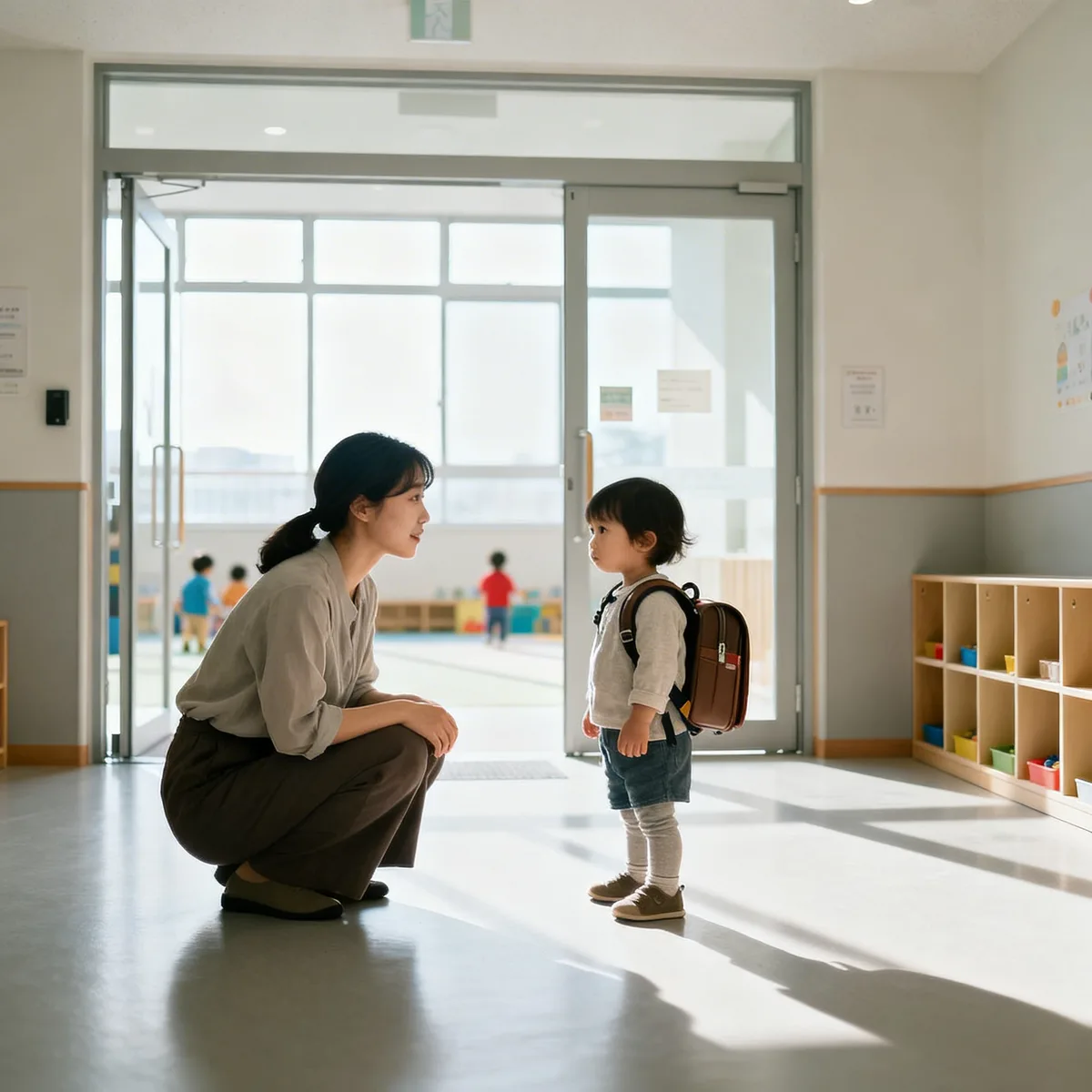
It’s 8 AM and your baby is clinging to your neck at the daycare door, tears streaming down their face. You’re walking away with a knot in your chest, wondering if you’re doing something terribly wrong. Here’s what nobody tells you: those tears are actually a sign that your baby’s brain is developing exactly as it should.
Baby separation anxiety at daycare is one of the most common — and most guilt-inducing — parts of the early parenting journey. But the tears don’t mean your baby isn’t ready. They don’t mean daycare is harmful. They mean your baby has formed a secure attachment to you, and their developing brain now understands that you exist even when you’re out of sight.
In this guide, we’ll walk through what separation anxiety really is, why it happens, how to ease drop-offs without the guilt, and when to know if something needs professional support.
Separation anxiety is a normal, healthy stage of infant development. It happens when your baby becomes distressed after being separated from you — their primary caregiver.
The underlying reason is cognitive, not emotional. Around 6 to 8 months, babies develop what developmental psychologists call object permanence — the understanding that things (and people) continue to exist even when out of sight. Once your baby knows you’re somewhere, they want you there.
The American Academy of Pediatrics notes that separation anxiety typically peaks between 10 and 18 months, though it can begin as early as 6 months and linger into toddlerhood.
For babies starting daycare, this timing matters. If your child begins care in this window, the transition may be harder — not because of anything you’ve done wrong, but because their brain is doing exactly what it should.
Baby separation anxiety at daycare can look different from child to child. Some babies cry at drop-off and settle within minutes. Others take longer to adjust, especially if the environment or caregiver is unfamiliar.
Attachment research, including work supported by the NIH’s National Institute of Child Health and Human Development, consistently shows that secure attachment to a caregiver is actually what makes separation harder in the short term — and easier in the long run.
If you want a deeper look at what’s happening developmentally during this stage, separation anxiety in babies covers the full arc — from first signs through toddlerhood.
What you’re seeing at daycare drop-off isn’t regression or a sign that something is wrong. It’s evidence that your baby has formed a strong bond with you.
The guilt hits the moment you walk away. Your baby is crying, arms reaching, and every instinct tells you something is wrong.
It isn’t. What you’re watching is a developmental milestone in real time.
Separation anxiety typically peaks between 8 and 18 months, according to the American Academy of Pediatrics. During this window, babies develop what researchers call “object permanence” — the understanding that you exist even when you’re out of sight. That cognitive leap is what makes your absence feel real, and significant, to them.
The tears mean your baby knows you’re gone. That’s not a small thing. It means their brain is working exactly as it should.
Research from the NIH confirms that babies who show distress at separation are typically those with secure attachment — not insecure attachment. The cry isn’t a sign of fear or instability. It’s a sign of trust. Your baby has learned that you are their safe base, and leaving that base registers as a real loss.
Baby separation anxiety at daycare drop-off can feel like evidence that you’ve made the wrong choice. It isn’t. Studies published in Child Development show that securely attached babies adapt more successfully to new caregiving environments over time — not less.
If you’re still in the process of finding the right environment for your child, our guide on how to choose a daycare walks through what to look for in a setting that supports this transition.
Most caregivers will tell you the same thing: the crying usually stops within minutes of a parent leaving. That fast recovery isn’t indifference. It’s resilience — built on the exact bond you’re worried about breaking.
The weeks before daycare starts are some of the most useful you have. Small, deliberate steps taken at home can meaningfully reduce baby separation anxiety at daycare — for your child and for you.
Start with predictability. The AAP notes that consistent daily routines help infants develop a sense of safety, because they begin to anticipate what comes next.
comfort items to bring along Do it regularly. Your baby learns, repeatedly, that you leave and you return.

soft blanket Research on object attachment, including work published through the NIH, shows transitional objects can buffer stress responses during caregiver absence.
Familiarize your baby with the daycare environment before drop-off begins. Many centers offer a short visit where you stay in the room. Your presence while your baby explores helps them build a first association with that space as safe.
Build a consistent goodbye ritual — brief, warm, and the same every time. The CDC’s developmental guidance is clear: drawn-out goodbyes increase distress. A predictable, confident farewell signals to your baby that this is normal, not alarming.
If your baby’s sleep is already disrupted heading into the transition, it’s worth addressing that separately. A settled sleep routine at home gives your baby more regulatory capacity during the day. Our guide on baby not sleeping through night covers practical approaches that work alongside daycare adjustment, not against it.
For a deeper look at the full transition process, including what to expect in the first week, the first day of daycare guide walks through each stage in detail.
The goodbye itself matters more than most people realize. Research published in Early Childhood Education Journal found that predictable, brief farewell rituals significantly reduce cortisol spikes in infants during caregiver separation.
The mechanism is straightforward. When your baby can anticipate what happens next, their nervous system stays more regulated. Unpredictability — not separation itself — is often what drives the most intense distress.
Build a routine with three to four fixed steps and repeat it exactly the same way every day. Something like: sign in together, find your baby’s cubby, give one hug, say your specific phrase (“I love you, I’ll be back after snack”), and leave.
The AAP is clear on one point: don’t sneak out. Disappearing without a goodbye may feel kinder in the moment, but it erodes trust. Your baby learns that you can vanish without warning — which makes the next drop-off harder, not easier.
Keep the goodbye short. Drawn-out farewells amplify distress signals rather than soothe them. Thirty seconds to one minute is a reasonable target once your routine is established.
Baby separation anxiety at daycare often peaks between eight and eighteen months, when object permanence is developing but the understanding that you will return is still forming. This is developmentally normal, not a sign that daycare is the wrong choice.
A comfort object — a small square of fabric that smells like home, or a family photo at the child’s eye level — can serve as a transitional anchor. Some centers actively encourage these; it’s worth asking.
What you do in the evenings also plays a role. If drop-offs are hard, predictable at-home routines before and after daycare build the broader sense of security your baby draws on. The same logic that helps during the baby witching hour — consistent cues, calm presence — applies here too.
Your baby is reading you constantly. Research published in Psychological Science confirms that infants as young as 12 months use their caregiver’s emotional expressions to decide how to respond to unfamiliar situations — a process called social referencing.
If you’re tense at drop-off, your baby registers it. That tension doesn’t reassure them that daycare is safe. It does the opposite.
This isn’t a parenting failure. It’s biology. The same attachment system that makes baby separation anxiety at daycare so hard for babies also makes leaving hard for you. Your nervous system is doing exactly what it evolved to do.
The practical implication: your emotional state at the door matters as much as your goodbye routine. A few concrete tools can help.
Box breathing — four counts in, hold four, out four, hold four — activates the parasympathetic nervous system within minutes. The NIH has documented its effectiveness in reducing acute stress responses. You can do it in the car before you walk in.
Reframing also works. The American Psychological Association notes that cognitive reappraisal — consciously shifting how you interpret a situation — measurably reduces emotional intensity. Instead of “I’m leaving my baby,” try “I’m giving my baby time with people who are trained to care for them.”
Keep your goodbye short and confident, not rushed and apologetic. The AAP recommends a warm, consistent farewell over a prolonged or hesitant one — extended goodbyes tend to amplify distress rather than ease it.
Then leave. Lingering to check whether your baby settled usually prolongs crying for both of you.

If your own anxiety around separation feels persistent or hard to manage, that’s worth naming. Postpartum anxiety affects up to 20% of new parents, according to the CDC, and it doesn’t always resolve on its own. Talking to your provider is a reasonable next step, not a last resort.
There’s no single answer, but research gives you a reasonable frame. For most babies, peak separation anxiety falls between 8 and 18 months, according to the American Academy of Pediatrics (AAP).
Baby separation anxiety at daycare often intensifies right around the transition itself, then gradually eases over two to six weeks as your baby builds familiarity with the caregivers and environment.
Developmental milestones play a real role in how this unfolds. Object permanence — the understanding that you still exist even when out of sight — begins forming around 8 months and becomes more stable through the second year. As that cognitive shift solidifies, separation distress typically softens.
Language development also helps. Once toddlers can express feelings and understand simple explanations like “Mama comes back after lunch,” anxiety tends to decrease. The CDC’s developmental milestones framework notes that most children show significant gains in emotional regulation between ages 2 and 3.
Expect some regression too. Illness, a change in routine, or a new sibling can temporarily reset the clock. That’s normal, and it usually resolves faster the second time around.
Where it gets worth watching: if crying at drop-off remains intense and inconsolable beyond 30 minutes most days, persists well past age 3, or is accompanied by physical symptoms like frequent stomachaches or sleep disruption, bring it up with your pediatrician.
The same applies if separation distress begins affecting your child’s eating, sleeping, or ability to engage with caregivers during the day. Your provider can rule out underlying anxiety disorders, which the NIH notes affect roughly 7% of children ages 3 to 17. Knowing when to call pediatrician baby concerns in — rather than waiting to see if things improve — is always the safer instinct.
Most children move through separation distress in waves — harder some weeks, easier others. But there are specific signs that indicate baby separation anxiety at daycare has moved beyond the typical developmental range.
According to the American Academy of Pediatrics, separation anxiety that persists beyond expected developmental windows — or intensifies rather than eases over time — warrants a closer look. So does distress that doesn’t reduce at all once your child is settled into the daycare environment.
Watch for these patterns: consistent refusal to eat or drink at daycare, regression in skills your child had already mastered (language, toilet training, sleep), persistent physical complaints like stomachaches or headaches with no medical cause, and panic-level distress that doesn’t settle within 15 to 20 minutes of drop-off.
Communication with caregivers matters here. Ask for specific observations — not just “she was fine,” but how long distress lasted, what helped, and whether your child engaged with others during the day. That data helps both you and any clinician form a clearer picture.
If you’re seeing these signs alongside other behavioral shifts — increased aggression, sleep disruption, or new fears at home — mention them together when you speak to your pediatrician. They may refer you to a child psychologist who can assess whether a diagnosable anxiety disorder is present. The CDC notes that anxiety is one of the most common mental health conditions in children, and early intervention consistently leads to better outcomes.
You might also notice these behaviors overlapping with other challenging phases. If so, it’s worth reading about the terrible twos — understanding what’s developmentally typical can help you identify what falls outside that range.
Trust your read on your child. You don’t need certainty to make the call — you just need concern.
Separation anxiety typically peaks between 10 and 18 months, but the intensity varies by child. Most babies show significant improvement by 24-30 months as they develop better communication skills and can anticipate your return. Some lingering distress at drop-off may continue into the preschool years, especially during transitions or stressful periods.
No. Sneaking away might feel easier in the moment, but it teaches your baby that you disappear without warning, which actually increases anxiety long-term. A brief, consistent goodbye ritual — even if your baby cries — helps them predict what’s happening and builds trust that you always return.
Separation anxiety fluctuates based on your baby’s sleep, hunger, illness, stress, and changes in routine. A rough night or an unfamiliar caregiver can intensify tears on a given day. Your own anxiety and mood also influence your baby’s response — babies pick up on parental stress and mirror it.
No. Research consistently shows that separation anxiety, while uncomfortable, does not harm emotional development in securely attached babies. In fact, securely attached babies who experience and work through separation actually develop stronger emotional resilience over time.
First, confirm with the daycare that your baby settles within 5-10 minutes of your departure — most do. If crying persists beyond that or intensifies over weeks, communicate with your caregiver about triggers, ensure consistent routines, and check your own anxiety levels at drop-off. If distress continues beyond what’s typical for your baby’s age, consult your pediatrician.