
Journal/Feeding Guides
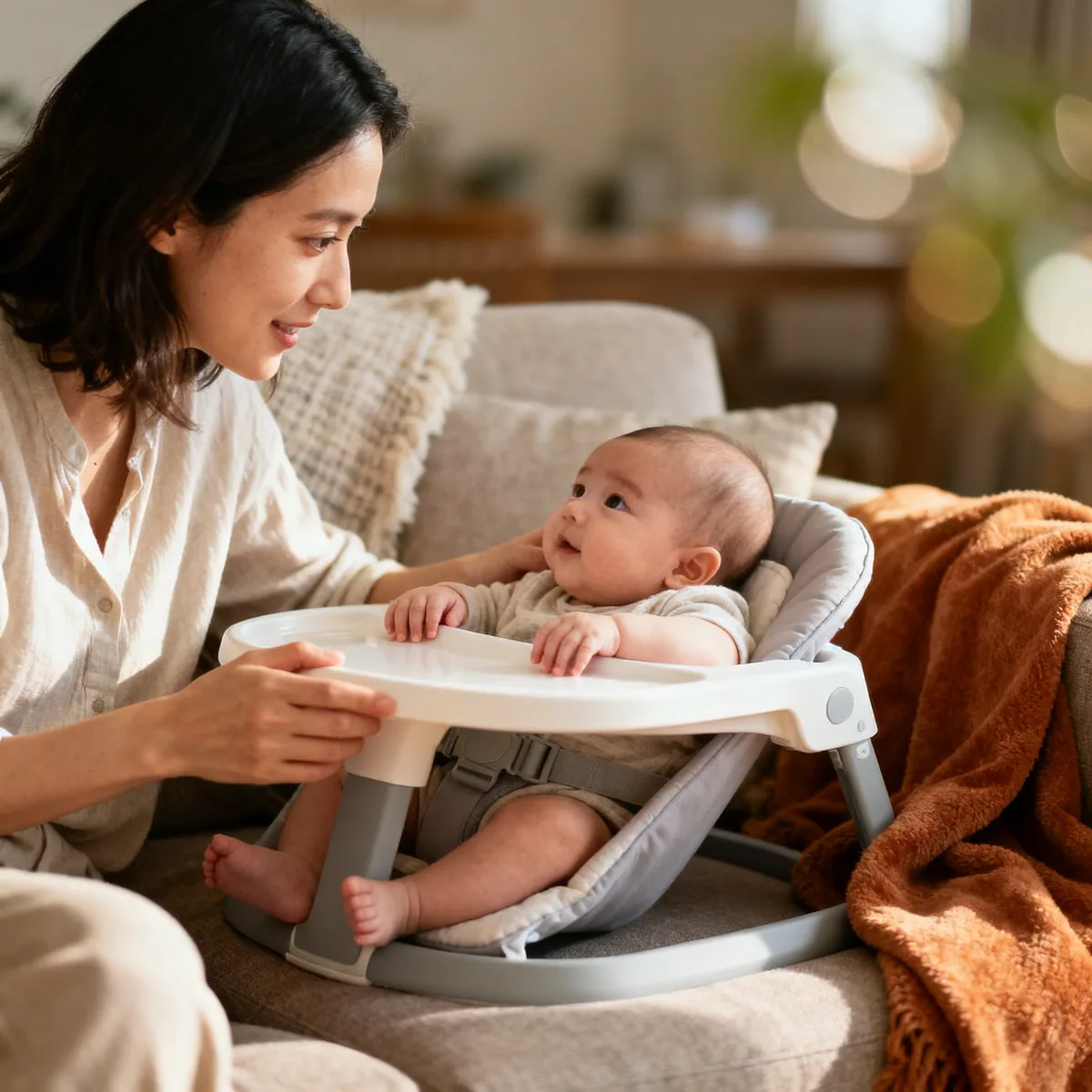
Mother and baby in warm lifestyle photo, Baby Feeding Support Seat: What It Is, Who Needs I
Feeding Guides

Baby Feeding Support Seat: What It Is, Who Needs It, and What to Look For

Laeeka Edries
Laeeka Edries
February 26, 2026·9 min read
Summarize with:
ChatGPTPerplexityClaudeGeminiGrok

A baby feeding support seat keeps your infant upright during bottle feeding — safely. Here's what it does, who needs it, and what to actually look for.

Here’s something nobody talks about enough: bottle feeding a baby is a two-handed job — and you don’t always have two free hands. If you’ve ever Googled “how to prop a bottle safely” at 3 AM while your other arm has gone completely numb, you’re not alone. The answer, by the way, is that you can’t prop a bottle safely — and the AAP is very clear on that. But there is a real solution, and it’s not a hack. It’s a baby feeding support seat. This guide covers exactly what it does, who genuinely benefits from it, what the safety rules are, and what to look for when you’re shopping for one. No fluff, no filler.

What a Baby Feeding Support Seat Actually Does

A baby feeding support seat is a small, cushioned seat designed to hold your infant in a semi-reclined, upright position during bottle feeding. Think of it as a posture assist — it cradles your baby at the right angle so that feeding is comfortable, controlled, and safer than lying flat.

The key word there is angle. When a baby feeds lying completely flat, milk can pool in the back of the throat and flow too fast into the middle ear canal — which is one of the reasons doctors link frequent flat feeding to ear infections. An upright or semi-upright position slows that flow, reduces the risk of ear discomfort, and makes feeding feel a lot more like a natural, gravity-assisted experience.

It also keeps your baby contained and supported so you can use both hands — to hold the bottle, burp them mid-feed, or just give your arm a break after the fourth feeding of the night.

Baby curiously exploring and discovering in a natural home setting

Who Actually Needs One (Be Honest With Yourself)

Not every family needs a feeding support seat. But if you fall into any of these situations, it’s worth taking seriously.

  • Single parents or solo feeders. When there’s no second adult in the house during feeding time, managing a wriggly infant and a bottle simultaneously is legitimately hard. A feeding seat gives you a stable base to work with.
  • Parents of multiples. Tandem feeding twins without any positioning support is an advanced skill that most people don’t figure out in the first few weeks. A feeding seat lets you manage one baby hands-on while the other is safely supported.
  • Parents whose babies have reflux or gas issues. Upright positioning during and after feeds is one of the most commonly recommended adjustments for babies who spit up frequently. A feeding seat keeps that angle consistent without you having to hold the position for 20 minutes straight.
  • Anyone who’s tempted to prop a bottle. If you’ve ever wedged a bottle against a rolled blanket because you needed one second to yourself — this is the safer, actually-designed-for-this alternative.

If none of those apply to you and feeding is going smoothly, you probably don’t need one. But if even one of those hit close to home, keep reading.

The Safety Rules — Read This Part

A baby feeding support seat is a feeding tool. That distinction matters, and it comes with non-negotiable rules.

The American Academy of Pediatrics is explicit: infants should never be left unattended with a propped bottle, and no soft or inclined surface should be used as a sleep surface. A feeding support seat is not a nap spot, not a bassinet substitute, and not somewhere to set your baby down and walk away. It is a supervised feeding aid — full stop.

  • Always stay within arm’s reach during a feeding session.
  • Remove your baby from the seat immediately after feeding — don’t let them fall asleep in it.
  • Never use it on an elevated surface like a table or countertop without your hands on the baby.
  • Check weight and age limits for the specific seat you’re using — most are designed for infants who cannot yet sit independently.

None of this is meant to scare you off the product. It’s just the honest framing it deserves. Used correctly and with supervision, a feeding support seat is a genuinely useful tool. Used as a shortcut for leaving a baby unsupervised, it’s not safe — and no product is.

Tender parent-child connection in golden warm light, cozy home

What to Look For When You’re Buying One

The market for feeding support seats is smaller than you’d think, which means a lot of people end up with products that weren’t really designed for this purpose. Here’s what actually matters.

  • Recline angle. You want a seat that positions baby at roughly 30–45 degrees — upright enough to slow milk flow and reduce ear pressure, but reclined enough to be comfortable for a baby who can’t hold their own head without support. Flat is a no. Fully upright is also a no for newborns.
  • Washable cover. Feeding is messy. Spit-up is inevitable. If the cover isn’t removable and machine washable, you will regret it within a week.
  • Size range and firmness. A good feeding seat supports babies across a range of early infant sizes — not just newborns, and not just 6-month-olds. Look for structured foam or cushioning that keeps its shape rather than collapsing under baby’s weight.
  • Portability and footprint. If you’re using this in a small apartment or want to move it between rooms, size matters. A lightweight seat that doesn’t take up half the couch is a practical win.
  • Non-slip base. The seat should stay where you put it. A grip base or non-slip bottom is a safety feature, not a nice-to-have.

If those specs describe exactly what you need, the Alpremio Cotton Baby Bottle Feeding Care Seat, available at Onzenna, checks every box — it has a removable, machine-washable cotton cover, a recline angle built specifically for bottle feeding (not borrowed from a lounger), and a compact footprint that actually fits in a real home.

How to Use a Feeding Support Seat Correctly

Knowing what it is and buying the right one is only part of the equation. Here’s how to actually use it well.

  • Place it on a flat, low surface. The floor or a firm sofa cushion works. Not a changing table. Not a counter.
  • Set your baby in before picking up the bottle. Get them settled and comfortable first, then introduce the bottle — same as you would if you were holding them.
  • Pace the feeding. A feeding seat doesn’t replace paced bottle feeding technique — tipping the bottle to control flow, pausing mid-feed for burping, watching baby’s cues. It just gives you the hands to do those things more easily.
  • Burp as usual. Lift baby out of the seat for burping. Don’t try to burp them while they’re seated — the angle isn’t right for it.
  • Take baby out when feeding is done. Repeat: this is not a place for them to hang out unsupervised after eating.

A Note on Bottle Propping (And Why It’s Not the Same Thing)

If you search “bottle propping alternatives,” y

BLW vs Purees: What Nobody Actually Tells You

Sources

Frequently Asked Questions

What age can babies use a feeding support seat?

Most feeding support seats are designed for babies around 6 months old when they can sit upright with minimal support, though some models work from 4-5 months depending on neck and back strength.

Is a feeding support seat the same as a high chair?

No—feeding support seats are smaller, portable, and designed to help babies sit upright during meals, while high chairs are larger, independent pieces of furniture with trays and leg space.

Do feeding support seats prevent choking?

They help keep babies in an upright position which reduces choking risk, but they’re not choking-prevention devices—supervision during feeding is always necessary.


You Might Also LikeShop All →
TagsAlpremiobaby feeding safetybottle feedingfeeding gearnew mom tips
Share

Shop the Collection

Browse Cups & Feeding

Curated for you

Recommended by Onzenna

Grosmimi
View all →
Alpremio
View all →

Keep Reading

More in Feeding Guides
Baby Feeding Support Seat: What It Is & Who Needs It | Onzenna