Quick Summary
Here’s what most parents discover too late: creating a truly baby proof kitchen means understanding that danger isn’t just what you can see — it’s what changes every three months. Most families learn this lesson after their first near-miss incident in the kitchen.
The CDC reports that burns, cuts, falls, and poisonings are among the leading causes of injury in children under five, and the kitchen is where most of them happen. But the risks don’t stay the same. A kitchen that’s safe for a 6-month-old crawler is a completely different space when that same baby starts walking at 14 months. Most families baby proof their kitchen once and call it done — then wonder why the hazards feel different as their child develops.
This guide walks you through kitchen safety at every stage, from cabinet locks to stove guards to hidden choking hazards, so you’re not reassessing in a panic when your toddler reaches a new milestone.
Why the Kitchen Is a High-Risk Zone (And What To Expect At Each Stage)
The kitchen accounts for a disproportionate share of childhood injuries at home. The CDC reports that burns, cuts, falls, and poisonings — all concentrated in this one room — are among the leading causes of unintentional injury in children under five.
What makes this space particularly deceptive is how functional it looks. Unlike a staircase or a pool, the kitchen doesn’t read as dangerous. It reads as ordinary.
But the risks shift at every developmental stage, and they tend to escalate faster than most families anticipate.
From around 6 months, babies begin reaching and grabbing. A hot mug on a low counter, a dangling appliance cord, an open cabinet — none of these register as threats until a baby’s hand finds them first.
Between 9 and 12 months, crawling brings floor-level hazards into play: cleaning products stored under the sink, small dropped items that become choking hazards for babies, and the undersides of appliances that radiate heat.
toddler mobility The AAP specifically flags stove knob access and pot handle positioning as common burn risk factors at this stage.
By ages 2 to 3, curiosity and physical capability combine in ways that are genuinely hard to predict. A child who has never shown interest in the knife block can develop that interest overnight.
Trying to baby proof kitchen spaces in a single pass — before your baby is mobile — often creates a false sense of security. The room that was safe at 6 months is a different environment at 14 months. Reassessment matters as much as the initial setup.
Essential Baby Proofing Steps for Cabinets & Drawers
Cabinets and drawers are among the most accessed hazard zones in any home. The CDC reports that poisoning is one of the leading causes of injury-related death in children under 5 — and household chemicals stored under kitchen sinks are a primary source.
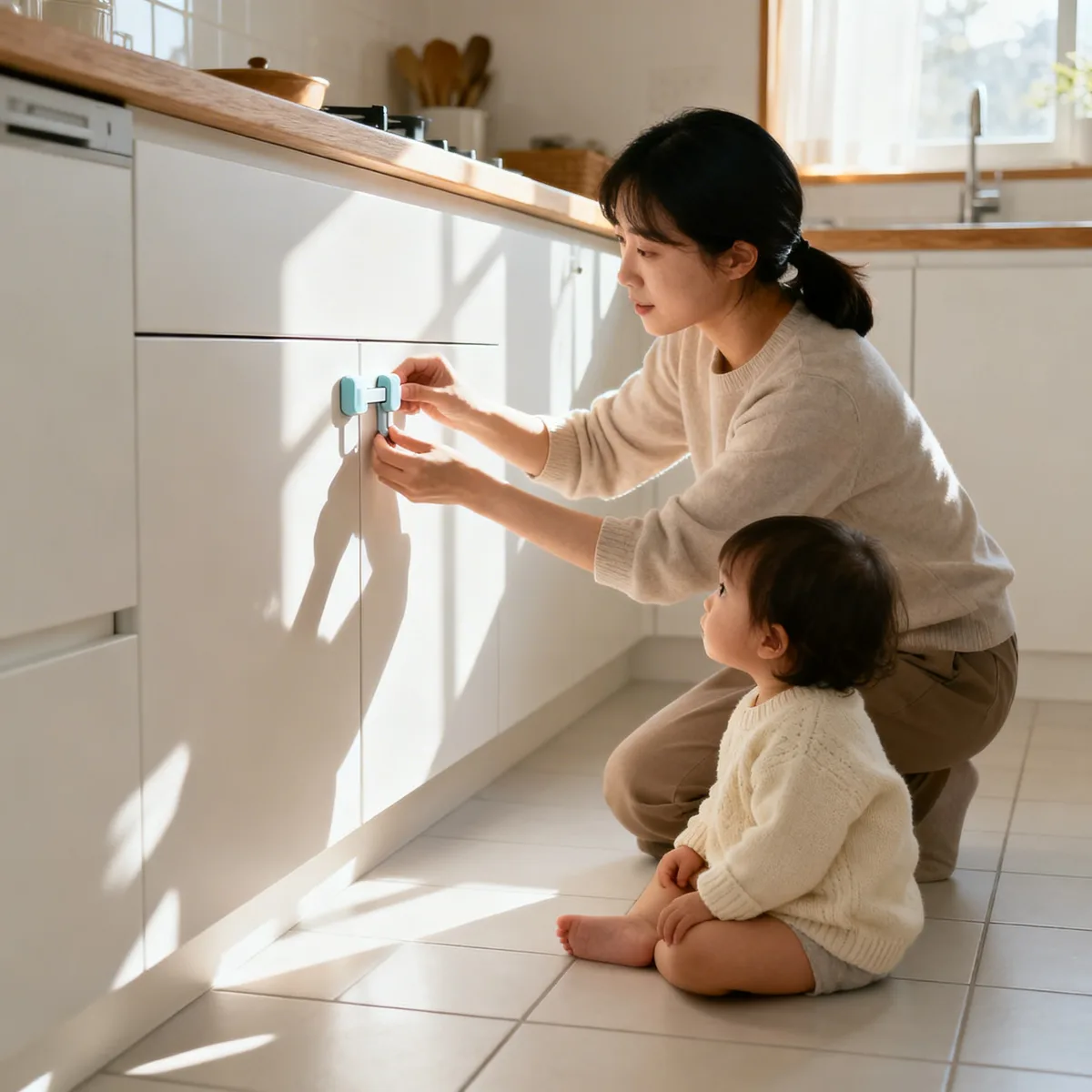
Magnetic cabinet locks are widely considered the most effective option. Unlike adhesive strap locks, they require a magnetic key held against the cabinet exterior to release — a mechanism a toddler cannot replicate.
For lower drawers holding sharp utensils, a sliding drawer lock that threads through the handle prevents full extension without completely blocking adult access. This matters for drawers you open frequently throughout the day.
Not every cabinet needs the same level of protection. Prioritize in this order: anything holding cleaning products or dishwasher pods, drawers with knives or graters, and cabinets where medications are stored — even if you believe they’re “too high to reach.”
The American Academy of Pediatrics specifically recommends storing all toxic substances in their original containers, in locked storage, and never within a child’s line of sight. Visibility can be enough to create fixation.
Drawer stops — small plastic inserts that fit inside the drawer track — prevent a drawer from being pulled out completely. They’re a low-cost, invisible layer of protection that works alongside locks rather than replacing them.
If you want a drill-free option, a no-drill magnetic cabinet lock set that works across both standard overlay and inset cabinet doors covers most kitchen configurations without permanent installation.
One detail that’s often missed: refrigerator and oven drawers. Both can be opened by a determined toddler and both present real hazards. Appliance latches designed specifically for these surfaces are available and worth including in your initial sweep.
If you’re also thinking through mealtime safety at this stage, the high chair buying guide covers stability and harness standards worth knowing before your baby starts solids.
Securing Appliances & Preventing Burns (Stovetop, Oven, Dishwasher)
Burns are among the most common kitchen injuries in young children. The CDC identifies scalds from hot liquids and steam as a leading cause of burn-related emergency department visits for children under five.
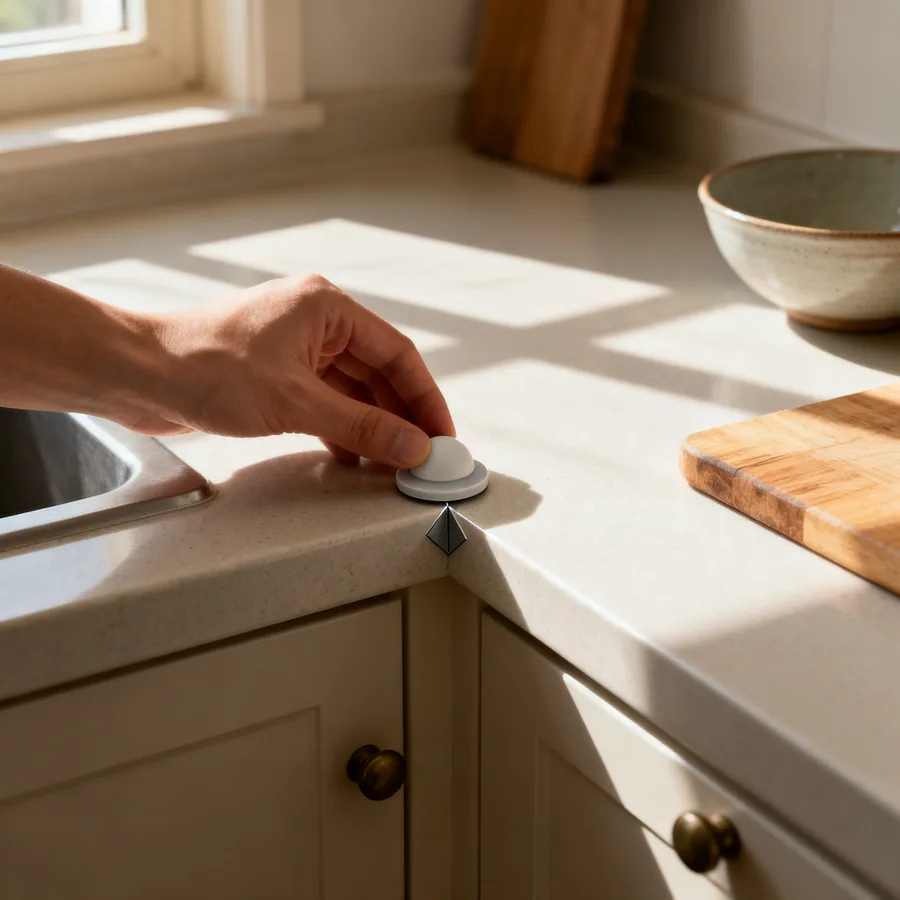
The stovetop is the highest-priority surface to address. A stove knob cover fits over each burner control and requires a two-step press-and-turn motion that most toddlers cannot replicate. A stovetop guard — a raised barrier that runs along the front edge of the range — keeps small hands from reaching pots and pans entirely.
Oven locks work on the same principle as cabinet latches: a strap or latch mechanism that requires adult hand strength and coordination to disengage. Some models secure both the oven door and the broiler drawer in a single unit. If your oven has a pull-out storage drawer at the base, a separate appliance latch for that drawer is worth adding.
The dishwasher is frequently overlooked when you baby proof kitchen surfaces and appliances. An open dishwasher door is a step stool at counter height — and the exposed silverware basket puts sharp utensils within reach. A dishwasher lock that prevents the door from latching open, combined with a habit of loading sharp items blade-down, covers both risks.
Induction cooktops reduce surface heat significantly compared to gas or electric coil ranges, but residual heat from cookware can still cause burns. A silicone cooktop barrier placed around the cooking zone adds a physical reminder not to touch, even after burners are off.
For any burn that breaks the skin, blisters immediately, or covers an area larger than a child’s palm, the guidance is consistent: seek medical attention promptly and know when to call pediatrician baby versus when to go directly to urgent care.
Making Floors & Low-Height Hazards Safe
Floors are where babies spend most of their time — and where hazards accumulate quietly. Spills, crumbs, and dropped items create a landscape that looks harmless to adults but presents real risks at ground level.
Clean spills immediately and thoroughly. Wet floors cause slips, and food residue draws babies to mouth whatever they find. The CDC identifies choking as a leading cause of injury-related death in children under four — small food scraps, bottle caps, twist ties, and rubber bands are all high-risk items that end up on kitchen floors.
Place non-slip mats in front of the sink, stove, and refrigerator. Look for mats with suction backing or a weighted edge — standard bath mats without grip undersides can slide under a crawling baby’s weight just as easily as an adult’s.
Eye-level hazards shift as your baby grows. At six to nine months, “eye level” is the lowest cabinet shelf and the floor. Breakable items — glass bowls, ceramic mugs stored low, heavy cutting boards leaning against a wall — should move up or inside locked cabinets before your baby is mobile. One pull or nudge is enough.
Check the space between your refrigerator and cabinets, under the toe kicks, and behind freestanding appliances. These gaps collect small objects that fall and are forgotten: coins, batteries, small magnets. The American Academy of Pediatrics specifically flags button batteries as an emergency-level choking and ingestion hazard — they can cause serious internal damage within two hours of swallowing.
If you’re working to fully baby proof kitchen spaces, the floor sweep is worth doing on your hands and knees at least once — you’ll see exactly what your baby sees.
For gentle, residue-free floor cleaning that’s safe around babies who mouth everything they touch, a plant-based, fragrance-free floor cleaner is worth keeping in the rotation — the kind of thing that matters more once you realize how much time babies spend right at that level.
Food Storage, Allergens & Choking Prevention
Where you store food matters as much as what you store. Keep snacks, fruit bowls, and any accessible pantry items at a height your baby or toddler cannot reach — ideally above counter level — and move anything at floor or lower-shelf height behind a locked door or cabinet.
Allergen labeling deserves deliberate attention. The nine major allergens — milk, eggs, fish, shellfish, tree nuts, peanuts, wheat, sesame, and soybeans — are required by law to appear on packaged food labels in the US. Read labels every time, even for brands you’ve bought before, because formulas can change.
Choking is one of the leading causes of injury in children under four. The CDC recommends cutting food into pieces no larger than half an inch for young children, and avoiding whole grapes, raw carrots, large chunks of cheese, nuts, and popcorn until a child has the jaw strength and molars to chew them properly.
Age-appropriate access matters beyond just what foods you offer. A toddler who can open the fridge or a low pantry door can reach foods that weren’t intended for them — including items belonging to older siblings that carry real choking or allergen risk.
Fridge locks and cabinet latches are straightforward solutions. So is being consistent: foods that pose a risk should never be stored at reachable height, even temporarily.
If your child is starting solids and you’re tracking their growth alongside what they’re eating, baby growth chart percentiles can give you useful context for whether their intake is supporting development as expected.
One practical rule: once a child is mobile, treat your kitchen floor as the boundary. Anything that lands there — a dropped grape, a spilled handful of mixed nuts — gets cleared immediately.
Gate Placement & Creating a Safe Kitchen Zone
A gate is often the first line of defense when you baby proof kitchen access for a crawling or walking child. The right placement depends on your kitchen layout — most families choose between a doorway gate that blocks entry entirely, or a freestanding play yard that creates a supervised zone nearby.
The AAP recommends hardware-mounted gates over pressure-mounted ones for high-traffic thresholds like kitchen doorways. Pressure-mounted gates are designed for stairs only — at a kitchen entrance, a determined toddler can dislodge them.
If your kitchen is open-plan with no single doorway to gate, a freestanding play yard positioned within sightline of where you cook gives your child a safe space without full exclusion. Research on child development consistently shows that proximity to a caregiver — even during routine tasks — supports secure attachment.
When choosing a gate, look for one certified to ASTM F1004 standards. This is the voluntary safety standard most reputable manufacturers test against, and it covers both structural integrity and latch security.
Gate height matters too. The CPSC advises that gates should be at least three-quarters the height of the child using the space — a measurement worth revisiting as your toddler grows.
If you’re managing nap schedules, feeding times, and a mobile baby simultaneously, a baby monitor types comparison can help you figure out which setup lets you hear or see your child from another room while you’re in the kitchen.
One practical approach: designate a low cabinet inside or just outside the kitchen as your child’s space — stocked with safe, unbreakable items they’re allowed to explore. It redirects curiosity without requiring constant redirection from you.
Cleaning Products & Chemical Safety in the Kitchen
Household cleaners are among the most common sources of accidental poisoning in young children. The CDC recommends storing all cleaning products in their original containers, locked away in cabinets that are out of reach — not just closed, but actively secured.
Standard under-sink storage is one of the first things to address when you baby proof kitchen spaces. A magnetic cabinet lock costs very little and removes access entirely, which matters more than any label or warning.
If you prefer to reduce chemical exposure at the source, plant-based and fragrance-free cleaners are a practical option for everyday surfaces — particularly for floors and low counters that babies touch and mouth. Nature Love Mere is one worth knowing about: genuinely gentle formulas that don’t require a tradeoff on effectiveness.
Accidental exposure still happens even in careful households. If your child touches, ingests, or inhales a cleaning product, call Poison Control immediately at 1-800-222-1222 in the US — don’t wait for symptoms to appear.
Have the product container in hand when you call. The label information helps Poison Control advise you accurately and quickly.
For sprays and aerosols specifically, ventilation matters. Open a window or run a fan when cleaning — fumes accumulate faster in a small kitchen than most people expect, and young children breathe proportionally more air relative to their body weight than adults do.
Keep a written list of the products you use regularly and store it somewhere accessible. In an urgent moment, knowing exactly what’s in your home saves time.
Frequently Asked Questions
At what age should I start baby proofing my kitchen?
Start before your baby becomes mobile — around 5 to 6 months, before crawling typically begins. Focus first on cabinets with toxic items and appliances that radiate heat. As your child reaches new developmental milestones (crawling, walking, climbing), reassess and add protections for new hazards they can now access.
What is the most common kitchen accident for babies and toddlers?
Burns are among the most frequent and serious. Hot surfaces on stoves and ovens, dangling pot handles, and contact with appliances account for a large share of kitchen injuries. Falls and poisoning from household chemicals stored under sinks are close seconds.
Are safety gates or cabinet locks more effective for kitchen safety?
Both serve different purposes and work best together. Cabinet locks prevent access to toxic items and sharp objects inside; gates physically block your child from entering high-risk zones. For maximum safety, use magnetic cabinet locks on all hazardous storage and a gate if your kitchen layout allows you to create a restricted zone.
How do I baby proof a kitchen without using plastic locks?
Magnetic locks are a durable alternative that don’t rely on adhesive. You can also rearrange your kitchen to move hazardous items to high shelves entirely out of reach, store toxic cleaners in a locked cabinet in another room, and use drawer stops instead of locks for frequently-accessed drawers. Physical barriers like gates also reduce reliance on individual locks.
What cleaning products are safest to use around babies in the kitchen?
Vinegar and water, baking soda, and plant-based cleaners certified by third-party organizations are safer alternatives to harsh chemicals. Whatever you use, store all cleaning products in their original containers in a locked cabinet or high shelf, never under the sink where crawling babies can reach them.
Keep Reading

Best Baby Swings and Bouncers 2026: Expert Reviews & Buying Guide

Best Infant Car Seat 2026: Top Safety Picks for Newborns & New Parents

Why is My Baby’s Skin So Sensitive? : Understanding the Probiotic Shower

K-Baby Is Having a Moment — Here's What's Real and What's Just Marketing

First Trimester Survival Guide: What Nobody Actually Tells You