

Child Development
15 Month Old Milestones: What Your Toddler Should Be Doing (and When to Worry)
Jeehoo Jeon·12 min read

When do babies start talking? Learn speech milestones from birth through age 3, from cooing to first words to sentences. Plus signs your baby needs evaluation.
Here’s what nobody tells you: babies are talking long before they say their first word, and understanding when do babies start talking requires looking beyond just those first recognizable words. From day one, they’re communicating through crying, cooing, and babbling — each sound a deliberate step toward language. Most parents expect the word “mama” to be the starting line, but speech development actually begins in the womb and unfolds across months of pre-language milestones.
Understanding when babies start talking means recognizing that talking isn’t binary. It’s a spectrum that begins with cries and ends (well, never really ends) with questions, storytelling, and negotiations over bedtime. This guide maps the entire journey from birth through age 3, so you know exactly what to expect — and when to raise a flag with your pediatrician.
Babies are communicating from the moment they’re born — just not with words.
In the first weeks, crying is the primary tool. It signals hunger, discomfort, fatigue, and overstimulation. You’ll likely start to notice patterns within the first month.
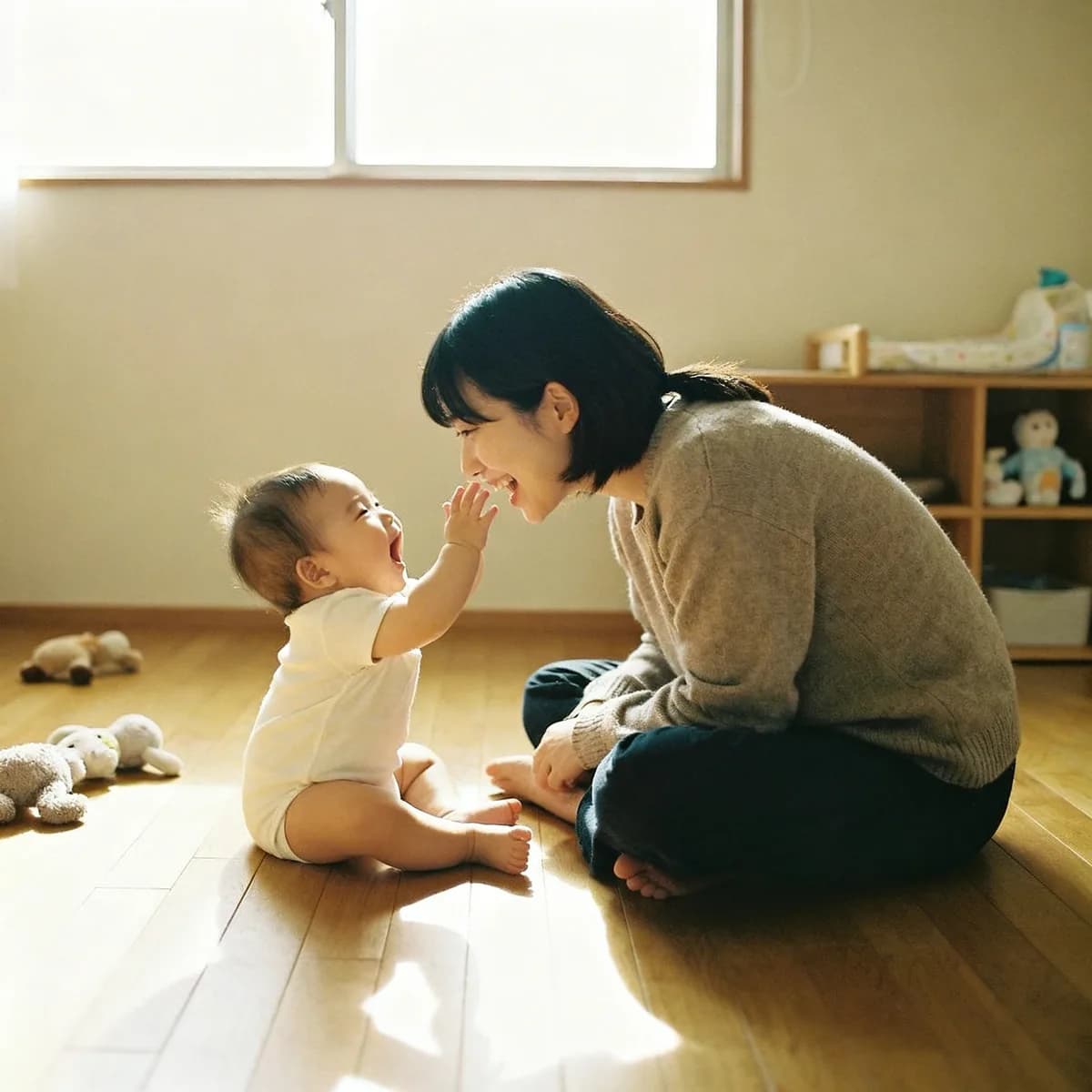
Between 1 and 3 months, cooing emerges. These soft, vowel-like sounds are your baby’s first experiments with using their voice intentionally. They’re also the beginning of turn-taking — your baby makes a sound, pauses, and responds to yours.
By 4 months, most babies are babbling more actively — stringing together sounds like “ooh” and “aah” and starting to vary pitch and volume. These are core 3-4 month milestones that speech-language pathologists and pediatricians watch for closely.
Canonical babbling — the repeated consonant-vowel combinations like “bababa” or “mamama” — typically begins around 6 to 8 months, according to the American Academy of Pediatrics (AAP).
So when do babies start talking in the true sense? The CDC defines a baby’s first words as intentional, recognizable words used consistently — and that typically happens between 12 and 18 months.
Most children say 1 to 3 words with meaning by their first birthday. By 24 months, the AAP expects a vocabulary of at least 50 words and the ability to combine two words together.
Every stage before those first words is building toward them. Crying, cooing, babbling, and gesture use — pointing, waving, reaching — are all part of the same developmental arc.
The timeline varies. Some babies say their first word at 10 months; others at 14. What matters more than the exact date is whether communication is developing across multiple channels.
Long before you’ll be wondering when do babies start talking, your baby is already building the groundwork for speech — one small sound at a time.
In the first few weeks, crying is your baby’s primary form of communication. It’s not random. Different cries carry different meanings, and responding to them consistently helps your baby understand that sound produces a result.
Around 6–8 weeks, cooing begins. These are soft, vowel-like sounds — “ooh,” “ahh” — often produced during calm, alert moments, especially during face-to-face interaction with you.
By 4 months, most babies start experimenting with raspberries, squeals, and pitch variation. They’re not forming words, but they are learning to control airflow, lip movement, and vocal tone — the physical mechanics that speech depends on.
Canonical babbling, where babies string together consonant-vowel combinations like “ba-ba” or “ma-ma,” typically emerges between 4 and 6 months. The AAP notes that babbling is a key developmental milestone, and its absence by 6 months is worth raising with your pediatrician.
What makes this stage particularly important is reciprocity. Your baby isn’t just making sounds — they’re watching your face, pausing for your response, and taking turns. This conversational pattern, called “serve and return,” lays the neural foundation for language long before a single word is spoken.
Talk back during these exchanges. Narrate what you’re doing. Repeat the sounds your baby makes. Research consistently shows that the quantity and quality of early verbal interaction shapes vocabulary development months and years later.
These early months overlap with other rapid developmental changes — including shifts in feeding patterns. If you’re breastfeeding, understanding issues like a clogged milk duct can help you stay comfortable and consistent during feeds, which are themselves rich opportunities for the face-to-face interaction that supports early communication.
Around 6 months, something shifts. The soft coos of early infancy give way to true babbling — strings of consonant-vowel sounds like “ba-ba-ba” or “da-da-da” that your baby repeats with clear intention.
This repetitive babbling is called canonical babbling, and it’s a significant milestone. Your baby is practicing the motor patterns that spoken language requires, experimenting with rhythm, pitch, and breath control.

Baby Wrist Teether They become true words when your baby consistently uses them to mean you.
The AAP considers a vocabulary of at least one to three recognizable words by 12 months a typical developmental marker. If that milestone isn’t met, a conversation with your pediatrician is worthwhile — early evaluation is always preferable to a wait-and-see approach.
For parents wondering when do babies start talking in the truest sense, most developmental researchers point to 10–14 months as the window when first real words reliably emerge. There’s meaningful variation within that range, and it’s normal.
What moves development forward during this period is consistent back-and-forth interaction. When you respond to your baby’s sounds as if they mean something, you’re reinforcing the social function of language before the words themselves arrive.
This is also the age when solid foods enter the picture — and mealtimes become rich moments for communication. Naming foods, describing textures, making eye contact across a high chair tray all count as language exposure. If you’re navigating early feeding, our guide to blw finger foods covers what’s developmentally appropriate at each stage of this window.
Babbling volume and variety are more predictive of later language development than any single word. Pay attention to the conversation — not just the words.
Something shifts noticeably around a child’s first birthday. The babbling that filled earlier months begins giving way to real, intentional words — and the pace picks up quickly.
Most children say their first words somewhere between 12 and 18 months. By 18 months, a typical range is 10 to 50 words, covering everyday objects, people, and actions.
The AAP considers 50 words a key developmental benchmark by around 18 months — alongside the ability to follow simple two-step instructions. If a child isn’t reaching toward that range, it’s worth raising with a pediatrician at the 18-month well visit.
Word learning during this window isn’t linear. Many children acquire words slowly at first, then hit a vocabulary burst — sometimes adding several new words in a single week. This acceleration is common and well-documented.
Two-word combinations — “more milk,” “daddy go,” “big dog” — typically begin emerging between 18 and 24 months. These short phrases signal a shift from labeling the world to making statements about it.
This is also the window when questions about when do babies start talking become more pressing for many families. There’s real variation in timing, and context matters: bilingual children, for instance, may distribute words across two languages in ways that look different on a single-language count but reflect normal development.
What supports vocabulary growth in this period? Responsive conversation remains the most evidence-backed approach — narrating routines, reading aloud, and following a child’s lead on what they’re interested in.
This stage often overlaps with other physical milestones that compete for attention. If your toddler seems fussier than usual while language is also developing, it may be worth checking whether when infant start teething is a factor — both processes tend to intensify around the same months.
Between 18 and 24 months, language development accelerates in a way that can feel almost sudden. Most toddlers move from a vocabulary of around 50 words at 18 months to well over 300 words by their second birthday.
This period is also when two- and three-word combinations begin to appear — “more milk,” “daddy go,” “big dog.” These early sentences signal that a child isn’t just storing words, but starting to understand how they connect.
The AAP considers 50 words and the use of two-word phrases by age 2 a key developmental benchmark. If a child isn’t reaching this point, the AAP recommends a formal speech and language evaluation rather than a wait-and-see approach.
For many families, this is the window where the question of when do babies start talking in full phrases gets a clearer answer — and the range is genuinely wide. Some children at 18 months have 20 words; others have 80. Both can be within normal limits depending on the full picture of development.
What drives the leap? Receptive language — the ability to understand words before producing them — has been building since birth. By this stage, that foundation is large enough to support rapid expressive output.
Daily routines carry more weight than structured learning here. Narrating what you’re doing, asking simple questions, and pausing to let your toddler respond all build the kind of back-and-forth that supports language growth.
This stage also overlaps with growing independence, which is why how to start potty training becomes a relevant question for many families around the same time — toddlers who are developing language quickly are often also showing readiness signals in other areas.

Something shifts noticeably between ages two and three. Language stops being just labeling and starts becoming communication with real structure.
By age two, most children are combining words into short phrases — “more milk,” “daddy go.” By three, many are using sentences of four to five words, applying basic grammar rules, and beginning to tell simple stories about things that happened to them.
The AAP notes that by age three, most children can use plurals and past tense, understand the concept of “same” and “different,” and follow three-part instructions — signals that language comprehension is deepening alongside production.
The “why” questions start here too. This isn’t defiance or randomness — it reflects a genuine cognitive leap toward understanding cause and effect. Abstract concepts like “later,” “yesterday,” and “because” begin to take hold.
Vocabulary grows rapidly during this window. A child at age two may have around 200–300 words. By three, that number often climbs past 1,000.
It’s worth noting that the question of when do babies start talking often focuses on first words — but the 2–3 year stage is where language becomes genuinely expressive and social. A child who spoke late but is now stringing sentences together with clear intent is usually on a healthy path.
Pretend play feeds language at this age. Narrating a story while playing with blocks, or “reading” a picture book aloud, draws on the same skills that support grammar and sequencing.
If your child isn’t combining words by 24 months or isn’t using simple sentences by 36 months, a conversation with your pediatrician is the right next step. Early speech-language evaluations are low-risk and often clarifying.
Most conversations about when do babies start talking focus on the exciting firsts. But knowing what to watch for matters just as much.
There are specific markers that warrant a closer look. No babbling by 9 months is one. No single words by 12 months is another. If your baby isn’t using at least a few words by 18 months, that’s a signal to bring up with your pediatrician — not a reason to panic, but not something to wait out either.
The AAP recommends developmental surveillance at every well-child visit, with formal screening at 9, 18, and 30 months. These checkpoints exist precisely so delays are caught early, when intervention tends to be most effective.
Other signs worth noting: not responding to their name by 12 months, losing words or sounds they previously used, or showing little interest in communicating — through gestures, pointing, or eye contact — alongside limited speech.
Hearing is always part of this picture. A child who isn’t hearing clearly won’t develop speech on the typical timeline. An audiology evaluation is often one of the first steps a pediatrician will recommend when a speech concern comes up.
If your baby has been unwell — particularly with a respiratory illness — and you’ve noticed changes in their responsiveness or attention, it’s worth flagging both to your doctor. Conditions like RSV in babies can sometimes affect hearing temporarily through fluid buildup in the ear, which in turn can affect language development.
A speech-language pathology referral isn’t a diagnosis. It’s information. Early evaluation gives you a clearer picture of where your child is and what, if anything, needs support.
Most babies say their first intentional, recognizable word between 12 and 18 months, though the range is normal and varies widely. By their first birthday, many babies have 1 to 3 words with meaning; others may not reach that point until closer to 18 months.
Yes — babbling is completely normal and essential. It means your baby is learning to control their voice, experiment with sounds, and practice the mouth movements speech requires. Canonical babbling (like “ba-ba” or “ma-ma”) typically starts between 4 and 6 months and is a major developmental milestone.
By age 2, the American Academy of Pediatrics expects a vocabulary of at least 50 words and the ability to combine two words together (like “more milk” or “mama up”). Some 2-year-olds have significantly larger vocabularies, while others are still building — both can be normal.
A true word is intentional, recognizable, and used consistently to mean the same thing. It doesn’t have to be perfectly pronounced — “duh” for “dog” or “ba” for “bottle” count as words if your baby uses them purposefully and repeatedly.
Red flags include no babbling by 9 months, no words by 18 months, loss of words or sounds your child previously used, or not responding to their name by 12 months. If you notice any of these, talk to your pediatrician about a speech evaluation — early intervention makes a real difference.